78° and Light rain shower
Image
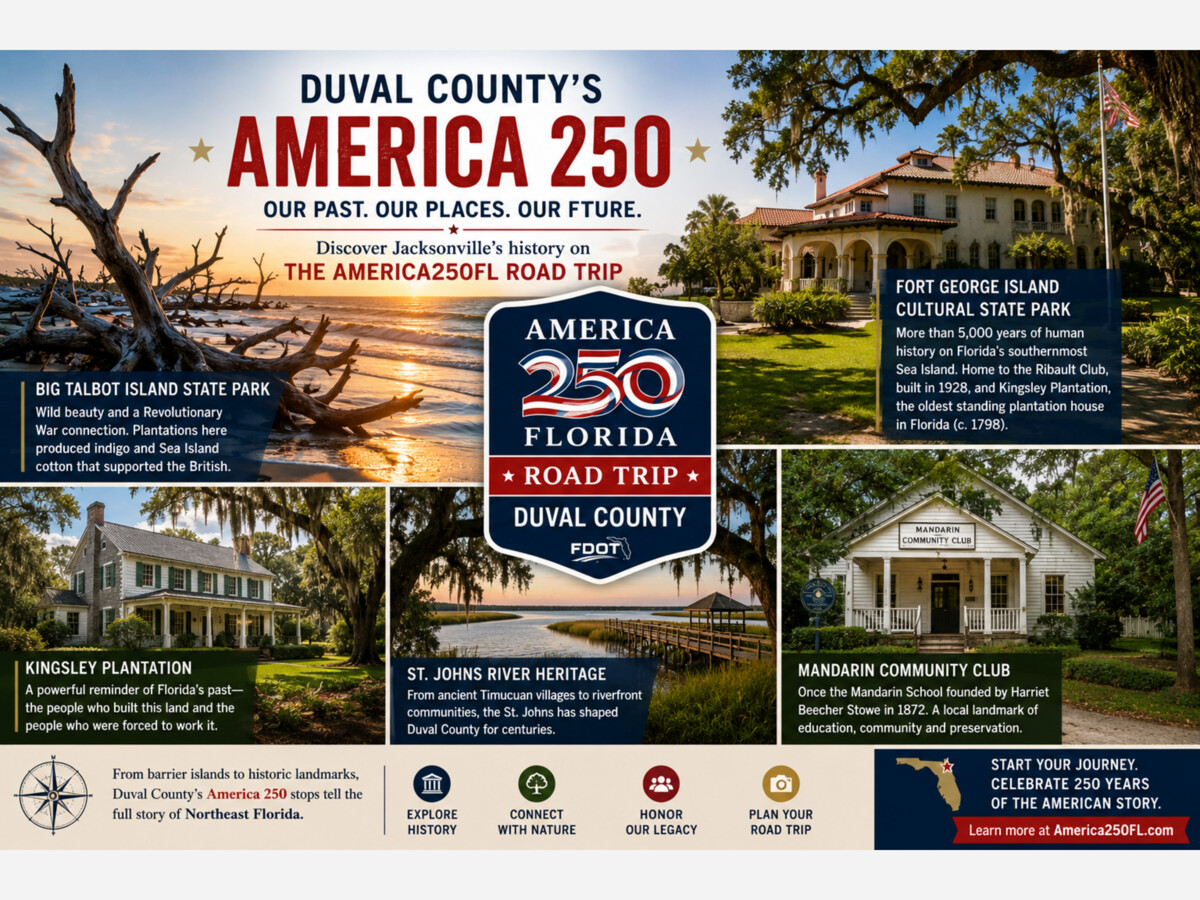



Big Talbot Island and Fort George Island give Jacksonville an America 250 story tied to wild coastlines, plantation history, the Revolutionary era and the deeper human history of Northeast Florida.
JACKSONVILLE — Duval County’s America 250 story is not confined to downtown Jacksonville.
It runs northeast, across marshes, barrier islands, river bends and coastal roads, to two of Jacksonville’s most historically layered landscapes: Big Talbot Island State Park and Fort George Island Cultural State Park.
The Florida Department of State has listed Big Talbot Island State Park and Fort George Island Cultural State Park in Jacksonville among the historic sites and state parks promoted through the America250FL Road Trip, Florida’s statewide commemoration of the nation’s 250th birthday. [1]
For Jacksonville, the designation is a reminder that Duval County’s history is not only urban. Some of the county’s most important stories are written in the landscape itself.
Florida State Parks says Big Talbot Island and Fort George Island are among the parks where visitors can explore Revolutionary War-era connections. During the British period, plantations in the area produced indigo and Sea Island cotton that helped support the British cause. [2]
That is the complicated local hook.
Florida was not one of the original 13 colonies, but it still had a role in the Revolutionary era. The state’s America 250 effort has leaned into that history by calling attention to Florida’s “14th Colony” connections and the places where British, Spanish, Indigenous, enslaved and early American stories overlapped.
In Duval County, those stories sit along the coast.
Big Talbot Island State Park gives visitors a wilder version of Jacksonville. The park is known for Boneyard Beach, a striking shoreline where fallen and weathered trees create one of the most unusual coastal landscapes in Florida. Florida State Parks describes it as a one-of-a-kind beach where visitors can see the power of nature and the role wild coastal ecosystems play in storm mitigation and resiliency. [3]
That makes Big Talbot more than a photo stop.
It is a visible lesson in how fragile barrier islands can be. The same forces that make the park dramatic — wind, water, erosion, storms and shifting shoreline — are also the forces shaping Northeast Florida’s future.
Fort George Island tells an even deeper story.
Florida State Parks says Fort George Island is the southernmost Sea Island in a barrier island chain stretching from North Carolina to Florida and has more than 5,000 years of continuous human occupation. [4]
That timeline matters. The America 250 frame is about the United States, but Jacksonville’s story is much older than the country. Fort George Island carries Indigenous history, colonial history, plantation history, resort history and preservation history in one place.
The island is also home to the Ribault Club, built in 1928 as a private winter resort and now restored as a visitor center. The National Park Service says the Ribault Club is on the National Register of Historic Places and is listed as a historic landmark by the City of Jacksonville. [5]
Nearby Kingsley Plantation, part of the Timucuan Ecological and Historic Preserve, brings the hardest part of that history into view.
The National Park Service says the planter’s house on Fort George Island was constructed in 1798, making it the oldest standing plantation house in Florida. The site tells the story of people who came to Florida seeking land and wealth, and of people forced to labor on plantations whose work created that wealth. [6]
That history should not be softened.
If America 250 is going to mean anything beyond patriotic signage, it has to tell the whole story. In Duval County, that means acknowledging the British-era plantation economy, slavery, Indigenous presence, coastal change and the later layers of resort development and preservation.
Big Talbot and Fort George allow Jacksonville to do that without turning the story into a classroom lecture. Visitors can walk trails, see marshes, visit historic structures, explore Boneyard Beach, tour museum exhibits and encounter the county’s past through the places where it happened.
Duval County also has a related America250FL heritage connection in Mandarin.
America250FL lists the Mandarin Community Club at 12447 Mandarin Road in Jacksonville as a Historic and Heritage Site. [7]
That site gives the county another local history angle, especially for readers familiar with the St. Johns River and Old Mandarin. The Mandarin Community Club says its building was once the Mandarin School, founded by author Harriet Beecher Stowe in 1872. Citizens later formed the Liberty League during World War I to support the Allies and sell war bonds, and the Mandarin Community Club was founded in 1923 after the war. [8]
The Mandarin story fits the broader theme: civic life, preservation, education and local identity.
Together, the Duval County stops show how Jacksonville’s history stretches across very different places.
Big Talbot shows the changing coast. Fort George shows thousands of years of human history and the legacy of plantations. Mandarin shows neighborhood preservation and civic life along the St. Johns River.
That gives Jacksonville a stronger America 250 story than a single marker could tell.
This is a county where the national story is not only found in monuments. It is found in a wild beach, a restored club, plantation structures, ancient landscapes, oak-lined roads and a schoolhouse turned community center.
As America prepares to mark 250 years since the signing of the Declaration of Independence, Duval County’s road-trip stops ask residents to look beyond the skyline.
Jacksonville’s story is not just what the city built.
It is what the coast remembers, what the river carried and what the community chose to preserve.
[1] Florida Department of State, “ICYMI: Governor Ron DeSantis Announces Statewide Commemoration of America’s 250th Birthday,” Feb. 1, 2026.
[2] Florida State Parks, “Celebration of America’s 250th Anniversary.”
[3] Florida State Parks, “Boneyard Beach.”
[4] Florida State Parks, “Hike Through History at Fort George.”
[5] National Park Service, “Ribault Club.”
[6] National Park Service, “Visiting Kingsley Plantation.”
[7] America250FL, “Historic and Heritage Sites,” listing for Mandarin Community Club, Jacksonville.
[8] Mandarin Community Club, “About/History of the Club.”



Overcast, with a high of 86 and low of 74 degrees. Overcast for the morning, light rain shower in the afternoon and evening, overcast overnight.