Image



By the Tidings Media Editorial Board
Nearly every American would describe fascism as evil.
Whether conservative, liberal, independent, or somewhere in between, most people agree that authoritarian governments which suppress dissent, eliminate political opposition, censor speech, and rule through intimidation represent one of history's darkest forms of government.
To oppose fascism is not controversial. It is a principle rooted in democracy, individual liberty, constitutional government, and the rule of law.
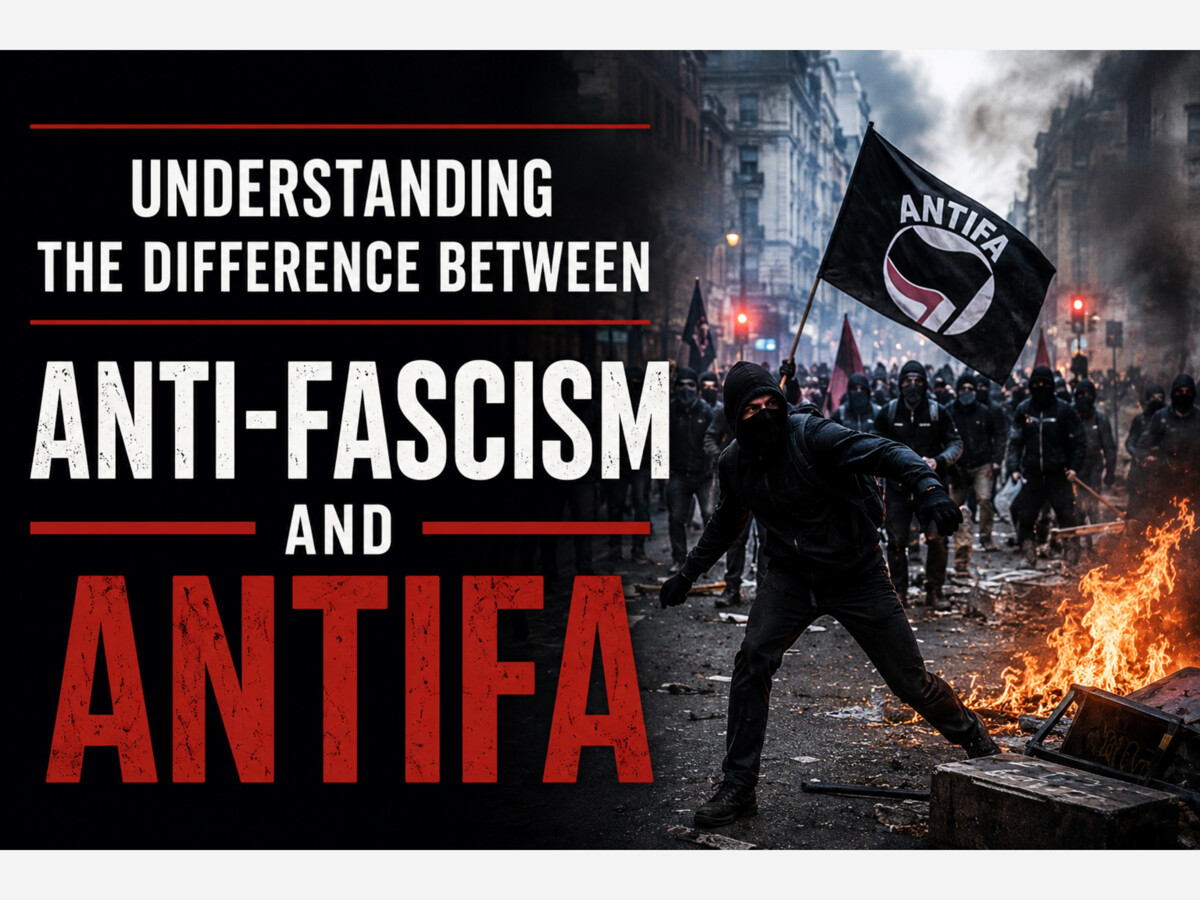
But somewhere along the way, a political movement successfully blurred the distinction between opposing fascism and identifying with ANTIFA.
The two are not the same.
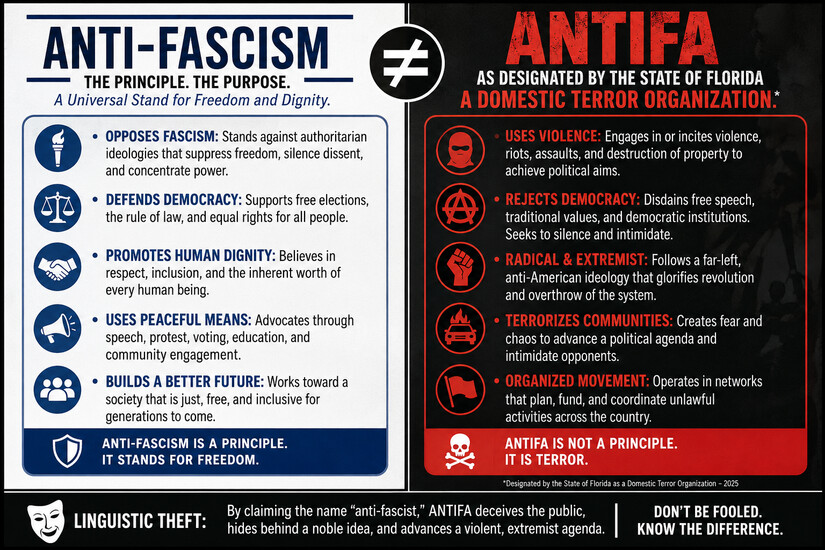
Understanding that distinction has become even more important following Florida's implementation of a new law establishing a process for designating domestic terrorist organizations. On July 1, Governor Ron DeSantis announced that Florida intends to designate ANTIFA under that process, making it one of the organizations the state will formally treat as a domestic terrorist organization under Florida law, subject to the procedures established by the statute.³
The name "ANTIFA" traces its roots to Antifaschistische Aktion, founded in Germany in 1932 by the Communist Party of Germany during the final years of the Weimar Republic.¹
While the organization opposed Adolf Hitler's National Socialist movement, it also opposed liberal democracy, capitalism, and many other political movements. Its objective extended beyond resisting fascism; it sought revolutionary political change through communist ideology.
Modern ANTIFA is not a single national organization with membership cards or a corporate headquarters. Instead, it is a decentralized collection of autonomous groups and activists who often share anarchist, anti-capitalist, and revolutionary political philosophies. Although there is no centralized command structure, many local groups openly identify themselves as ANTIFA and coordinate through regional networks and online platforms.
In recent years, ANTIFA became widely known during violent demonstrations in Berkeley, Charlottesville, Portland, Seattle, Atlanta, and other American cities.
Individuals identifying with ANTIFA have been arrested or prosecuted for offenses including assault, arson, rioting, vandalism, destruction of property, and attacks on law enforcement officers. During the unrest that followed the death of George Floyd in 2020, black bloc tactics frequently associated with ANTIFA appeared in numerous cities as businesses burned, police precincts were attacked, and millions of dollars in property damage occurred.²
It is important to be precise.
Not everyone attending those demonstrations identified with ANTIFA, and not every protest where ANTIFA supporters were present became violent. Likewise, ANTIFA is not a centralized organization directing every participant's actions.
However, it is equally inaccurate to pretend that the movement has not been repeatedly associated with organized political violence. The historical record demonstrates otherwise.
Perhaps ANTIFA's greatest strategic achievement has not occurred in the streets.
It has occurred in language.
By adopting a name that literally means "anti-fascist," the movement wrapped itself in a universally admired moral principle.
Most Americans are anti-fascist.
Most Americans reject authoritarianism.
Most Americans believe political disagreements should be resolved through elections, peaceful protest, public debate, and the courts rather than intimidation or violence.
Those beliefs have nothing to do with supporting ANTIFA.
Yet the similarity in names has created a rhetorical trap.
Critics of ANTIFA are frequently asked, "So you're against anti-fascism?"
That question confuses a principle with a movement.
It is entirely possible to oppose fascism while also rejecting political violence.
It is entirely possible to defend democracy while condemning organizations that attack democratic institutions.
Those positions are not contradictory.
They are consistent.
Florida's new domestic terrorism law reflects the state's determination that organizations engaging in politically motivated violence should face additional legal consequences.
Whether readers agree or disagree with that policy, the state's announcement highlights the importance of distinguishing between ideas and organizations.
Anti-fascism is an idea.
ANTIFA is a political movement that Florida officials have announced they intend to designate as a domestic terrorist organization pursuant to state law.³
Those are fundamentally different concepts.
Many well-intentioned people casually describe themselves as "antifa" simply because they believe fascism is wrong.
Their intentions may be entirely honorable.
They may never have participated in a protest, condoned violence, or even researched the movement's history.
Yet language carries meaning.
As ANTIFA has become increasingly associated with political violence and, now in Florida, with designation under the state's domestic terrorism framework, individuals should understand what the label communicates.
Opposing fascism does not require identifying with ANTIFA.
Supporting democracy does not require embracing groups associated with intimidation or violence.
Words matter.
When political movements appropriate words that almost everyone agrees with, public understanding becomes clouded. Separating principles from organizations is not merely an exercise in semantics. It is essential to informed civic debate.
Democracy deserves that clarity.
Enjoyed this article? Subscribe free at Tidings.Town.News for independent Florida journalism, investigative reporting, and thoughtful commentary delivered directly to your inbox. No paywall. No clickbait. Just journalism that respects your intelligence.



Sunny, with a high of 88 and low of 74 degrees. Patchy rain nearby for the morning, overcast in the afternoon and evening, clear overnight.