78° and Patchy rain nearby
Image
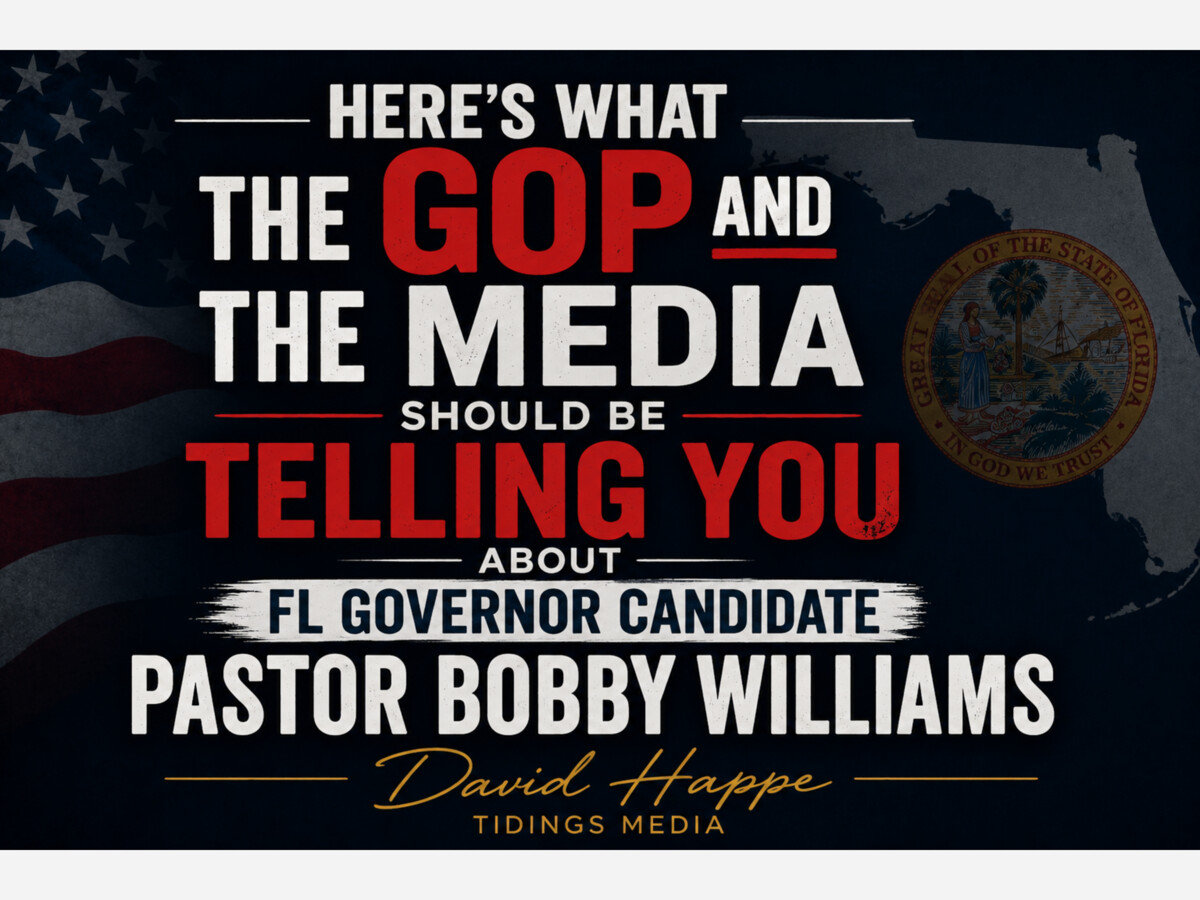



By David Happe
Political campaigns are designed to persuade. Candidates speak in carefully crafted sound bites, debates reward quick responses, and television advertisements rarely leave room for thoughtful discussion. By the time voters cast their ballots, many know where a candidate stands on a handful of issues but very little about how that person thinks.
That is why Tidings Media is launching a series of long-form conversations with candidates seeking public office. Every qualified gubernatorial candidate, regardless of political party or ideology, will be offered the same opportunity to answer the same difficult questions. My purpose is not to endorse candidates or produce "gotcha" journalism. It is to give voters enough information to evaluate the person behind the campaign.
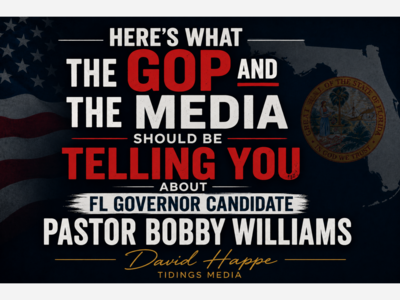
Bobby Williams, a Republican candidate for Governor of Florida, was the first to accept that invitation. Actually, he called me on the recommendation of a mutual acquaintance.
I came into the interview with the same question many Floridians are likely asking. Williams has never held elected office. Why should voters entrust him with leading one of the nation's largest and most complex state governments?
By the end of our conversation, I understood that he believes many people are asking the wrong question.
Williams isn't running on the argument that he has more political experience than his opponents. He is running on the belief that Florida's greatest need is not another experienced politician but a leader whose decisions are rooted in character. Whether readers agree with that premise or reject it entirely, it is impossible to miss how consistently it shaped his answers.
When I asked what ultimately convinced him to run for governor, he didn't mention polling, dissatisfaction with another candidate, or political opportunity. His answer was simple. He said the decision came through prayer. Throughout the interview he returned repeatedly to the conviction that
God called him to seek the office "for such a time as this.*"
(*I am quoting the bible, not Bobby Williams here.)
He also expressed frustration with what he described as a political culture that asks voters to choose "the lesser of two evils." In his view, the deeper problem is a shortage of leaders who demonstrate integrity in both public and private life. As a pastor, he lamented what he sees as too many Christians who profess faith but fail to display the Fruit of the Spirit in their daily lives. He believes that leadership begins with personal character, and that governments inevitably reflect the character of the people who lead them.
That philosophy is not confined to the campaign trail. Williams pastors Freedom Church, a non-denominational congregation in Polk County, and founded The Freedom Tour, a ministry focused on disaster relief, food distribution, and community outreach. Rather than presenting ministry as unrelated to government, he argued that the experience of coordinating churches, nonprofits, schools, businesses, and volunteers has prepared him for executive leadership in scale.
He described a network of approximately 500 organizations working together to serve communities throughout Florida. According to Williams, The Freedom Tour distributes roughly one million pounds of food each month while providing millions of pounds of products to schools and nonprofit organizations each year. He also described a model that leverages donated goods and volunteer partnerships to multiply charitable resources far beyond the cash contributions received.
Whether those operational claims withstand independent verification is an appropriate subject for future reporting, but there is little doubt that Williams views those accomplishments as evidence that leadership is measured by the ability to unite people around a common purpose rather than simply manage an organization chart.
He also spoke openly about stepping away from (or better said, maybe downscaling) a successful communications business in order to devote more time to ministry. He did not present that decision as a financial sacrifice so much as a personal one. His repeated emphasis was that success should be measured by lives changed rather than income earned. He draws a modest salary from the Freedom Tour.
As the conversation turned toward public policy, one issue consistently rose above the others.
Without hesitation, Williams identified overdevelopment as Florida's most pressing challenge. He believes developers are changing the character of the state at a pace that threatens both its communities and its natural resources. Unlike many candidates whose campaigns revolve around taxes, education, or crime, Williams repeatedly returned to growth management as the issue that deserves the governor's immediate attention.
I would have liked to hear more specifics. Criticizing overdevelopment is considerably easier than explaining where state authority should end and local control should begin, but Williams is a huge proponent of home rule for local control. Florida's housing shortage, continued population growth, and property rights create difficult policy questions that cannot be answered with slogans. Those details remain to be filled in as the campaign progresses. If we had more time, it seems like he had more to say about that.
Property taxes produced another revealing discussion.
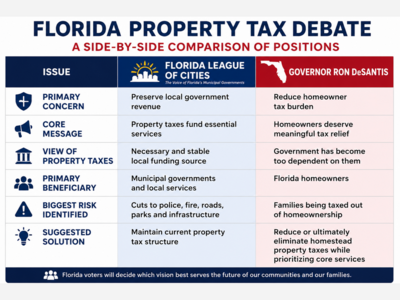
Williams supports eliminating property taxes on homesteaded residences and praised Governor Ron DeSantis for elevating the issue, while also arguing that the governor should have acted earlier and pursued a stronger proposal. He believes the current system gives local governments little incentive to control spending because increasing property values naturally generate additional revenue. He believes there should be zero property taxes on Florida homesteads.
On immigration, Williams drew a distinction between legal and illegal immigration. He argued that existing laws should be enforced while also reducing unnecessary bureaucracy within the legal immigration process. He repeatedly returned to concerns about fraud and corruption and expressed the view that Congress, not the states, ultimately bears responsibility for comprehensive immigration reform. Florida already has borders. Most immigration issues are federal.
One of the more interesting portions of our conversation involved the relationship between faith and government. Williams agreed that the concept of church and state should remain separate institutions, yet he also argued that government benefits when public officials are guided by biblical principles. He believes more Christians should seek public office and that moral leadership is one of the nation's greatest needs.
Reasonable people will disagree about where that line should be drawn, and readers will undoubtedly reach different conclusions. What struck me was not the position itself but the consistency with which Williams returned to it. He did not compartmentalize faith as a private matter disconnected from public service. Whether discussing campaign finance, leadership, taxes, or immigration, he viewed those issues through the same moral framework.
That consistency also appeared in his discussion of campaign fundraising. Williams said his campaign relies on small-dollar donors rather than political action committees and insisted he cannot be bought. Every candidate promises independence, of course, and voters should evaluate those claims over time. Still, the theme fit naturally with everything else he said during the interview. He has taken no PAC money. Refreshing, but its hurting his short term ability to carpet bomb his message.
Near the end of our conversation, I asked Williams how he hoped history would remember him if he were elected governor. His answer was not about passing a particular bill or winning another election. He said he hoped Florida would experience a significant shift away from what he described as wickedness and toward government that serves ordinary citizens rather than large corporate interests.
My final question was intentionally personal. I asked him to complete the sentence, "If I fail at one thing, let it never be said that I failed to..."
His answer came without hesitation.
"Fight for the people." - Bobby Williams
Whether voters ultimately conclude that Bobby Williams is the right person to lead Florida remains to be seen. Campaigns have a way of exposing strengths, weaknesses, and unanswered questions that early interviews cannot fully address. His candidacy also raises legitimate questions about executive experience, implementation of major policy proposals, and how broad philosophical principles translate into governing a state of more than twenty million residents.
At the same time, Williams deserves credit for something increasingly uncommon in politics. Over the course of an extended interview, his answers remained remarkably consistent. He did not attempt to become a different person depending on the subject. His worldview may persuade some voters and alienate others, but it is coherent. Every significant issue eventually returned to the same foundation: godly character, common sense, integrity, and a conviction that government exists to serve people rather than institutions. Nothing he said in the hour I spent with him felt like the usual, canned political BS we have become so accustomed to.
Those themes are now before the voters.
It is their judgment, not mine, that will determine whether Bobby Williams' message becomes Florida's future.
**Editor's Note**
We as a publication will not be endorsing a candidate for FL governor, primarily because we are a house divided at Tidings with multiple candidates being favored by individuals at Tidings. We accept zero money from any candidate, party, PAC or other political special interest group for any Tidings Media article or editorial. We do not accept political advertising, sponsorships or patrons.
Tidings Media is committed to giving voters an opportunity to hear directly from the people asking to serve them. Every qualified candidate for FL governor, regardless of political party or ideology, is invited to participate in this long-form interview series under the same editorial standards and with the same opportunity to answer substantive questions. The only rule of this interview was there were no rules. Candidates interested in participating may contact Tidings Media at tidingsmedia@protonmail.com
---
### Footnotes
1. Bobby Williams campaign biography and background, BWFLGov.com, "About Bobby Williams."
2. BWFLGov.com, campaign issues and policy positions.
3. Florida Division of Elections, candidate filing information for Bobby Williams, Republican candidate for Governor of Florida.


Light rain shower, with a high of 86 and low of 76 degrees. Light rain shower for the morning, patchy rain nearby for the afternoon and evening, overcast overnight.