84° and Clear
Image
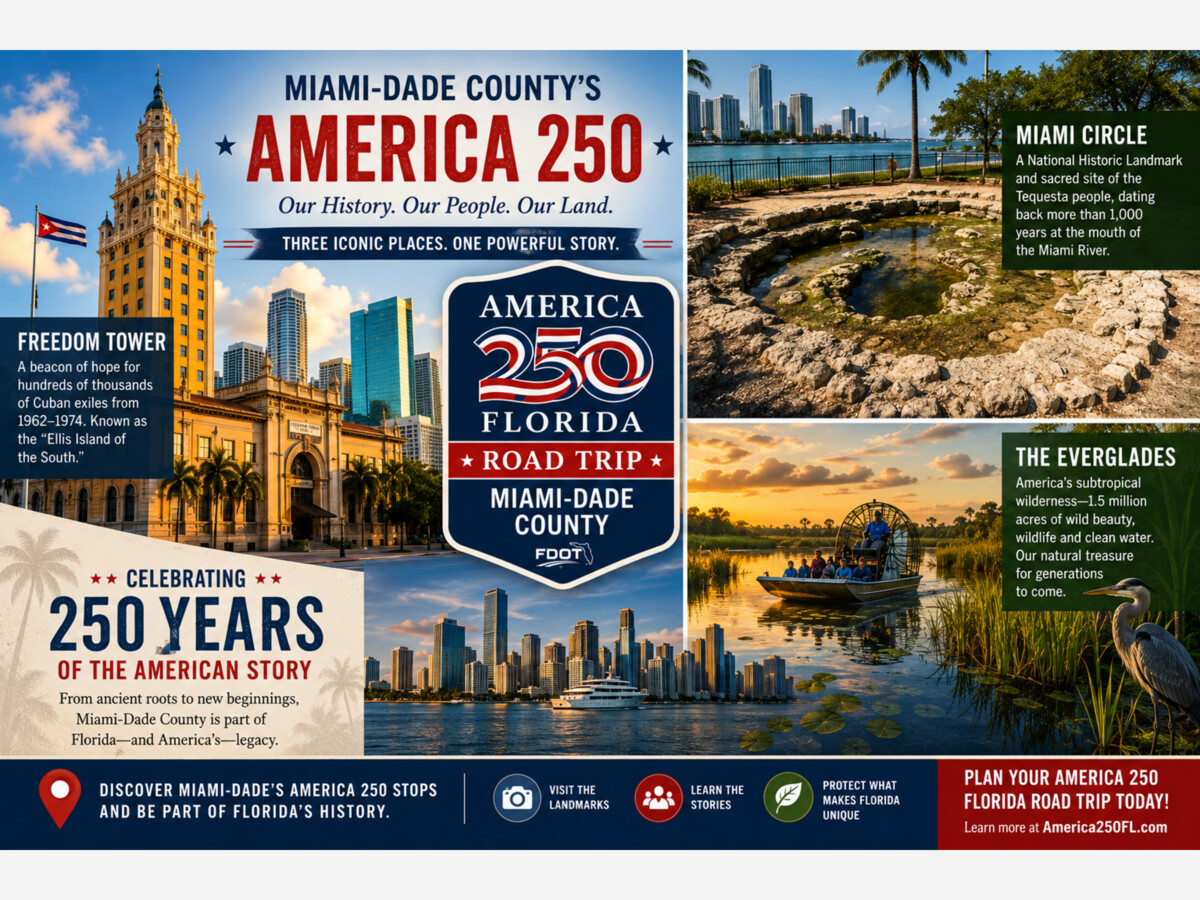



Florida’s statewide road-trip celebration puts Miami-Dade’s history in focus, connecting Cuban exile history, ancient Tequesta roots and one of America’s most important natural landscapes.
MIAMI-DADE COUNTY — Miami-Dade’s America 250 story is not one landmark. It is a sweep of history that runs from downtown Miami to the Everglades.
As Florida prepares for the 250th anniversary of the signing of the Declaration of Independence, the America 250 Florida Road Trip is highlighting three major Miami landmarks: the Freedom Tower, the Miami Circle and the Everglades. [1]
That gives Miami, Hialeah and the rest of Miami-Dade County a broader local story than a single photo stop.
The county’s America 250 highlights connect ancient Indigenous history, immigrant history, architecture, exile, freedom, ecology and the uneasy truth that Miami’s past is much deeper than its skyline suggests.
The most visible symbol is the Freedom Tower.
Built in 1925 as the headquarters of The Miami News, the Freedom Tower became one of Miami’s most recognizable buildings. Miami Dade College describes it as an icon of the downtown skyline and a symbol of hope, freedom and opportunity. [2]
Its national importance came later.
From 1962 to 1974, the building served as the Cuban Refugee Center, helping hundreds of thousands of Cubans seeking asylum in the United States. The National Park Service calls the Freedom Tower the “Ellis Island of the South” because of that role in the Cuban exodus and resettlement during the Cold War. [3]
That is why the Freedom Tower belongs in the America 250 conversation.
For many Miami families, the American story is not abstract. It is tied to arrival, exile, paperwork, medical services, family separation, English classes, work, sacrifice and the hope of starting over in a free country.
Miami Dade College says the Freedom Tower turned 100 in 2025 and now features immersive exhibitions tracing the building’s history from its newspaper roots to its role welcoming Cuban exiles. [4]
The second landmark reaches much further back.
The Miami Circle at Brickell Point was discovered in 1998 during archaeological salvage excavations. The Florida Division of Historical Resources says the site is made up of holes and basins carved into shallow limestone and is designated as a National Historic Landmark. [5]
The site is connected to the Tequesta people, who lived in the region long before Miami, Florida or the United States existed.
That makes the Miami Circle one of the most important reminders in this series: Florida’s story does not begin in 1776. It does not even begin with statehood in 1845. In Miami-Dade, the story reaches back thousands of years, to people who built, fished, traded, worshiped and lived at the mouth of the Miami River long before glass towers rose around Brickell.
The third America 250 highlight is the Everglades.
Everglades National Park protects 1.5 million acres of wetland, forest and marine habitat. The National Park Service describes it as the largest subtropical wilderness in the United States and notes that it was established in 1947 as the first national park created for biodiversity. [6]
For Miami-Dade residents, the Everglades is not just a scenic backdrop or an airboat-tour postcard. It is part of South Florida’s identity and survival.
The park protects native plants and animals, provides recreational opportunities and is connected to the region’s drinking water and environmental future. [6]
That makes the Everglades a different kind of America 250 stop. It is not a building or a monument. It is a landscape that shows the scale of what America inherited, altered, damaged and is still trying to protect.
Taken together, the three Miami-Dade stops tell a stronger story than any one of them could tell alone.
The Miami Circle represents the county’s ancient roots. The Freedom Tower represents arrival, exile and the meaning of freedom to families who fled communism and political persecution. The Everglades represents the natural system that shaped South Florida before modern development and still shapes its future.
For Miami and Hialeah readers, the local relevance is obvious.
This is not a road trip that requires leaving the county to understand the country. Miami-Dade’s own landmarks already carry national meaning.
The Freedom Tower tells the story of people who came here looking for liberty. The Miami Circle tells the story of people who were here long before the country existed. The Everglades tells the story of a natural treasure that belongs not only to Florida, but to the nation.
That is why Miami-Dade’s America 250 entry may be one of the most layered in the state.
It is ancient and modern. Urban and wild. Cuban American and Indigenous. Civic and environmental. Local and national.
As America prepares to celebrate 250 years, Miami-Dade’s contribution is not just that it has landmarks worth visiting.
It is that those landmarks force the bigger question.
What does freedom mean when people risk everything to reach it? What does history mean when the oldest stories are buried under modern development? And what does patriotism mean if the land itself is not preserved for the next generation?
In Miami-Dade County, America 250 is not just a birthday celebration.
It is a reminder that the American story is still being written at the water’s edge, in the heart of downtown, and across the River of Grass.
[1] Greater Miami & Miami Beach, “250 Anniversary Events,” America 250 Florida Road Trip section.
[2] Miami Dade College Museum of Art and Design, “About the Freedom Tower.”
[3] National Park Service, “Freedom Tower, Florida.”
[4] Miami Dade College, “The Freedom Tower — 100 Years.”
[5] Florida Division of Historical Resources, “Miami Circle.”
[6] National Park Service, “Everglades National Park.”
:::


Sunny, with a high of 89 and low of 83 degrees. Overcast for the morning, sunny during the afternoon, overcast in the evening, clear overnight.