75° and Light rain shower
Image
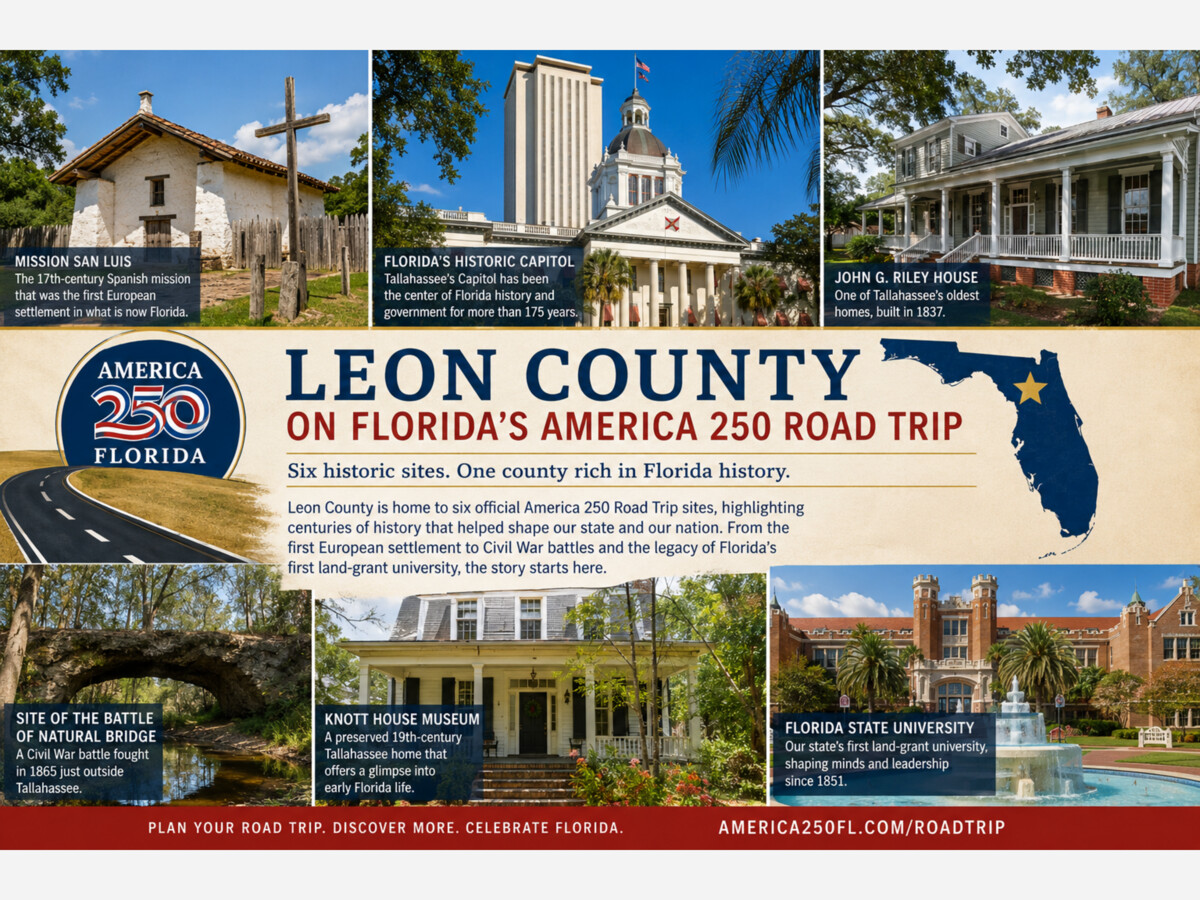



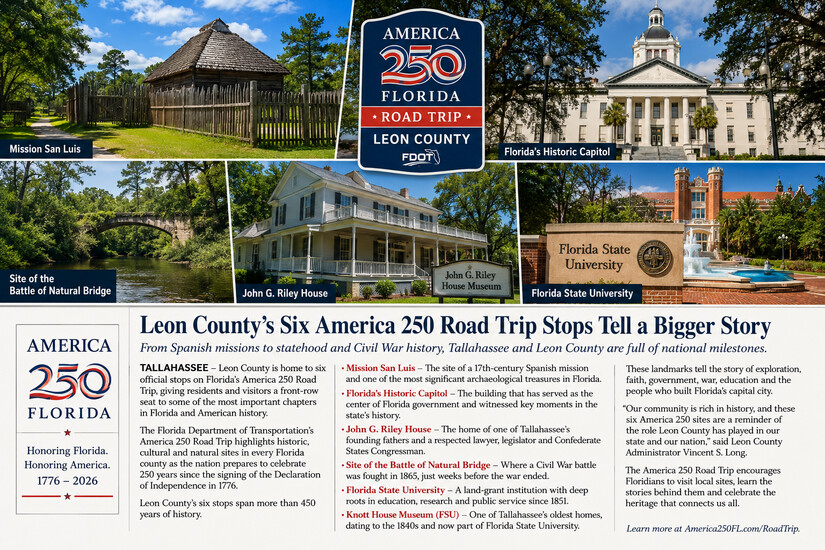
Tallahassee’s America 250 highlights include Mission San Luis, Florida’s Historic Capitol, the John G. Riley House, Florida State University and the battlefield that helped keep the capital from falling during the Civil War.
TALLAHASSEE — Leon County is not getting a token stop on Florida’s America 250 Road Trip. It is getting a history trail.
As Florida prepares for the 250th anniversary of the signing of the Declaration of Independence, Tallahassee and Leon County are being promoted as one of the state’s strongest local history destinations. Visit Tallahassee says Leon County has six official America 250 stops, giving residents and visitors a concentrated way to connect with Florida’s role in the American story. [1]
The stops reach across centuries: Spanish mission history, Indigenous history, state government, African American heritage, higher education, Civil War history and even the Spanish explorer whose name is attached to Leon County.
For a city sometimes reduced to politics and college football, the America 250 trail is a reminder that Tallahassee’s importance did not begin with modern campaign season.
It begins much earlier.
Mission San Luis, located at 2100 W. Tennessee Street, is Tallahassee’s only National Historic Landmark. The site preserves the story of the Apalachee and Spanish people who lived there more than 300 years ago. From 1656 to 1704, Mission San Luis served as the western capital of Spanish Florida’s mission system. Today, the site functions as a living-history museum with reconstructed buildings, costumed interpreters and educational programming. [2]
That stop alone gives Leon County a deeper timeline than many Florida communities can claim. It places Tallahassee inside the story of colonial Florida, long before the United States existed.
From there, the trail moves to the center of Florida government.
Florida’s Historic Capitol, located at 400 S. Monroe Street, was originally built in 1845, the year Florida became a state. The building has been restored to its 1902 appearance, with its stained-glass dome, candy-striped awnings, former legislative chambers, Supreme Court and Governor’s suite. The museum now interprets Florida’s political history from the heart of the Capitol Complex. [3]
The Historic Capitol is an obvious America 250 stop because it sits at the center of Florida’s civic life. But Leon County’s story is not only told through government buildings.
The John G. Riley House and Museum is also part of the Great Florida Road Trip. The City of Tallahassee announced in October 2025 that the Riley House had been selected as a featured destination, with a sign to be installed on site and the museum included in the road-trip guidebook and interactive map. [4]
The Riley House stands as one of the last physical reminders of Smokey Hollow, a once-thriving African American community near downtown Tallahassee. The home was built in 1890 for John Gilmore Riley, a formerly enslaved man who became an educator, businessman, Mason and civic leader. Riley became principal of Lincoln Academy, Tallahassee’s first local high school for African Americans, in 1892 and served until retiring in 1926. [4]
That gives the America 250 trail a more complete story. It is not just about founders and capitals. It is also about the people and communities that carried Florida forward through Reconstruction, segregation and the long fight for civil rights.
Another stop takes visitors south of Tallahassee to Natural Bridge Battlefield Historic State Park.
The Battle of Natural Bridge was fought in March 1865 in the final weeks of the Civil War. Florida State Parks describes the site as the place where Union troops, including the 2nd and 99th Regiments U.S. Colored Infantry, reached what became Florida’s second-largest Civil War battle. Confederate forces ultimately held the crossing, and Tallahassee remained the last Confederate capital east of the Mississippi River not captured by Union forces. [5]
The battlefield adds a more difficult chapter to the local trail. It is a place tied to war, slavery, Union troops, Confederate defense, memory and interpretation. For Leon County, it is also a reminder that national history was not something happening somewhere else. It came directly to the woods and waterways south of Tallahassee.
Florida State University is also included in Tallahassee’s America 250 story. Visit Tallahassee describes FSU as a historic campus with roots in West Florida Seminary, established in 1851. The school later became Florida State College for Women after the Buckman Act of 1905 and returned to coeducation in 1947 as Florida State University. [6]
The FSU stop widens the story from government and war to education. It connects the county’s modern identity as a college town to a much older legacy of public higher education in Florida.
The sixth Leon County stop has a different feel. Drivers arriving from the west can find an America 250 Florida road-trip marker at the Exit 196 rest area dedicated to Juan Ponce de León, the Spanish explorer whose name inspired Leon County. Visit Tallahassee frames the marker as a gateway into the county’s history and nearby Market District attractions. [1]
Taken together, the six stops make Leon County one of the richer local America 250 destinations in Florida.
This is not a single-photo tourism stop. It is a countywide lesson.
Mission San Luis tells the story of the Apalachee and Spanish Florida. The Historic Capitol tells the story of statehood and government. The Riley House tells the story of Black leadership and preservation. Natural Bridge tells the story of war and contested memory. Florida State University tells the story of education. The Ponce de León marker reminds travelers how deep the county’s name and Florida’s colonial-era history run.
America 250 will be celebrated nationally on July 4, 2026. In Leon County, the story is already on the ground.
Residents do not need to leave the county to see how Florida’s history connects to the nation’s. They can start downtown, drive west to Mission San Luis and FSU, head south to Natural Bridge, or stop at the marker that introduces travelers to the name Leon itself.
For Tallahassee, the road trip is also a branding opportunity. The city is the state capital, a university town and a political hub. But it is also a place where the story of Florida can be read in missions, museums, battlefields, campuses and neighborhoods that survived long enough to be remembered.
That may be the real value of the America 250 trail.
It gives Leon County a chance to remind Florida that the capital city is not just where laws are made. It is where centuries of Florida history are still sitting within driving distance.
[1] Visit Tallahassee, “Beyond Your Block: America 250 Challenge in Tallahassee.”
[2] Visit Tallahassee, “Mission San Luis.”
[3] Visit Tallahassee, “Florida Historic Capitol Museum.”
[4] City of Tallahassee, “City’s John G. Riley House & Museum Included on Great Florida Road Trip,” Oct. 23, 2025.
[5] Florida State Parks, “The Battle of Natural Bridge.”
[6] Visit Tallahassee, “Celebrating America 250: A Journey Through Tallahassee History.”


Moderate rain, with a high of 75 and low of 70 degrees. Patchy rain nearby in the morning, moderate rain in the afternoon, mist overnight.