Image
Tidings Media is a Weather Ready Nation Brand Ambassador for NOAA. Subscribe for free for alerts!



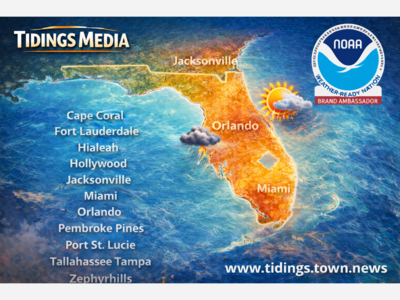
Tidings Media is expanding its weather coverage and hurricane education efforts across Florida through its role as a NOAA Weather-Ready Nation Ambassador serving the Tampa Bay area. The shift comes as the company moves to become a more weather-centered media organization with a larger public-service focus on preparedness, forecast literacy, and storm awareness in one of the nation’s most hurricane-prone states. With sites in Tampa, Tallahassee, Miami, Jacksonville, Orlando, Port St. Lucie, Fort Lauderdale, Cape Coral, Hialeah, Hollywood, and Pembroke Pines, Tidings Media is positioning itself to help Florida readers better understand storm risk before hurricane season reaches its peak.
In Florida, weather shapes daily life in ways that people in other states may never fully appreciate. It affects travel, schools, business operations, family routines, and, during hurricane season, the decision-making of entire communities. For a media company with a growing footprint across the state, that creates a clear opportunity and a serious responsibility. Tidings Media is leaning further into hurricane education because timely, understandable preparedness information can make a real difference when conditions begin to deteriorate.
The Weather-Ready Nation Ambassador program is designed to recognize organizations that help improve readiness, responsiveness, and resilience in the face of extreme weather, water, and climate events. NOAA says ambassadors work with the agency and with other partners to increase community engagement and strengthen resilience. The expectation goes beyond passive affiliation. Ambassador organizations are expected to promote hazardous-weather awareness and preparedness within their communities and organizations.
That mission carries extra weight in Florida, where hurricane preparation needs to begin well before a named storm is approaching the coast. NOAA’s current hurricane preparedness guidance urges residents to understand their risk, prepare before the season, and maintain multiple ways to receive forecasts and alerts. That advice is practical for a reason. Major storms can disrupt power, strain communications networks, and compress decision windows for families trying to make choices about evacuation, supplies, medications, fuel, and shelter.
This is where a media organization can serve a broader purpose. Strong weather coverage should do more than amplify dramatic radar images and social media urgency. It should explain what forecasts mean, clarify what watches and warnings require people to do, and reinforce preparedness steps before the rush begins. The National Weather Service notes that hurricane watches are generally issued 48 hours before the anticipated onset of tropical-storm-force winds, while hurricane warnings are generally issued 36 hours in advance. In a state like Florida, those timeframes can disappear quickly.
Tidings Media wants to operate in that window before panic sets in. That means expanding coverage of hurricane readiness, evacuation basics, alerting systems, forecast interpretation, and the practical realities of living in a storm-prone state. It also means treating preparedness as year-round civic information rather than as occasional seasonal content. Florida needs clearer communication, repeated reminders about trusted basics, and more local reporting that helps people act earlier.
The Tampa Bay area is the starting point for that effort, but it is not the limit. A statewide footprint matters because hurricane education in Florida cannot be uniform in every market. A family in Tampa Bay faces a different mix of risks and logistics than a resident in Miami, a business owner in Jacksonville, or a retiree in Cape Coral. Flood exposure, evacuation routes, housing stock, infrastructure, and local storm history all shape how people prepare. A stronger Florida weather strategy requires local relevance backed by a consistent statewide message: prepare early, follow trusted sources, and avoid waiting until the final hours.
For Tidings Media, this transition also reflects a broader view of what a modern regional media organization can be. It can do more than publish stories. It can become a platform for public education around storm safety and readiness. That includes reminding readers to use multiple alert sources, including local National Weather Service information, emergency management guidance, and other trusted forecast channels. In severe weather, redundancy is a strength.
NOAA’s ambassador program exists because public readiness improves when government, nonprofits, businesses, schools, and media organizations all participate. NOAA describes the initiative as a way to foster stronger collaboration across sectors to make the nation more ready, responsive, and resilient against extreme environmental hazards. Tidings Media’s evolving role in Florida fits squarely within that framework.
For a state that returns to hurricane headlines every year, the larger challenge is not simply covering storms when they arrive. It is helping people prepare before they do. That is the direction Tidings Media is taking as it deepens its involvement in hurricane education across Florida and builds on its role as a Weather-Ready Nation Ambassador in the Tampa Bay area.


Sunny, with a high of 80 and low of 62 degrees. Sunny for the morning, clear during the afternoon and evening,