Image




Polls show Florida homeowners are ready for historic relief. Now the only question is whether Tallahassee will let voters decide.
By Tidings Media
Florida may be heading toward one of the most important taxpayer votes in modern state history.
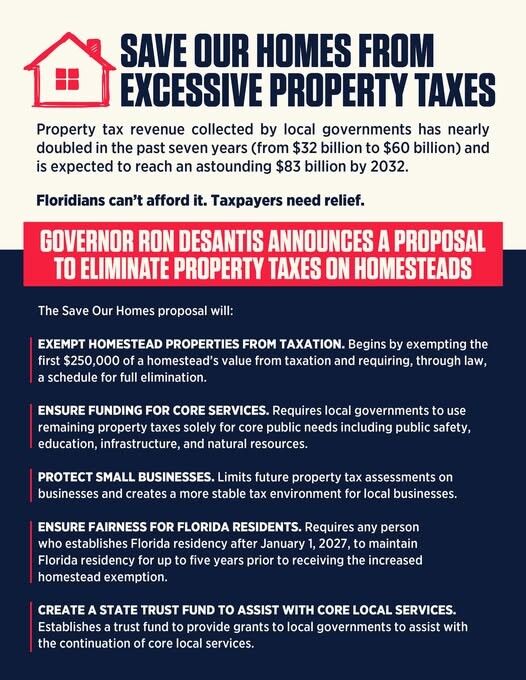 Image by Office of Governor Ron DeSantis
After years of rising home values, rising insurance premiums, rising repair costs, rising storm preparation costs, and rising local tax bills, the state’s property tax debate has broken out of the committee rooms and into the open. This is no longer a quiet argument among lawmakers, county officials, lobbyists, and budget analysts.
This is becoming a homeowner revolt.
The idea is simple enough for every Florida homeowner to understand: protect the family homestead from the non-school portion of the property tax bill and stop treating primary residences like a permanent revenue machine for local government.
That is the essence of the property tax relief push now moving through Florida politics. Gov. Ron DeSantis has been pressing lawmakers to put a constitutional amendment before voters in November 2026. The most likely version would focus on homesteaded primary residences and phase out the non-school portion of the property tax bill over time.
The politics are obvious.
The public appetite may be even more obvious.
A University of North Florida poll released in March found that 56% of likely Florida midterm voters supported eliminating non-school property taxes on homesteaded property. That number alone is significant because Florida constitutional amendments require 60% voter approval to pass. Even more telling, support reached 76% among Republicans, 56% among independents, and 58% among homeowners. The same poll found that affordability and cost of living was the top issue in Florida, named by 50% of respondents.
A later poll reported by Florida Politics showed an even stronger result, with three out of four Florida voters saying they would vote for homestead property tax relief. If that level of support holds through a statewide campaign, the proposal would not merely clear Florida’s 60% constitutional threshold. It would clear it comfortably.
That is the breaking-news center of this story.
Florida homeowners are not mildly interested in property tax relief. They appear ready to vote for it.
And why wouldn’t they be?
Property taxes have become one of the clearest symbols of Florida’s affordability squeeze. Kiplinger reported that Florida property taxes have risen nearly 60% in five years, with Tampa bills up about 56% and Miami bills up about 48%, citing Redfin data.
For homeowners, that is not an abstract policy issue. That is a bill in the mailbox.
A family does not feel richer because a property appraiser says the house is worth more. A retiree on a fixed income cannot use a higher assessed value to buy groceries. A widow cannot pay an insurance premium with theoretical equity. A working family cannot cover a rising tax bill with paper wealth unless they sell, borrow, or leave.
That is the emotional power of this issue.
Florida voters already showed where they stand on homestead tax relief. In 2024, more than 66% of voters approved Amendment 5, which tied part of the homestead exemption to inflation. That was a smaller measure. This one would be much larger. But the political signal was clear: when Florida voters are given a chance to protect the homestead, they are willing to do it.
Now the question is whether Tallahassee will give them the chance.
Earlier this year, the Florida House passed HJR 203 by an 80-30 vote. That proposal would have increased the homestead exemption from non-school ad valorem taxes by $100,000 each year for ten years, beginning in 2027. By 2037, homesteaded property would have been exempt from all non-school property taxes. The proposal also included language intended to protect public safety funding.
But the Senate did not move it. HJR 203 died in the Senate Appropriations Committee on March 13, 2026.
That is why the next phase matters.
DeSantis is now pushing for a dedicated property tax special session after the budget process, with the goal of getting a constitutional amendment onto the November ballot. Public reports indicate the likely approach may be phased in, focused on homesteaded property, and structured as a “glide path” rather than immediate elimination. The special session will convene Monday June 1, and the Republicans have enough of a majority to force this issue on to the November 2026 ballot.
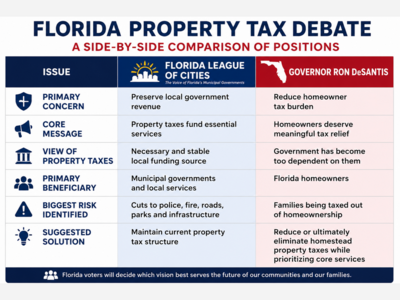
That matters because the critics’ strongest argument has always been local government revenue. Cities and counties rely heavily on property taxes. They will warn that cutting non-school property taxes on homesteads could pressure local budgets, affect parks, roads, libraries, emergency services, stormwater systems, and general operations.
But that argument has a political weakness.
Florida families have already been pressured.
Homeowners have already had to absorb the insurance crisis, maintenance inflation, roof replacement costs, hurricane preparation, higher utility bills, and higher everyday costs. Local governments are not the only institutions facing financial pressure. They are simply the ones most accustomed to passing that pressure down.
A serious homestead property tax relief plan would force government to do what families already do: prioritize.
That does not mean public safety should be weakened. It does not mean core services should disappear. It means local budgets should not be allowed to grow automatically because home values rose on paper.
The homestead is different from a commercial warehouse, a rental portfolio, a vacation home, or speculative land. It is the place where people live. It is where families build stability. It is where retirees age in place. It is where working Floridians try to hold onto the life they built.
Taxing that home year after year, even after the mortgage is paid, makes many people feel like they are renting their own house from the government.
That is why this issue cuts so deep.
It is not merely about millage rates.
It is about ownership.
The property tax debate also lands at a perfect political moment. Florida is a no-income-tax state. It has built its brand around freedom, growth, entrepreneurship, retirement, and family relocation. But the affordability bargain has been strained. Insurance costs have exploded. Housing costs remain high. Local taxes keep rising. The state that once marketed itself as the place where people could keep more of what they earned now has homeowners asking why they can never fully own the roof over their heads.
That question is powerful.
The ballot threshold is high. Florida constitutional amendments need 60% voter approval. But property tax relief may be one of the rare issues that can cross that line. It speaks to retirees, young families, longtime residents, conservatives, independents, and anyone who has watched household costs climb while government revenue keeps growing.
If the proposal reaches the ballot, opponents will spend months warning voters about budget holes. Supporters should welcome that debate. Voters are capable of weighing the tradeoffs. They are also capable of deciding that the family homestead deserves stronger constitutional protection.
The Legislature should put the question before them.
Florida homeowners do not need another study. They do not need another symbolic rebate. They do not need another small exemption that barely survives the next assessment cycle. They need structural relief that changes the relationship between the homeowner and the local tax collector.
This is the moment.
The polls show the appetite is there. The prior House vote showed the concept already has legislative strength. The 2024 Amendment 5 vote showed Floridians are willing to protect the homestead when given the chance. The cost-of-living crisis gives the issue urgency.
Now Tallahassee has to decide whether voters get a say.
Property tax relief should be on the November ballot.
Let the opposition make its case.
Let the supporters make theirs.
Then let Florida homeowners decide whether the family homestead should finally get the protection it deserves.



Sunny, with a high of 80 and low of 62 degrees. Sunny for the morning, clear during the afternoon and evening,