81° and Overcast
Image




The homestead exemption would rise from today’s $50,000 to $150,000 in 2027, then $250,000 in 2028, with future increases tied to inflation.
Florida voters are about to get a rare chance to do something meaningful about the cost of staying in their own homes.
Not a rebate. Not a temporary gimmick. Not another government announcement dressed up as relief. A real property tax reform amendment is headed to the November 2026 ballot. If 60 percent of voters approve it, Florida’s homestead exemption for non-school property taxes would rise to $150,000 in 2027 and $250,000 in 2028. Beginning in 2029, that exemption would rise with inflation.¹
That matters because property taxes are different from almost every other bill. You can pay off your mortgage. You can buy your home in cash. You can live responsibly, save carefully, and retire modestly, and still receive a government bill every year for the privilege of remaining in the home you already own. Miss enough payments, and the government can eventually take the house.
So this is not merely a budget debate. It is a question of ownership. Does the homeowner own the home, or is the homeowner just renting it from the government forever?
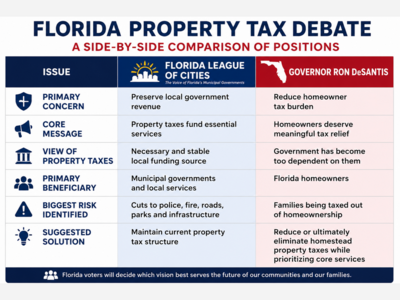
Governor Ron DeSantis has framed the issue bluntly. “Property tax revenue collected by local governments has nearly doubled in the past seven years and is expected to reach an astounding $83 billion by 2032,” DeSantis said when announcing the special session on property tax relief. “Florida homeowners need relief. Now is the time to stand up for taxpayers, enact a historic reform, and save the home of every Floridian.”²
According to the Governor’s Office, local government property tax collections have increased from $32 billion to $60 billion and are projected to reach $83 billion by 2032.³ That is the number local officials will not want on the yard sign.
They will talk about services. They will talk about police, fire, roads, libraries, parks, stormwater, pensions, staffing, public safety, and infrastructure. Some of that is legitimate. Much of it matters. But taxpayers are still entitled to ask the next question: after years of record revenue growth, how much more do you need?
Local government has not been operating in austerity. A rise from $32 billion to $60 billion in property tax collections is not scarcity. A projection of $83 billion by 2032 is not starvation.
Not every dollar was wasted. Growth costs money. Storm recovery costs money. Infrastructure costs money. Public safety costs money. But the facts undermine the fairy tale that local governments have been scraping by on nickels and prayers.
They have not.
Here is the plain-English version of what voters are being asked to approve.
Today, Florida’s standard homestead exemption is worth up to $50,000. The first $25,000 applies to all property taxes, including school taxes. The second $25,000 generally applies only to non-school taxes and only to assessed value above $50,000.⁴
That sounds more complicated than it needs to be, so use a simple example.
If a Florida homeowner has a homesteaded property with an assessed value of $300,000, the current exemption does not mean every part of the tax bill is based on $250,000. School taxes and non-school taxes are treated differently. For school taxes, the first $25,000 is exempt. For most other local taxes, up to $50,000 may be exempt.
The 2026 proposal would make the non-school side much larger.
If voters approve the amendment, the non-school homestead exemption would rise to $150,000 in 2027 and $250,000 in 2028. Beginning in 2029, it would increase with inflation. School taxes would remain separate.⁵
So take that same $300,000 assessed home. Today, up to $50,000 may be exempt from non-school property taxes. In 2027, that non-school exemption would rise to $150,000, leaving about $150,000 exposed to non-school property taxes. In 2028, the exemption would rise to $250,000, leaving about $50,000 exposed to non-school property taxes.
That does not mean the homeowner pays no property tax. School taxes would still apply. Some assessments and other charges may still appear on the tax bill. But the non-school property tax burden could drop sharply.
For a $500,000 assessed home, the same idea applies. Today, the non-school homestead exemption may be up to $50,000. In 2027, that would rise to $150,000. In 2028, it would rise to $250,000. That means the taxable value for non-school taxes could fall from about $450,000 today to about $350,000 in 2027, and then about $250,000 in 2028.
That is why this matters. It does not send homeowners a check. It reduces the amount of homesteaded value local governments can tax for non-school purposes.
The amendment also includes an important Florida-resident rule. Homeowners who are Florida residents on or before December 31, 2026 would be eligible for the expanded benefit. New Florida residents after that date would receive the current $50,000 homestead exemption for four years before becoming eligible for the larger exemption.⁶
That is not anti-newcomer. It is pro-Floridian. The people already here have lived through the insurance crisis, the pandemic migration surge, assessment increases, inflation, and runaway local budgets. They should not be priced out of the homes and communities they helped build.
There is also an inflation feature. The confirmed structure is $150,000 in 2027, $250,000 in 2028, and inflation indexing beginning in 2029. If inflation indexing continues for many years, the exemption could eventually grow much larger. But voters should understand the actual ballot structure: this is not an instant jump to $500,000. It is a phased increase, followed by inflation adjustments.⁷
The proposal also lowers the annual assessment cap on non-homestead property from 10 percent to 5 percent, excluding school taxes.⁸ That provision matters for renters and small businesses, but it should not be oversold. This is primarily a homeowner tax cut. The expanded homestead exemption does not directly lower an apartment tenant’s tax bill, and renters do not receive a homestead exemption on someone else’s property.
But renters should still care. Many renters do not want to rent forever. Zillow’s 2025 Consumer Housing Trends Report found that about 69 percent of renters are considering moving within the next three years, or might consider moving but are not sure when. Among that group, 56 percent say they intend to save for a down payment or buy a home outright.⁹
Those are people trying to cross the bridge from renter to homeowner.
For them, the cost of ownership is not just the purchase price. It is the mortgage, the insurance, the repairs, the utilities, and the taxes. Lowering the long-term property tax burden on a primary residence makes that bridge a little less impossible. This reform may not lower next month’s rent check, but it can make the next step — buying a home and staying in it — more affordable.
That is a serious affordability policy.
The opposition will say local governments cannot survive. They will warn of catastrophic service cuts. They will say the state is tying their hands. But taxpayers have had their hands tied for years. Families make choices every day. Seniors make choices every day. Small businesses make choices every day. They prioritize needs over wants. They delay purchases. They cut waste. They live within limits.
Local government should not be exempt from that discipline.
The myth is that property tax reform is reckless. The truth is that unchecked property tax growth is reckless.
It is reckless to tell a widow on a fixed income that her home is worth more on paper, so the government deserves more money. It is reckless to tell a retired couple that paying off the mortgage did not really secure the house. It is reckless to tell a young family that homeownership is the American dream, then load the dream with taxes, insurance, assessments, fees, and endless local spending.
Most of all, it is reckless to let local governments treat rising property values as free money.
Property ownership should mean something. Homestead should mean something. Paying off a house should mean something. Florida has no state income tax, and that remains one of the great advantages of living here. But if property taxes become a backdoor income tax on homeownership, Florida will lose part of what made it different.
This amendment will not fix every problem. It will not fix insurance. It will not build more houses. It will not lower interest rates. It will not make every renter a buyer or every local government efficient. But it does something big: it shifts power back toward the homeowner.
It gives renters who want to buy a better shot at long-term affordability. It protects school taxes. It rewards existing Florida residents. It forces local governments to justify spending after years of revenue growth. And most importantly, it gives voters the final word.
That is why this is more than tax policy.
It is a homeownership amendment. It is a stay-in-your-home amendment. It is a stop-the-escalator amendment.
Florida voters should approve it in November 2026.
Vote yes.
Stay connected with Tidings Media: Tidings Media offers local curated news for Tampa, Tallahassee, Miami, Jacksonville, Orlando, Port St. Lucie, Fort Lauderdale, Cape Coral, Hialeah, Hollywood, Pembroke Pines, and Zephyrhills. Subscribe free at tidings.town.news for local headlines, weather alerts, civic updates, practical Florida news, and community stories without the clutter.
About Tidings Media: Tidings Media is a local news and information network built to give Florida communities useful, curated coverage of the issues that affect daily life — from weather and public safety to government, schools, business, taxes, growth, and quality of life. Our goal is simple: make local news easier to follow, easier to trust, and easier to use.
Footnotes:



Light rain shower, with a high of 89 and low of 74 degrees. Overcast in the morning, light rain shower in the afternoon, overcast overnight.