81° and Overcast
Image
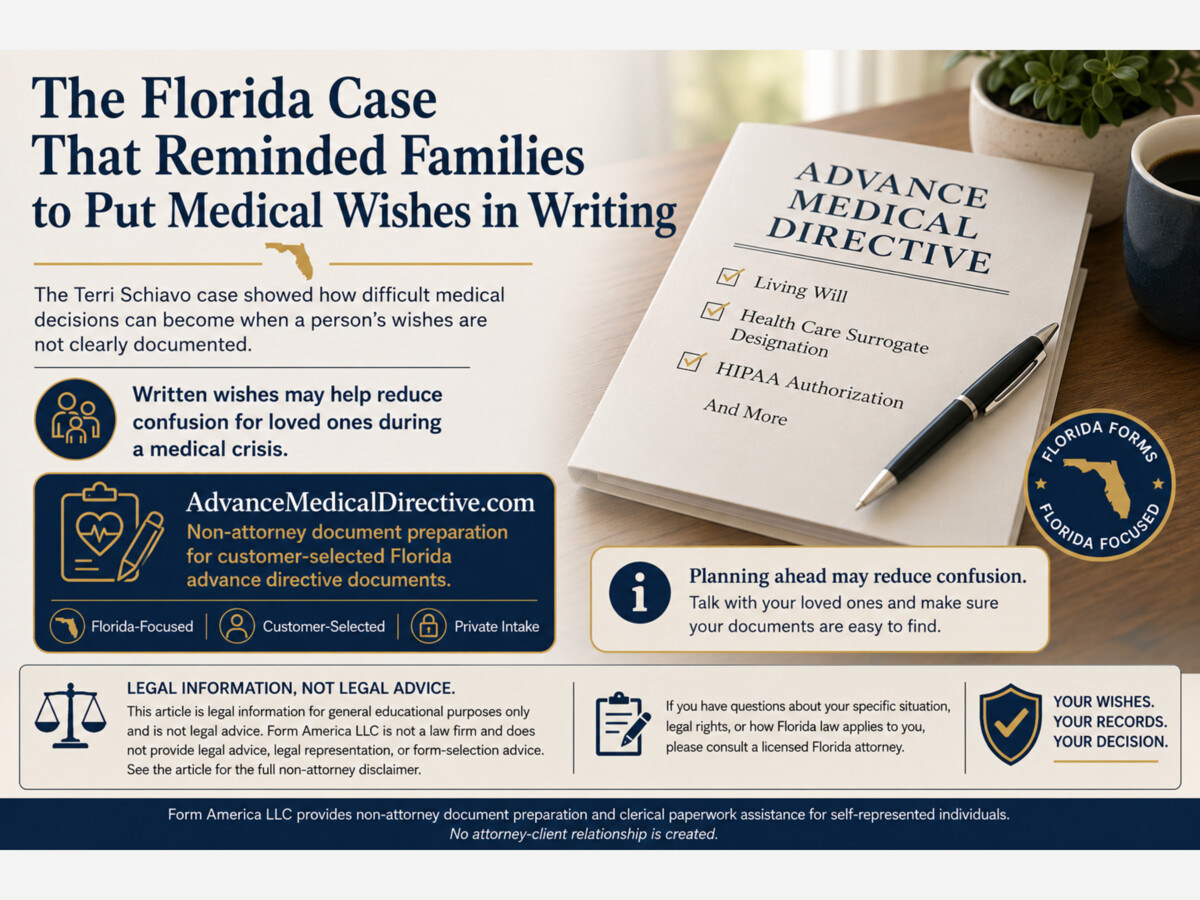



Editor’s Note / Legal Information Disclaimer: This article was submitted by Form America LLC, a Tidings Media supporter and a member of the Florida Association of Legal Document Preparers, a private professional association. Form America LLC provides non-attorney document preparation and clerical paperwork assistance for self-represented, pro se individuals. Form America LLC is not a law firm, is not owned or operated by an attorney, does not provide legal advice, and does not represent customers in any legal matter.
This article is provided for general legal-information and educational purposes only. It is not legal advice and should not be relied upon as legal advice. Form America LLC does not select forms for customers, does not advise customers which documents to use, does not advise customers what information to include in a document, and does not advise customers how Florida law applies to their specific circumstances. If you have questions about your legal rights, medical wishes, estate plan, family circumstances, or how Florida law applies to you, you should consult a licensed Florida attorney.
Many people put off advance medical directive paperwork because the subject feels distant, uncomfortable, or easy to postpone. It is common to assume there will be time later to talk with family, organize records, or write down medical preferences.
A medical crisis can change that quickly.
A sudden hospitalization, accident, stroke, cardiac event, diagnosis, or decline in capacity may require family members and medical providers to determine who should be contacted, who may be involved, and what the person previously expressed about medical care. In those moments, uncertainty can make an already difficult situation even harder.
Advance medical directive documents are one way people may choose to record certain health care wishes and identify who they want involved if they cannot communicate.
In Florida, advance directives can include a living will and a designation of health care surrogate. Florida public health guidance explains that a living will, a health care surrogate designation, and an anatomical donation form are among the sample forms recognized under Florida law, and that people may complete one or more types of advance directives depending on their wishes and circumstances.[1] Chapter 765, Florida Statutes, also addresses health care advance directives, including procedures related to living wills and health care surrogate designations.[2]
AdvanceMedicalDirective.com is a Form America LLC service focused on non-attorney document preparation for customer-selected Florida advance medical directive forms. The service is intended for customers who have already chosen the form or document package they want completed and who want clerical assistance entering customer-provided information into those documents.
The service does not replace an attorney. It does not provide legal advice. It does not tell customers which documents they legally need, what medical choices they should make, whom they should name, or how Florida law applies to a specific family situation. Customers choose the forms they want prepared. Customers provide the information to be used. Customers review the completed documents before signing.
That distinction is important. Florida courts publish self-help resources for people handling certain legal matters themselves, and Florida Courts also publishes nonlawyer disclosure resources in certain court-form contexts so people understand the limited role of a nonlawyer.[3] Non-attorney assistance must remain limited. It may not become legal advice, legal judgment, legal strategy, or legal representation.
The purpose of AdvanceMedicalDirective.com is therefore limited: non-attorney document preparation and general legal information for customers who have selected the paperwork they want completed.
The reason this subject matters so much in Florida is not theoretical. It is part of the state’s history.
Terri Schiavo, a young woman from Pinellas County, became the center of one of the most widely followed medical, legal, and family disputes in American history. After suffering cardiac arrest in 1990, she sustained severe brain injury and later became the subject of a prolonged dispute over her medical condition, her wishes, and whether life-prolonging procedures should continue.
The case lasted for years and moved through Florida courts, legislative action, executive action, federal involvement, and national public debate. What began as a private family tragedy became a public legal and political controversy.
One of the important facts noted by the Florida Supreme Court was that Terri Schiavo had not left a written advance directive expressing her wishes for medical decisions in the event of incapacity. The Court stated that she “left no advance directive expressing her wishes about medical decisions in the event of her incapacity.”[4]
That absence did not mean she had no wishes. It meant the question of her wishes had to be addressed through testimony, evidence, court findings, and years of litigation. Her husband and her parents sharply disagreed. Each side believed it was acting out of love and conviction. Without a written directive, however, the question of what Terri would have wanted became central to a painful and public dispute.
That is the enduring lesson of the Schiavo case.
An advance directive cannot prevent every disagreement. It cannot answer every medical question. It cannot guarantee that a family will never go to court. It cannot guarantee that a hospital, court, government agency, or other institution will reach any particular result.
But a written advance directive may provide evidence of a person’s stated wishes. It may identify the person the individual wanted involved in health care decisions. It may give family members and medical providers something more concrete than memory, assumption, or competing interpretations of past conversations.
For some Florida families, that may be meaningful.
Additional Resource: Terri Schiavo Life & Hope Network
The Terri Schiavo Life & Hope Network provides advocacy, resources, and crisis support for medically vulnerable patients and families facing serious medical situations. The organization describes its mission as upholding human dignity through service to the medically vulnerable, including public advocacy and support for at-risk patients and their families.[5]
Form America LLC has no affiliation, sponsorship, partnership, endorsement arrangement, or formal relationship with the Terri Schiavo Life & Hope Network. This resource is provided for additional information only and to highlight an organization serving medically vulnerable patients and families. Readers who want to learn more about that work may visit the organization directly at LifeAndHope.com.
A living will may be used to express certain wishes about life-prolonging procedures under circumstances recognized by Florida law. A designation of health care surrogate may be used to name a person to make health care decisions or receive health information under the terms of the designation and applicable law.[6]
Some adults choose to prepare these documents because they want family members to have written information available during a medical crisis. Others do so as part of a broader personal records file that may include emergency contacts, physician information, medication lists, insurance information, or other practical materials.
The documents are not limited to older adults.
Parents of adult children sometimes think about health care documents when a child turns 18, leaves for college, joins the military, travels, or lives independently. Once a child becomes an adult, the legal relationship is not the same as when the child was a minor. Written health care documents may help clarify whom the adult child wants contacted or involved if the adult child cannot communicate.
Married couples may also choose to put wishes in writing. Even where family members believe they understand one another, medical crises can create pressure, confusion, and disagreement. Written documents may help provide a clearer record of what a person expressed before the crisis.
Older Floridians may choose to include advance directive documents in a broader life-planning file. That file might also include contact lists, physician information, medication information, insurance details, and instructions about where important documents are located. Florida public health guidance encourages people who complete advance directives to tell important people that the directive exists and where it is located, and to provide copies to appropriate people.[7]
AdvanceMedicalDirective.com is designed for customers who have already decided they want non-attorney assistance completing customer-selected Florida advance directive forms. The service helps enter customer-provided information into the forms selected by the customer and return completed documents for the customer’s review.
It is not designed for contested matters, family disputes, capacity concerns, unusual legal questions, disagreement about who should be involved, or situations where someone needs a legal opinion. Those matters should be discussed with a licensed Florida attorney.
For customers whose needs are limited to clerical document preparation, the service is intended to provide a practical way to complete customer-selected paperwork without suggesting that Form America LLC is providing legal advice or legal representation.
The broader point is straightforward: advance medical directive documents are not about expecting the worst. They are about giving loved ones and medical providers written information that may be useful if the person cannot communicate.
Terri Schiavo’s case remains powerful because it showed how difficult and public medical decision-making can become when wishes are disputed and not clearly documented in writing. It was not just a legal case. It was a family tragedy. It was also a reminder that deeply personal decisions can become public when there is no written direction.
The better time to discuss medical wishes is before the emergency.
The better time to organize documents is before anyone needs them.
And for those who choose to do so, putting wishes in writing may help reduce confusion if a medical crisis occurs.
This article was submitted by Form America LLC, a Tidings Media supporter and a member of the Florida Association of Legal Document Preparers, a private professional association. Form America LLC provides non-attorney document preparation and clerical paperwork assistance for self-represented, pro se individuals.
Form America LLC and AdvanceMedicalDirective.com are not law firms. They are not owned or operated by an attorney. They do not provide legal advice, legal representation, legal opinions, legal analysis, or legal strategy. No attorney-client relationship is created by reading this article, visiting AdvanceMedicalDirective.com, submitting information through the website, communicating with Form America LLC, or purchasing document-preparation services.
The information in this article is provided for general legal-information and educational purposes only. It is not legal advice and should not be relied upon as legal advice. Florida law recognizes advance directives, and Florida courts publish self-help resources for self-represented people in certain legal matters. Nothing in this article should be understood to mean that Form America LLC is authorized to practice law, provide legal advice, or determine what legal documents are appropriate for a customer’s specific situation.
Non-attorney assistance is limited. Form America LLC does not choose forms for customers, does not recommend which forms customers should use, does not advise customers about legal rights or legal remedies, does not advise customers about legal consequences, does not advise customers about legal strategy, does not advise customers about who should be named as a health care surrogate, does not advise customers about what medical wishes to include, does not determine whether a document is legally sufficient for a customer’s specific circumstances, and does not guarantee any legal, medical, court, hospital, government, or institutional outcome.
Customers are responsible for selecting the documents they want prepared, providing the information used to complete those documents, reviewing completed documents for accuracy, signing documents according to applicable requirements, determining where and with whom documents should be shared, and deciding whether to seek legal advice.
If you have questions about your legal rights, your estate plan, your medical wishes, family conflict, capacity concerns, guardianship issues, contested matters, or how Florida law applies to your specific circumstances, you should seek the advice of a licensed Florida attorney. For advance directive questions connected to wills, trusts, probate, powers of attorney, guardianship, or broader estate planning, you may wish to consult a licensed Florida estate planning attorney.
[1] Florida Health Finder, “Consumer Guides — Health Care Advance Directive,” explaining Florida advance directive forms, including living wills and health care surrogate designations.
[2] Chapter 765, Florida Statutes, Health Care Advance Directives, including provisions regarding living wills and health care surrogate designations.
[3] Florida Courts, “Disclosure from Nonlawyer” and related self-help resources, addressing the limited role of a nonlawyer in certain court-form contexts.
[4] Supreme Court of Florida, In re Guardianship of Theresa Marie Schiavo, Case No. SC03-1242, noting that Terri Schiavo left no advance directive expressing her medical wishes in the event of incapacity.
[5] Terri Schiavo Life & Hope Network, organizational mission statement and crisis-support materials, describing its work serving medically vulnerable patients and families.
[6] Chapter 765, Florida Statutes, including definitions and procedures related to health care surrogates and advance directives.
[7] Florida Health Finder, “Consumer Guides — Health Care Advance Directive,” advising that people who complete advance directives should tell important people that the directive exists and where it is located and provide copies to appropriate people.


Light rain shower, with a high of 89 and low of 74 degrees. Overcast in the morning, light rain shower in the afternoon, overcast overnight.