81° and Overcast
Image



The new surveillance state does not need to look like science fiction. It does not need a command center with wall-sized monitors, a federal agent in a dark room, or a government official announcing that citizens are now being tracked.
It can arrive more quietly than that.
It can arrive on a pole beside a road.
It can arrive at the entrance to a subdivision, near a school, outside a shopping center, along a county corridor, or beside the everyday routes Floridians take to work, church, the grocery store, the doctor, the courthouse, the beach, a campaign event, or home.
It can arrive with a solar panel, a small camera, a contract, a dashboard, a vendor presentation, and a name that sounds harmless.
Flock.
The company behind these cameras, Flock Safety, markets its license plate reader technology as a public safety tool. Its pitch is not hard to understand. A stolen car passes a camera. A wanted vehicle is flagged. A missing person case gets a lead. Police receive an alert. A crime is solved faster.
Those are real public safety goals. No serious article should pretend otherwise. Police departments do need tools. Families do want dangerous people found. Floridians do want stolen vehicles recovered and violent criminals caught.
But the fact that a technology can be useful does not make it safe.
A license plate reader is not merely a camera. It captures a tag, a vehicle, a location, a time, and often a direction of travel. When those scans are stored, indexed, searched, shared, and compared, they can become something far more powerful than a crime-fighting tool.
They can become a movement biography.
That is the issue Florida needs to confront before Flock becomes just another line item in local public safety budgets.
A single plate scan may not tell the government much. It might show only that a car passed a specific location at a specific time.
But a network of scans can tell a very different story.
It can show when someone usually leaves home. It can show where they worship. It can show whether they attend school board meetings, political rallies, gun shows, protests, union meetings, addiction clinics, pregnancy centers, courthouses, law offices, medical appointments, campaign fundraisers, or a journalist’s house. It can show the school a child attends, the workplace someone visits, the nights a vehicle is away from home, the neighborhood someone frequents, and the associations a person keeps.
That is not just observation. It is behavioral mapping.
This is where the Flock debate becomes much more serious than a discussion about stolen cars. A database of vehicle sightings can become a record of habits, beliefs, vulnerabilities, routines, relationships, and private choices. It can begin to answer not just where a car was seen, but what kind of life a person lives.
That kind of information is power.
In the hands of honest law enforcement, it may solve a crime. In the hands of a corrupt official, a rogue employee, a political actor, a bitter ex-spouse with access, a careless contractor, a malicious insider, or a hacker, it can become a weapon.
A bad actor could search for a political rival. A rogue employee could look up an ex-girlfriend, a local activist, a journalist, a business competitor, or someone involved in a personal dispute. A corrupt official could identify who attended a meeting. A future administration could pressure agencies to identify vehicles near disfavored gatherings. A criminal who gained access could learn when a family is usually away from home. A breach could expose sensitive travel patterns. A private organization with access could use data to screen, monitor, or retaliate against people it dislikes.
That is why the phrase “it is only a license plate” is so dangerously incomplete.
A license plate connects a vehicle to a person. A timestamp connects that person to a place. A database connects many places over time. Once those points are searchable, the system does not merely see traffic. It can reconstruct a life.
Flock’s own public materials describe searchable evidence across locations and time, vehicle searches by time and location, cross-agency visibility, and audit-ready use. The company markets its services to public safety agencies, communities, and businesses.[1]
That matters.
The public may think it is debating a camera. The more important question is the search function behind the camera.
A camera on a pole is visible. The database is not. The alert rules are not. The agency-sharing arrangements are not. The search logs are not usually understood by the public. The retention settings are not debated at most kitchen tables. The private-camera integrations are not obvious to the people driving past them. The vendor dashboard is not something most citizens will ever see.
That invisibility is part of the danger.
Surveillance becomes politically easier when citizens can see the pole but not the system. They may notice the hardware without understanding the network. They may hear the safety pitch without seeing the future uses. They may accept the first deployment without realizing that the value of the system grows as more cameras, more agencies, more databases, and more searches are added.
The promise is safety.
The product is data.
The business model depends on scale.
Florida law does not treat automated license plate recognition as imaginary or futuristic. State statute defines an automated license plate recognition system as one or more fixed or mobile high-speed cameras combined with computer algorithms that convert license plate images into computer-readable data. Florida law also requires a retention schedule for records containing images and data generated by those systems.[2]
That definition is important because it strips away the comforting fiction that these are ordinary cameras. The entire point is not simply to take a picture. The point is to convert the image into data that can be stored, searched, retained, shared, and acted upon.
Florida also regulates installation of automated license plate recognition systems on state highway rights-of-way. State law provides that such systems must be installed according to Florida Department of Transportation guidelines and removed within 30 days if FDOT notifies the requesting law enforcement agency that removal must occur.[3]
Those rules matter, but they are not enough.
A permit does not answer whether the local public had a meaningful debate. A retention schedule does not answer who can search the data. A vendor policy does not answer whether outside agencies can access it. A general assurance does not answer whether the system can be misused later.
The state has recognized the technology. Now Florida citizens need to decide whether recognition is being mistaken for oversight.
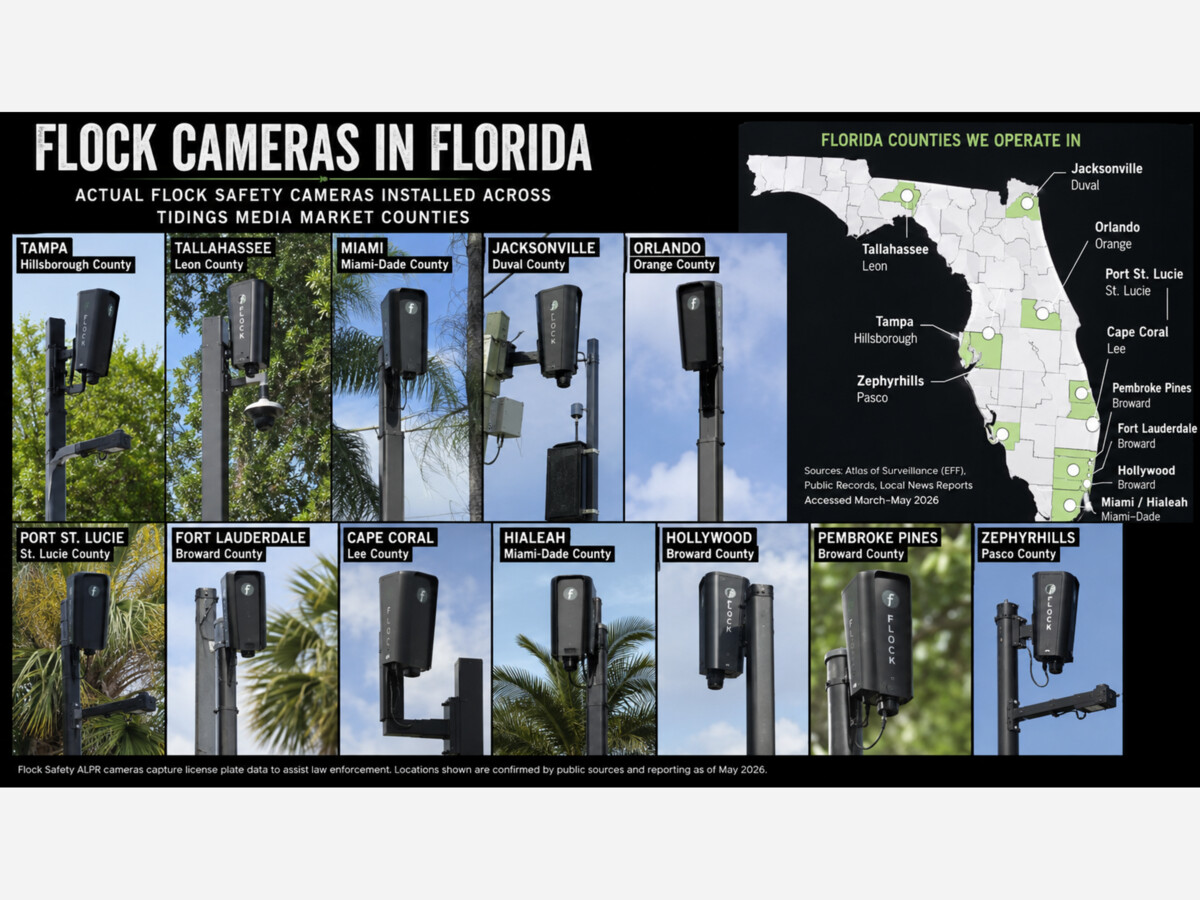
The spread of Flock and Flock-linked license plate reader systems is not limited to one county, one police department, or one region of Florida. Public surveillance trackers, local reporting, procurement records, and government references now show Flock or related automated license plate reader systems in or around many of the markets served by Tidings Media.
This does not mean every city has the same vendor, the same number of cameras, the same policies, or the same level of public transparency. In several markets, public sources confirm county-level or nearby municipal deployments while the city-specific picture still needs a direct records request.
But the pattern is clear enough to make the larger point.
Florida is not debating whether this technology might arrive someday. In many places, it is already here.
Based on public-source tracking, local reporting, procurement records, and government references reviewed by Tidings Media, Flock or Flock-linked camera systems have been confirmed in or around many of the counties where Tidings Media operates. “Confirmed” below means a public tracker, local news report, government record, procurement record, or public-budget document identifies Flock Safety technology in that city, county, sheriff’s office, or nearby county law-enforcement network.
| Tidings Market | County | Public-source Flock verification |
|---|---|---|
| Tampa | Hillsborough County | ✅ Confirmed. Public tracking identifies Flock Safety automated license plate reader activity in the Tampa Bay/Hillsborough County market. Earlier Tampa Bay reporting also described Flock’s presence across the broader region. |
| Tallahassee | Leon County | ✅ Confirmed in area tracking. Public tracking has identified Flock Safety ALPR use by agencies in the Tallahassee/Leon County area, including law enforcement and public-safety entities. Tidings should request current camera counts, access rules, and retention policies from Tallahassee Police, Leon County Sheriff, and campus/public-safety agencies. |
| Miami | Miami-Dade County | ✅ County confirmed. Public tracking identifies Flock Safety ALPR use in Miami-Dade County through county or municipal law-enforcement networks. A City of Miami-specific confirmation should still be requested directly from Miami Police. |
| Jacksonville | Duval County | ✅ Confirmed. Public tracking identifies Jacksonville/Duval County Flock Safety ALPR activity. A Jacksonville procurement record also identifies Flock Safety as the sole manufacturer and developer for Flock Flex LPR cameras and software. |
| Orlando | Orange County | ⚠️ County-area confirmed; City of Orlando vendor status still needs direct confirmation. Public reporting and surveillance tracking show license plate reader deployments across Central Florida, including the Orlando market. Tidings should request current vendor, camera count, search policy, and outside-agency access from Orlando Police and Orange County agencies. |
| Port St. Lucie | St. Lucie County | ✅ Confirmed. Public tracking identifies Port St. Lucie Police Department as operating Flock Safety automated license plate readers, with additional Flock-related activity reported in the St. Lucie County area. |
| Fort Lauderdale | Broward County | ⚠️ County confirmed; city-specific vendor status should be verified. Public tracking and local reporting identify Flock-linked systems in Broward County and nearby municipalities. Fort Lauderdale-specific vendor confirmation should be requested directly. |
| Cape Coral | Lee County | ✅ County confirmed. Public tracking identifies Lee County Sheriff’s Office Flock Safety use. Cape Coral Police-specific deployment and policy details should still be requested directly from the city. |
| Hialeah | Miami-Dade County | ✅ County confirmed; city-specific confirmation pending. Public tracking confirms Flock Safety ALPRs in Miami-Dade County through county and municipal deployments, but reviewed sources did not independently confirm a Hialeah Police Department Flock deployment. |
| Hollywood | Broward County | ✅ Confirmed. Public tracking and local references identify Hollywood Police Department Flock Safety ALPR activity, including a reported purchase of 60 Flock Safety ALPRs. |
| Pembroke Pines | Broward County | ⚠️ Flock-linked evidence found; city-specific installation should be verified directly. Public and local surveillance-tracking sources have reported Pembroke Pines expenditures or Flock-platform integration claims, but reviewed results also show other ALPR vendors in use. A direct city records request is needed before calling it fully confirmed. |
| Zephyrhills | Pasco County | ⚠️ Budget evidence found; installation should be verified directly. A City of Zephyrhills budget reference reportedly includes “Flock Safety Falcon System (6)” and a license plate reader service agreement. Tidings should request the current contract, installation map, retention policy, and data-sharing rules before calling the system fully installed. |
This checklist is not the end of the reporting. It is the beginning.
The next questions are local and specific. How many cameras are installed? Who approved them? Which roads are covered? What data is retained? Which agencies can search it? Are searches audited? Can outside agencies access the information? Can federal agencies access it? Do private cameras feed public systems? Are elected officials receiving reports? Are citizens allowed to see meaningful aggregate data? What happens when a search is improper?
Those are not hostile questions. They are self-government questions.
The debate has already surfaced in Hernando County, where residents raised concerns about Flock cameras installed along county roads. Spectrum News reported that the Hernando County Sheriff’s Office had begun installing Flock license plate recognition cameras about a year earlier, with the stated goal of helping solve crime.[4]
Some residents objected that they had not meaningfully consented to the cameras and could not opt out. The sheriff’s office defended the system, saying the cameras do not use facial recognition, that they capture still images of vehicles in public areas, and that data is stored for 30 days before deletion.[4]
That answer may sound reassuring. It should not end the debate.
Facial recognition is not the only form of surveillance that matters. A system does not need to identify a face to track a car. It does not need to know a person’s name at the moment of collection to become useful later. It does not need to be abused today to create an abuse risk tomorrow.
The deeper question is not whether one sheriff’s office says it is using the system properly. The deeper question is what hard limits exist when a future sheriff, police chief, city manager, federal agency, contractor, or private partner wants to use the system more aggressively.
Conservatives should be especially alert to this problem. Power should not be trusted simply because the current officeholder seems reasonable. Power should be limited because future officeholders may not be.
Recent Florida reporting has connected Flock license plate reader systems to immigration-related searches. Suncoast Searchlight reported that Florida Highway Patrol troopers ran more than 250 immigration-related searches using Flock’s automatic license plate reader system during a period tied to a major federal-state immigration operation.[5] Other reporting has described the broader concern that Florida agencies have used Flock license plate camera systems for immigration-related purposes.[6]
Some conservatives may not object to that use. Florida has taken a hard line on illegal immigration, and many voters support aggressive enforcement.
But the civil-liberties issue is larger than immigration.
A surveillance system should not be judged only by whether the current target is politically popular. The same architecture that can identify a vehicle connected to immigration enforcement can identify vehicles near a church, gun show, campaign event, school board meeting, protest, pregnancy center, medical clinic, addiction treatment center, courthouse, union meeting, or journalist’s source.
That does not mean every agency is abusing the system. It means the machinery exists.
Free societies do not protect liberty by trusting that surveillance tools will always be used in popular ways. They protect liberty by drawing hard limits before the tools are turned toward unpopular people, unpopular causes, or ordinary citizens who were never suspected of a crime.
The risk is not only privacy. Accuracy matters too.
Business Insider reported in 2026 on cases in which automated license plate reader systems were tied to mistaken or high-risk police stops after plate misreads or bad alerts. The publication reported on misidentified plates that led to false arrests, traumatic stops, and police encounters involving innocent people.[7]
A camera error is not just a software issue when it causes a family to be stopped at gunpoint, a person to be jailed, or a police officer to approach a vehicle as if a dangerous criminal is inside.
If Florida agencies rely on automated plate readers, they should be required to verify hits before enforcement action, document verification procedures, audit mistakes, report false positives, and disclose how often alerts lead to stops.
Citizens should not be asked to trust a black-box system without knowing how often it is wrong or what happens when it fails.
The weakest response to surveillance concerns is the familiar line: if you have nothing to hide, you have nothing to worry about.
That is not a conservative argument. It is not a constitutional argument. It is not an American argument.
The Fourth Amendment was not written because the Founders wanted to protect criminals. It was written because government power must be limited even when government claims to be acting for good reasons. Privacy is not an admission of guilt. Movement is not suspicion. Driving to work, church, school, a doctor, a pharmacy, the beach, a lawyer’s office, or a county meeting should not automatically create a searchable record that can be retained, queried, or shared without serious oversight.
Florida has branded itself as the Free State of Florida. That promise should mean more than low taxes and fewer mandates. It should also mean the state does not allow a vehicle-tracking grid to grow across public roads and private spaces without a full public debate.
A free state should not have to choose between catching criminals and protecting innocent citizens from unnecessary monitoring. It can do both, but only if the rules are written before the network becomes too entrenched to challenge.
The most durable surveillance systems are not always imposed by force. They are often accepted by convenience.
A sheriff gets a useful tool. A police department gets faster alerts. A homeowners association gets a safety pitch. A business district gets a camera package. A school gets another security layer. A city gets a grant. A county gets a contract. Each decision is defended as narrow, practical, and local.
Then the systems connect.
The cameras become searchable. The searches become routine. The data becomes normal. The vendor platform improves. Outside agencies ask for access. A dashboard becomes easier to use. A narrow crime-fighting tool becomes part of the daily operating environment.
Eventually, the public is told the cameras have always been there.
That is how a free society can become a watched society without ever holding a clear vote on whether it wanted to become one.
The danger is not that every Flock camera is illegitimate. The danger is not that every police department is acting in bad faith. The danger is not that every public safety justification is false.
The danger is that the infrastructure can grow faster than the rules, and that citizens may not discover the true scale of the network until it is politically, financially, and operationally difficult to unwind.
Every Florida city, county, sheriff’s office, police department, school district, business district, apartment complex, and homeowners association using or considering Flock or similar technology should be required to answer specific questions in public.
Who approved the cameras? Where are they located? Who can search the data? How often are searches conducted? Are searches tied to specific investigations? Can outside agencies access the system? Can federal agencies access it? Can private cameras be searched by law enforcement? How long is data retained? Are improper searches reported? Are elected officials reviewing usage? Are audit logs available in meaningful form? What happens when the technology misreads a plate? What happens when a future agency wants to use the system for a purpose never discussed when the cameras were installed?
Florida should require public votes before deployment, written use policies, short retention periods for non-investigative data, independent audits, public aggregate reporting, strong verification requirements before enforcement action, disclosure of outside-agency access, and penalties for misuse.
The state should also draw a bright line around constitutionally sensitive activity. License plate readers should not become tools for monitoring political gatherings, religious services, lawful protests, gun-related events, medical visits, legal consultations, school board participation, or civic activity.
If a camera hit is tied to a serious criminal investigation, use it.
If the system is being used to map the habits of ordinary Floridians, stop it.
That distinction should not be controversial in a free state.
Flock may help solve crimes. That should be acknowledged honestly. But useful technology can still be dangerous technology.
A system that helps recover a stolen vehicle can also create a searchable record of innocent people’s movements. A database created for public safety can become irresistible to agencies, investigators, contractors, prosecutors, politicians, private actors, and bad insiders who discover how much information it contains.
The issue is not whether Florida should fight crime. Of course it should.
The issue is whether Florida can fight crime without building a permanent record of where ordinary people go.
That is the danger hidden beneath the safety pitch. Once vehicle-location data is collected, indexed, shared, and made searchable, it becomes more than evidence. It becomes power. It can reveal patterns, associations, routines, beliefs, vulnerabilities, and private choices. It can be used properly by honest people, but it can also be misused by dishonest people. It can solve a crime, but it can also chill lawful behavior. It can help a sheriff today and tempt a bureaucrat tomorrow.
Florida should not accept that risk casually.
The state does not need to choose between public safety and civil liberty. It can support law enforcement while refusing to let public roads become a passive tracking network for innocent citizens. It can allow targeted searches for serious crimes while rejecting open-ended surveillance, casual data sharing, weak retention rules, secret access by outside agencies, and the quiet normalization of movement tracking.
Big Brother does not need to kick down the door anymore. In Florida, he may only need a permit, a pole, a solar panel, a cloud dashboard, and a friendly name.
Flock.
Tidings Media will continue to watch the watchers. As these cameras appear across Florida, we will keep following where they are installed, who approves them, how the data is used, which agencies get access, and whether local officials are asking the questions citizens deserve to have answered.
Florida should not become a surveillance state by contract, convenience, or silence.
Tidings Media provides local and statewide Florida news, civic coverage, community stories, weather updates, practical public-interest reporting, and curated local information for readers across Tampa, Tallahassee, Miami, Jacksonville, Orlando, Port St. Lucie, Fort Lauderdale, Cape Coral, Hialeah, Hollywood, Pembroke Pines, Zephyrhills, and surrounding communities.
Stay connected with Tidings Media: Subscribe free at tidings.town.news for local headlines, weather alerts, civic updates, practical Florida news, and community stories without the clutter.
Subscribe to Tidings.Town.News for free
[1] Flock Safety, company and product materials describing searchable evidence across locations and time, vehicle searches by time and location, cross-agency visibility, audit-ready use, and marketing to public safety agencies, communities, and businesses.
[2] Florida Statutes § 316.0778, defining automated license plate recognition systems as high-speed cameras combined with computer algorithms that convert license plate images into computer-readable data, and requiring a records-retention schedule for generated images and data.
[3] Florida Statutes § 316.0777 and Florida Department of Transportation guidance governing placement of automated license plate recognition systems on state highway rights-of-way, including permit and removal rules.
[4] Spectrum News / Bay News 9, “Hernando County residents concerned about Flock cameras,” reporting resident concerns and the Hernando County Sheriff’s Office’s explanation of the system, including no facial recognition and a stated 30-day retention policy.
[5] Suncoast Searchlight, “Florida troopers tapped surveillance network for immigrant searches,” reporting that Florida Highway Patrol troopers ran more than 250 immigration-related searches using Flock’s ALPR system during Operation Tidal Wave.
[6] Government Technology / Bradenton Herald reporting on Florida Highway Patrol use of a private surveillance network for immigration-related plate searches.
[7] Business Insider, “AI cameras are everywhere — and people are paying the price for their mistakes,” reporting on mistaken ALPR-related stops, false positives, and documented concerns over verification procedures.
[8] Atlas of Surveillance, Electronic Frontier Foundation and Reynolds School of Journalism project, public tracker entries for Flock Safety and automated license plate reader deployments in Florida markets including Hillsborough County, Jacksonville/Duval County, Port St. Lucie/St. Lucie County, Miami-Dade municipalities, Broward County municipalities, and other Florida agencies.
[9] HigherGov procurement record, “JSO-ISM-Flock Flex LPR Cameras,” identifying Flock Safety as the sole manufacturer and developer of required LPR cameras and software for Jacksonville Sheriff’s Office procurement.
[10] Tampa Bay, Central Florida, and South Florida reporting and public surveillance-tracking projects documenting license plate reader deployments across Florida communities, with city-specific vendor confirmation still needed where noted.

Light rain shower, with a high of 89 and low of 74 degrees. Overcast in the morning, light rain shower in the afternoon, overcast overnight.