Image




Florida does not have a state property tax. That distinction matters.
The fight now building toward the November 2026 ballot is not about Tallahassee collecting a statewide property tax from homeowners. It is about local property taxes — especially the non-school ad valorem taxes levied by counties, cities and special districts — and whether Florida homeowners should get far more protection from a system that has become a cash machine for local government.
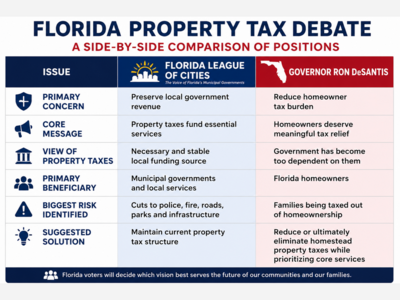
Gov. Ron DeSantis has put the issue in blunt terms. In announcing his “Save Our Homes from Excessive Property Taxes” proposal, DeSantis said the plan would “eliminate taxes on homesteads” and argued that local property tax revenue “has nearly doubled in the past seven years.” He warned that local property tax revenue is expected to reach $83 billion by 2032 unless Florida changes course.[1]
The counties should not pretend they are innocent bystanders.
Across major Florida counties covered by Tidings Media, county government operating ad valorem levies have climbed sharply since 2020. In several counties, the increase in county property tax collections has been five, six, ten or even twenty times larger than population growth.
That is not simply growth paying for growth. That is local government feasting on inflated property values.
“Ad valorem” means “according to value.” In property taxes, the government taxes real estate based on taxable value after exemptions. A millage rate is then applied to that taxable value. One mill equals $1 in tax for every $1,000 of taxable value.[2]
That is why local officials can say they did not dramatically raise the tax rate while still collecting far more money. If taxable property values rise, the same millage rate can produce a bigger tax bill and a bigger government haul.
This is the part homeowners understand instinctively. They do not care whether the pain came from a higher rate, a higher assessment or some budget-room sleight of hand. They care that the bill went up.
The DeSantis-backed constitutional amendment is headed to Florida voters in November 2026. The proposal would expand the homestead exemption for non-school property taxes, raising it to $150,000 in 2027 and then $250,000 in 2028. School taxes would remain outside the exemption. Because it is a constitutional amendment, it must receive 60% voter approval to pass.[3]
That is not an immediate repeal of every property tax bill in Florida. But it would be a major reduction in non-school property taxes for homesteaded homeowners and a direct challenge to the local-government revenue model that has grown fat since 2020.
County commissions will warn about consequences. Some of those warnings will be legitimate. Police, fire, infrastructure, emergency services, parks, libraries and basic government operations all cost money.
But the warnings would be easier to take seriously if counties had shown more discipline when the tax base was exploding.
The chart below uses county government operating ad valorem levies only. It does not include city levies, school board levies, independent special districts or broader combined property tax totals. This is the cleaner county-government comparison.
| Rank | County | 2020 County Ad Valorem Levy | 2025 County Ad Valorem Levy | 5-Year Increase | Population Change, 2020–2025 |
|---|---|---|---|---|---|
| 1 | St. Lucie | $98.8 million | $186.4 million | +88.7% | +19.7% |
| 2 | Pasco | $241.5 million | $447.9 million | +85.5% | +15.4% |
| 3 | Duval | $761.7 million | $1.276 billion | +67.6% | +8.4% |
| 4 | Miami-Dade | $1.486 billion | $2.343 billion | +57.7% | +4.2% |
| 5 | Broward | $1.152 billion | $1.806 billion | +56.7% | +2.5% |
| 6 | Lee | $361.8 million | $562.1 million | +55.4% | +10.3% |
| 7 | Hillsborough | $644.3 million | $980.3 million | +52.1% | +7.9% |
| 8 | Orange | $689.5 million | $1.042 billion | +51.2% | +7.4% |
| 9 | Leon | $154.7 million | $227.3 million | +46.9% | +4.7% |
| 10 | Pinellas | $483.9 million | $639.2 million | +32.1% | +0.8% |
The pattern is hard to ignore.
St. Lucie County’s population grew by about 19.7% from 2020 to 2025, while its county ad valorem levy rose 88.7%. Pasco County grew by about 15.4%, while its county levy rose 85.5%. Duval County grew by about 8.4%, while its county levy rose 67.6%.
Then there are the counties where the mismatch is even harder to explain away.
Broward County’s population grew by only about 2.5%, yet its county ad valorem levy rose 56.7%. Miami-Dade grew by about 4.2%, while its county levy rose 57.7%. Pinellas grew by less than 1%, while its county levy still rose 32.1%.
That is the heart of the political problem for county commissions. They can talk about growth all they want. But in county after county, the tax collections grew far faster than the population.
Because Pinellas ranks last on this chart, county officials may be tempted to point to it as proof of restraint.
They should not.
This chart measures county government operating ad valorem levies only. It is useful, but it is not the whole spending picture. Pinellas County’s overall budget has exploded.
Pinellas County’s Fiscal Year 2020 budget was reported at $2.5 billion. By Fiscal Year 2022, the county itself described its adopted budget as $2.9 billion. By Fiscal Year 2026, the county announced a full adopted budget of $4.8 billion, including $3.6 billion for core services and $1.2 billion for capital improvements.[7][8][9]
That means Pinellas’ total budget has nearly doubled since FY2020, even though the county’s population has barely moved or by some estimates, reversed and declined in population.
So no, Pinellas should not use this chart as absolution. A lower relative increase in one property-tax measure does not erase the larger budget reality. A county can cut or flatten a millage rate and still become much larger, much more expensive and much harder for taxpayers to afford.
That is exactly the kind of budget-room maneuvering that has made homeowners so skeptical.
County officials love to hide behind the language of “growth,” “service demand” and “inflation.”
Some of that is real. Inflation happened. Florida grew. Construction costs rose. Public safety costs rose. Insurance costs hit governments too.
But these increases are too large to explain away with a shrug.
County commissions had tools. They could have rolled back millage rates more aggressively. They could have restrained spending. They could have treated rising property values as a warning sign instead of a windfall. They could have told staff to live within the same reality as the families receiving the tax bills.
Instead, many counties treated the post-2020 property boom like a revenue buffet.
The budget grew. The bureaucracy adjusted. The new revenue became the new normal. Then, when homeowners started demanding relief, local governments suddenly discovered fiscal restraint — not for themselves, but for taxpayers.
The 2026 referendum will be framed by local governments as a threat to services. That argument will have power, especially in communities worried about public safety and infrastructure.
But there is another side of the argument that county officials do not want to discuss: homeowners are tired of being treated as the automatic funding source for every local-government appetite.
DeSantis did not create that anger. County budget decisions helped create it.
The governor gave the tax revolt a vehicle. County governments supplied the fuel.
If local officials want voters to reject the amendment, they will need to do more than warn about cuts. They will need to explain why county tax levies rose so much faster than county populations. They will need to explain why “holding the millage rate” was supposed to comfort homeowners whose bills kept rising. They will need to explain why Florida families were expected to absorb the insurance crisis, inflation, food costs and housing pressure while county governments kept collecting more.
That will not be an easy case to make.
For years, homeowners were told to tighten their belts. In 2026, county governments may finally be asked to do the same.
Stay connected with Tidings Media: Tidings Media offers local curated news for Tampa, Tallahassee, Miami, Jacksonville, Orlando, Port St. Lucie, Fort Lauderdale, Cape Coral, Hialeah, Hollywood, Pembroke Pines, and Zephyrhills. Subscribe free at tidings.town.news for local headlines, weather alerts, civic updates, practical Florida news, and community stories without the clutter.
[1] Florida Governor Ron DeSantis, “Governor Ron DeSantis Announces Special Session on Property Tax Relief, Unveils ‘Save Our Homes from Excessive Property Taxes’ Proposal,” May 27, 2026. https://www.flgov.com/eog/news/press/2026/governor-ron-desantis-announces-special-session-property-tax-relief-unveils-save
[2] Marion County Tax Collector, “Ad Valorem Taxes.” https://www.mariontax.com/ad-valorem
[3] Ballotpedia, “Florida Homestead Tax Exemptions, Property Assessments, and Spending Restrictions Amendment (2026).” https://ballotpedia.org/Florida_Homestead_Tax_Exemptions%2C_Property_Assessments%2C_and_Spending_Restrictions_Amendment_%282026%29
[4] Florida Department of Revenue, “County Property Tax Levy Comparison — 2021,” using the 2020 county taxes levied baseline. https://floridarevenue.com/property/dataportal/Documents/PTO%20Data%20Portal/Max%20Millage%20Compliance/Comparison-Taxes%20Levied/comp21.pdf
[5] Florida Department of Revenue, “County Property Tax Levy Comparison — 2025,” using the 2025 adopted-rate county taxes levied figure. https://floridarevenue.com/property/dataportal/Documents/PTO%20Data%20Portal/Max%20Millage%20Compliance/Comparison-Taxes%20Levied/comp25.pdf
[6] Florida Legislature Office of Economic and Demographic Research, “Florida Estimates of Population 2025,” using April 1, 2020 Census counts and April 1, 2025 county estimates. https://www.edr.state.fl.us/Content/population-demographics/data/2025_Pop_Estimates.pdf
[7] Tampa Bay Newspapers / Beacon Media, “Pinellas County passes $2.5 billion budget for FY2020,” Oct. 8, 2019. https://www.tbnweekly.com/pinellas_county/article_0618ad48-e9f8-11e9-8696-6f705d7f009c.html
[8] Pinellas County, “BCC adopts final millage rates and budgets for FY22,” Sept. 21, 2021. https://pinellas.gov/news/bcc-adopts-final-millage-rates-and-budgets-for-fy22/
[9] Pinellas County, “County Commission adopts final FY 26 budget with lower rate,” Sept. 19, 2025. https://pinellas.gov/news/county-commission-adopts-final-fy-26-budget-with-lower-rate/



Sunny, with a high of 88 and low of 72 degrees. Sunny in the morning, clear during the afternoon and evening, overcast overnight.