Image
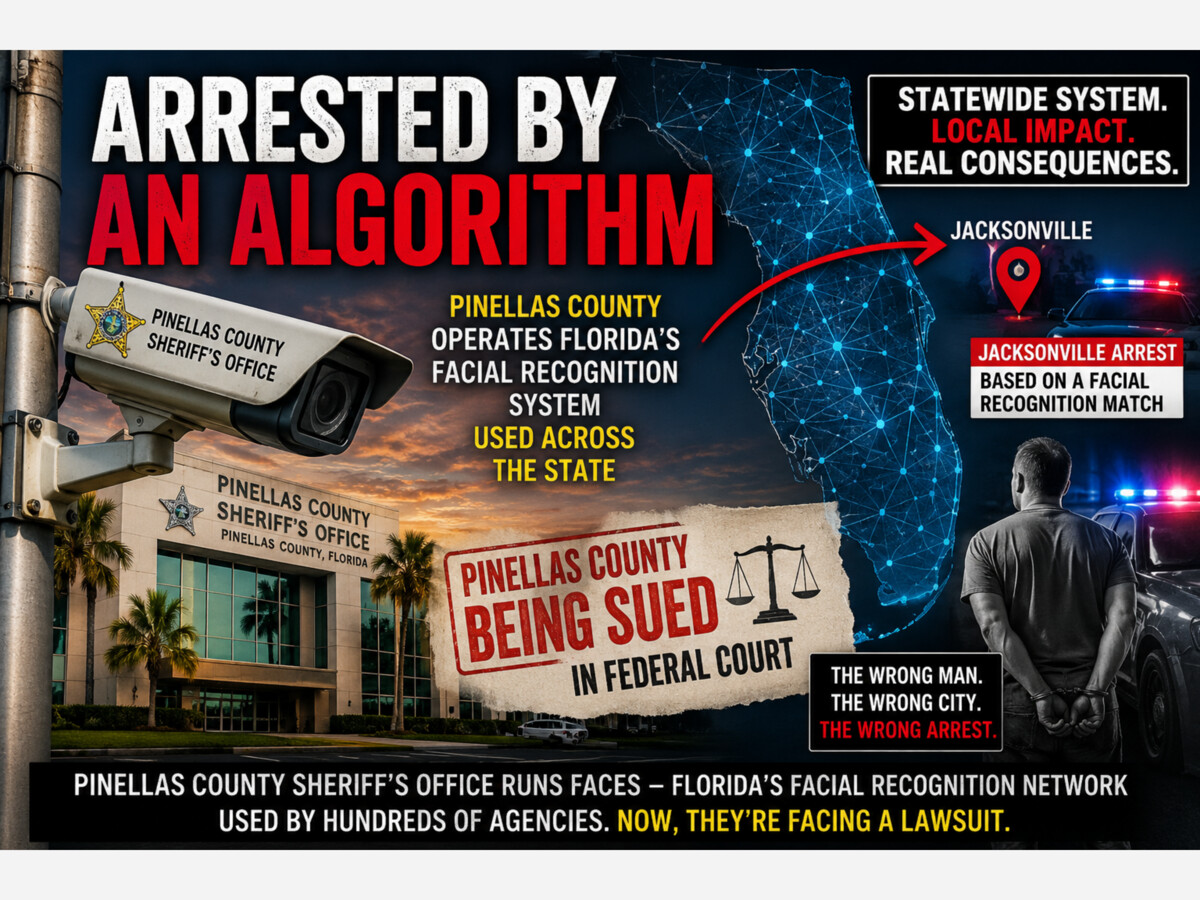



Robert Dillon says he was arrested for a crime he did not commit in a city he had never visited.
Dillon, a Fort Myers commercial crabber, has filed a federal lawsuit against the Jacksonville Beach Police Department, the Jacksonville Sheriff's Office, and Pinellas County Sheriff Bob Gualtieri in his official capacity after what the ACLU calls a faulty facial recognition match turned into an arrest warrant, a criminal case, and months of damage to an innocent man’s life.¹
The case centers on a 2023 child-luring investigation in Jacksonville Beach. According to the lawsuit, police had a suspect image from a McDonald’s surveillance-related investigation and submitted that image into FACES, Florida’s facial recognition system operated by the Pinellas County Sheriff’s Office. The system reportedly returned Dillon as a 93% match.²
That match, Dillon’s attorneys argue, was not treated as a lead to be carefully tested. It became the backbone of the case.
The lawsuit alleges Dillon lived more than 300 miles from Jacksonville Beach and had never been there. It also says investigators had information that should have raised serious doubt, including vehicle-location information and witness details suggesting the suspect was a local McDonald’s regular.³
Dillon was later arrested at his home in front of his family. Prosecutors eventually dropped the charges, but the lawsuit says the damage had already been done. The ACLU framed the case starkly, saying Dillon was arrested “for a crime he never committed in a city he’d never been to.”⁴
The defendants have not yet had a full opportunity to respond in court. But the allegations raise two related questions: whether police relied too heavily on facial recognition in a single criminal case, and whether Florida has enough oversight over the statewide facial recognition network operated from Pinellas County.
A computer match is not proof. It is not an eyewitness, a confession, GPS evidence, or independent confirmation that a suspect was at the scene of a crime. It is an investigative suggestion produced by software.
The lawsuit alleges police treated that suggestion as far more than it was.
WIRED reported that the facial recognition result came from a blurry cellphone photo and became a central part of the investigation that led to Dillon’s arrest.⁵ If true, that is the point where faulty AI becomes faulty police work. A bad algorithmic match can point investigators in the wrong direction. But only officers, supervisors, prosecutors, and courts can turn that lead into an arrest.
In practical terms, investigators can submit a “probe” photo — an image of an unknown person — into the system. The Pinellas operated software then compares that image against galleries of known images, including driver’s license photos, identification-card photos, and law-enforcement images. The system returns possible matches based on algorithmic similarity.
That does not mean the system “knows” who the person is. It means the software has produced a possible match.
That distinction is at the center of Dillon’s lawsuit.
That makes the Pinellas County Sheriff’s Office more than a bystander.
The safest way to describe Pinellas’ role is that the agency operates, maintains, hosts, and provides access to FACES/FACESNXT for law enforcement use. “Owns” may be close in ordinary conversation, but without procurement records or formal ownership documents, “operates and maintains” is cleaner for publication. We now have to figure out what entity or individuals own this massive surveillance network.
FACES is not a small local tool used only inside Pinellas County. It is one of the oldest law-enforcement facial recognition systems in the country. WIRED reported that the Pinellas County Sheriff’s Office has operated it since 2001.⁷ Who owns it? Where does the revenue come from, and are county employees running it? Who pays for the technology, and what do the counties pay to Pinellas? Where is the revenue recognized? Who gets a cut?
Older Pinellas materials describe the program as grant-funded in its early development and identify FACES as part of a statewide facial-recognition partnership. A 2014 Pinellas presentation said the sheriff’s office administered FACES, granted access to authorized trained users, and provided law-enforcement training. It also said the system was available through Florida’s Criminal Justice Network and had more than 1,500 Florida law-enforcement users at that time.⁸ Are these subscribers? How is this funded? Where is the cash flowing to and from?
That history matters because a system operated from Pinellas County can influence arrests far beyond Pinellas County. In this case, it also created potential financial liability for the Pinellas County residents when the system backfires, and Pinellas County Government faces a gigantic lawsuit.
Public materials and surveillance databases describe FACES as a network connected to millions of driver’s license photos, mugshot images, and law-enforcement records. The Electronic Frontier Foundation’s Atlas of Surveillance identifies the Pinellas County Sheriff’s Office as the agency associated with face recognition through FACES.⁹
That raises a financial and operational question Tidings Media is now pursuing: Are Pinellas County employees administering, maintaining, auditing, training users on, or otherwise staffing a statewide law-enforcement facial recognition system? If so, how is that staff time funded? If outside agencies pay for access, where is the revenue recognized? If they do not pay, are Pinellas County taxpayers subsidizing a system used by agencies across Florida?
The Guardian reported that Pinellas “leases” FACES to other law enforcement agencies.¹⁰ That reporting raises an obvious question: if agencies are paying for FACES access, where is that money booked in Pinellas County or sheriff’s office financial records?
Tidings Media could not confirm an annual revenue number from public sources. It's not reported at a surface level that you could Google.
At least one public MOU reviewed by Tidings Media — the Winter Springs agreement — does not list a subscription price, license fee, or per-search charge. Instead, it describes a partner-access model. Agencies receive access after agreeing to rules involving training, audits, user controls, use limitations, liability language, and data-sharing responsibilities.¹¹
That does not resolve the issue. It deepens it. Where is the money flow?
If there are paid agreements, they should be disclosed. If the system is funded through grants, interlocal agreements, sheriff’s office funds, or county taxpayer dollars, the public should be able to see that. If the benefit flows statewide, the cost and risk should not be hidden inside vague budget categories.
Tidings Media has submitted a public records request to the Pinellas County Sheriff’s Office seeking records related to FACES staffing, funding, revenue, contracts, interlocal agreements, invoices, grants, audits, search volumes, outside-agency participation, and any budget line items connected to FACES, FACESNXT, or Florida’s Facial Recognition Network.
Those records should answer basic questions the public has a right to ask.
How many sheriff’s office employees are assigned to FACES, FACESNXT, or FR-Net? Are county employees merely maintaining the software, or are they also administering searches, reviewing results, onboarding users, providing training, and auditing outside agencies? What does the system cost to operate each year? Does Pinellas receive payments from outside law-enforcement agencies? If so, how much, from whom, and where is the revenue recognized? How many agencies have access? How many searches are run each year? How often are matches later determined to be wrong? The Sheriff of Pinellas County has a ton of questions to answer here. This likely should be researched at the State level.
These are not minor accounting questions. In Dillon’s case, a match from a Pinellas-operated system allegedly helped set in motion an arrest in a city on the other side of the state. If that system is being used statewide, then statewide accountability should follow.
Police departments often defend facial recognition by saying it is only an investigative lead. That defense only works if officers treat it that way.
Some Florida law-enforcement policies say exactly that. A St. Petersburg Police Department policy says a positive facial recognition search result alone does not constitute probable cause for arrest.¹² A New Smyrna Beach Police Department policy similarly says law-enforcement action based on a FACESNXT submission must be based on an officer’s own identity determination and not solely on the results of a FACESNXT search.¹³
The lawsuit alleges that safeguard failed.
That is where the Dillon case becomes larger than one mistake. Facial recognition systems are often presented as neutral technology. But in real criminal cases, a bad match can become powerful once it appears in a police file, an affidavit, or a warrant application. Investigators may begin searching for evidence that confirms the machine instead of testing whether the machine was wrong.
That problem is sometimes called automation bias. In plain English, it means people can over-trust a computer answer because it looks scientific.
In policing, that can be dangerous.
A blurry photo, poor lighting, a partial face, the wrong angle, or a low-quality surveillance image can all make facial recognition less reliable. If officers then fail to independently verify the result, the technology can become a shortcut around traditional police work.
The Guardian reported that Dillon’s lawsuit accuses law enforcement of relying on flawed AI and omitting crucial exculpatory evidence, including vehicle-location data and issues with the image quality used in the facial recognition search.¹⁴
That is the core allegation: not merely that the machine was wrong, but that police had reasons to question the machine and did not do enough.
The ACLU says Dillon’s case is part of a national pattern of wrongful arrests and prosecutions connected to facial recognition technology. CBS News reported that the lawsuit describes police as letting “an error-prone artificial intelligence system stand in for an investigation.”¹⁵
The known number of wrongful arrests linked to facial recognition remains relatively small compared with the total number of police investigations, but that does not make the risk small for the person on the receiving end. A single false match can mean arrest, booking, public humiliation, legal bills, lost work, family trauma, and a permanent online trail that may outlive the dropped charges.
The case also raises a disclosure problem. If facial recognition is used to generate a suspect, defendants, defense attorneys, prosecutors, and judges should know that. If the technology was used but minimized or omitted, the court may not understand how the suspect was identified or what weaknesses exist in the case.
Florida lawmakers and local governments should now ask whether facial recognition can be used to support an arrest warrant without independent evidence tying the suspect to the crime. They should ask whether agencies must disclose facial recognition use in police reports, warrant applications, charging documents, and discovery. They should ask whether agencies should publish annual reports showing how often FACES is used, by whom, for what crimes, and with what results.
Pinellas County has an additional responsibility because its sheriff’s office operates the system at the center of the case. In this case, it has created potential financial jeopardy that could impact negatively the taxpayers in Pinellas County. Residents should know how the network is funded, who staffs it, what outside agencies have access, what audits are performed, and whether false matches are tracked.
Dillon’s lawsuit is still pending, and the defendants will have the opportunity to respond in court. But the case has already exposed a larger public concern. Florida has a facial recognition network operated from Pinellas County, used by law enforcement agencies beyond Pinellas County, and powerful enough that a bad match allegedly helped put the wrong man in handcuffs.
A machine did not arrest Robert Dillon. People did.
But if the machine pointed police to the wrong man, and if police failed to independently verify that lead, then every agency involved owes the public answers.
Tidings Media will update this story when the Pinellas County Sheriff’s Office responds to the public records request.
Stay connected with Tidings Media: Tidings Media offers local curated news for Tampa, Tallahassee, Miami, Jacksonville, Orlando, Port St. Lucie, Fort Lauderdale, Cape Coral, Hialeah, Hollywood, Pembroke Pines, and Zephyrhills. Subscribe free at tidings.town.news for local headlines, weather alerts, civic updates, practical Florida news, and community stories without the clutter.


Sunny, with a high of 81 and low of 63 degrees. Sunny in the morning, clear for the afternoon and evening,