62° and Clear
Image



The Tampa Bay Rays’ latest stadium plan may be about baseball on paper, but it is quickly becoming a test case for something much larger: whether local governments can still justify massive public stadium commitments in the middle of Florida’s property tax revolt.
The proposed deal calls for a new $2.3 billion ballpark on the Hillsborough College Dale Mabry campus in Tampa, near Raymond James Stadium and Steinbrenner Field. Under the current framework, the Rays would contribute roughly $1.27 billion and cover construction cost overruns, while public contributions from Hillsborough County and the City of Tampa would be capped at about $976 million.[1]
That number is the political problem.
At almost the same moment Tampa and Hillsborough leaders are being asked to keep the Rays in Tampa Bay with one of the largest public stadium commitments in Florida history, voters are being asked to decide whether cities and counties should have less property tax money to spend in the first place.
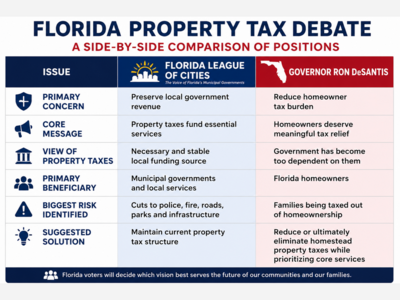
The Florida Legislature has placed a proposed constitutional amendment on the November 2026 ballot that would increase the homestead exemption on non-school property taxes. If approved by 60 percent of voters, the exemption would rise to $150,000 in 2027 and $250,000 in 2028 for eligible Florida homeowners. The proposal would also limit increases in assessed value for non-homestead property by reducing the current 10 percent cap to 5 percent.[2]
Supporters of the tax proposal argue that Florida homeowners have been squeezed by rising property taxes, insurance costs and local government spending. Gov. Ron DeSantis has framed the effort as a major property tax cut for homeowners, with his office saying the proposal would exempt the first $250,000 of a homestead’s value from taxation and require local governments to focus remaining property tax revenue on core needs.[3]
But the stadium debate exposes the collision between two visions of local government.
One vision says local governments should tighten their belts, lower the burden on residents and prioritize basic services such as public safety, roads, drainage, infrastructure and emergency response. The other says that public money can still be used for large economic development plays, including stadiums, entertainment districts and redevelopment projects, if elected officials believe the long-term return justifies the investment.
The Rays deal now sits directly in the middle of that argument.
Hillsborough County commissioners approved a nonbinding memorandum of understanding in May by a 5-2 vote. Tampa City Council also approved the nonbinding framework by a narrow 4-3 vote. Those votes did not finalize the stadium deal, but they authorized staff and officials to keep negotiating toward binding agreements.[4]
The public contribution would rely on a mix of tax-backed tools, including county funds, city funds, tourism development tax revenue, community investment tax revenue and redevelopment mechanisms tied to the Drew Park area. The memorandum of understanding says the public contribution for the new ballpark project would not exceed $976,024,522, plus certain interest and investment earnings.[5]
That is why the property tax amendment matters even if the stadium money is not coming directly from a homeowner’s annual tax bill.
Public budgets are connected. When one revenue source is reduced, pressure often shifts elsewhere. If Florida voters approve a major reduction in non-school property tax collections, local governments will face harder choices about debt, capital projects, emergency services, infrastructure and optional economic development spending.
The timing could not be more awkward for stadium supporters.
Tampa and Hillsborough County are not debating this project in a vacuum. Hillsborough already has obligations tied to existing sports facilities, including Raymond James Stadium. The Tampa Sports Authority has reportedly emphasized that Raymond James Stadium remains a priority as local officials weigh the Rays project.[6]
Meanwhile, Tampa’s Community Redevelopment Agency board has delayed a vote on a related nonbinding stadium agreement until August, a sign that even after earlier approvals, the political path remains uncertain.[7]
The Rays and their supporters are making the familiar argument that a new ballpark is not just about baseball. They argue the stadium could anchor a larger mixed-use district, redevelop part of the Hillsborough College campus, keep Major League Baseball in Tampa Bay, and generate long-term economic activity. Rays CEO Ken Babby has described the proposal as a “Forever Home” ballpark and part of a broader transformation for the region.[8]
That may be the sales pitch. But for taxpayers, the issue is simpler.
If local governments are warning that property tax cuts could endanger services, they will have a harder time explaining why nearly $1 billion in public stadium participation is still affordable. If local governments say the stadium money comes from different buckets, voters may reasonably ask why government has so many buckets for stadiums but never enough buckets for tax relief.
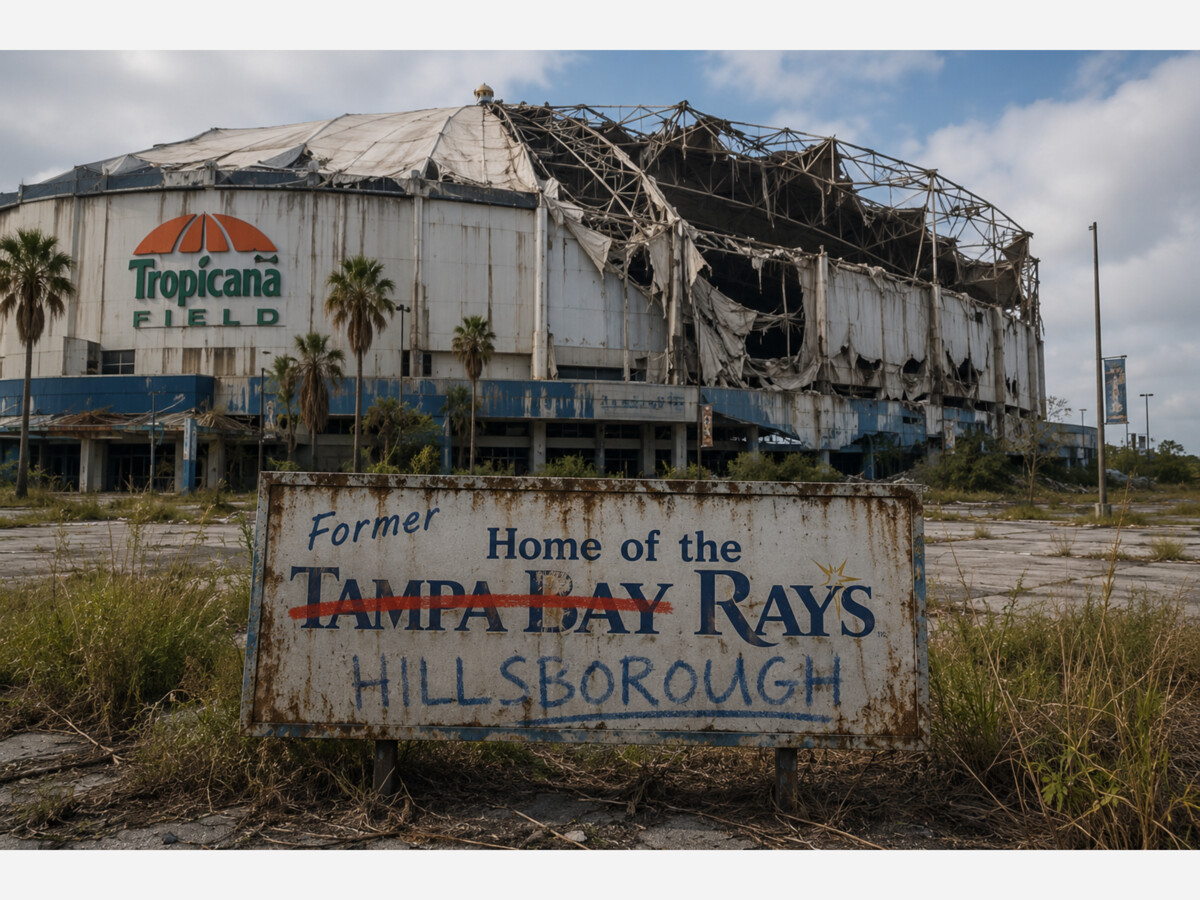
The stadium debate is also unfolding after the Rays’ previous stadium plan in St. Petersburg collapsed. Pinellas County and St. Petersburg had approved public financing for a new stadium and redevelopment project around Tropicana Field, but that agreement unraveled after delays, hurricane damage to the Tropicana Field roof and shifting political conditions.[9]
Now the team’s future has moved across the bay into a new political climate.
The old stadium argument was local: Where should the Rays play? St. Petersburg? Tampa? Somewhere else?
The new argument is statewide: In a Florida where homeowners are being asked whether local government has grown too expensive, should local taxpayers still be used as financial partners in professional sports deals?
That question will not be answered only by baseball fans. It will be answered by voters, taxpayers, commissioners, council members and state lawmakers who are all staring at the same contradiction.
Florida’s leaders cannot say, on one hand, that homeowners desperately need property tax relief because local government spending has become too heavy, and then say, on the other hand, that nearly $1 billion in public participation for a baseball stadium is just another routine economic development project.
The Rays may ultimately get their new stadium. Tampa Bay may keep its Major League Baseball team. The project may even deliver some of the redevelopment benefits supporters are promising.
But the politics have changed.
In 2026 Florida, every major public spending decision is now being judged against the property tax question. The Rays stadium deal is no longer just about baseball. It is about whether government can still ask taxpayers for patience while offering sports franchises urgency.
And in a year when Florida voters may be preparing to tell local governments to live with less, that may be the hardest sell of all.
Stay connected with Tidings Media: Tidings Media offers local curated news for Tampa, Tallahassee, Miami, Jacksonville, Orlando, Port St. Lucie, Fort Lauderdale, Cape Coral, Hialeah, Hollywood, Pembroke Pines, and Zephyrhills. Subscribe free at tidings.town.news for local headlines, weather alerts, civic updates, practical Florida news, and community stories without the clutter.
Footnotes
[1] MLB.com, “City, county approve non-binding deal for Rays’ new ballpark proposal,” May 2026; Associated Press, “Tampa Bay Rays and local officials announce a tentative $2.3B deal for a new ballpark,” May 14, 2026.
[2] Florida Senate, “Senate Passes Historic $250,000 Property Tax Cut for Florida Homeowners,” June 2, 2026; Florida Realtors, “Property tax amendment heads to voters,” June 2026.
[3] Office of Gov. Ron DeSantis, “Governor Ron DeSantis Announces Special Session on Property Tax Relief, Unveils SAVE Florida Plan,” May 27, 2026.
[4] WUSF, “Hillsborough commission passes Rays stadium agreement,” May 20, 2026; MLB.com, “City, county approve non-binding deal for Rays’ new ballpark proposal,” May 2026.
[5] Non-binding Memorandum of Understanding Regarding New Stadium Project and Outline of Future Project Agreements, Rays Baseball Club, City of Tampa, Hillsborough County and related parties, 2026.
[6] WUSF, “Rays’ stadium proposal feels pinch of state property tax vote, Bucs renovations,” June 3, 2026.
[7] Spectrum Bay News 9, “Tampa City Council pushes back Rays stadium vote to August,” June 11, 2026.
[8] MLB.com, “City, county approve non-binding deal for Rays’ new ballpark proposal,” May 2026.
[9] Construction Dive, “Rays exit $1.3B stadium deal,” March 13, 2025.

Sunny, with a high of 80 and low of 61 degrees. Sunny in the morning, clear in the afternoon and evening,