Image



Florida homeowners are now in hurricane season, and one of the most expensive misunderstandings in the state is still sitting in plain sight.
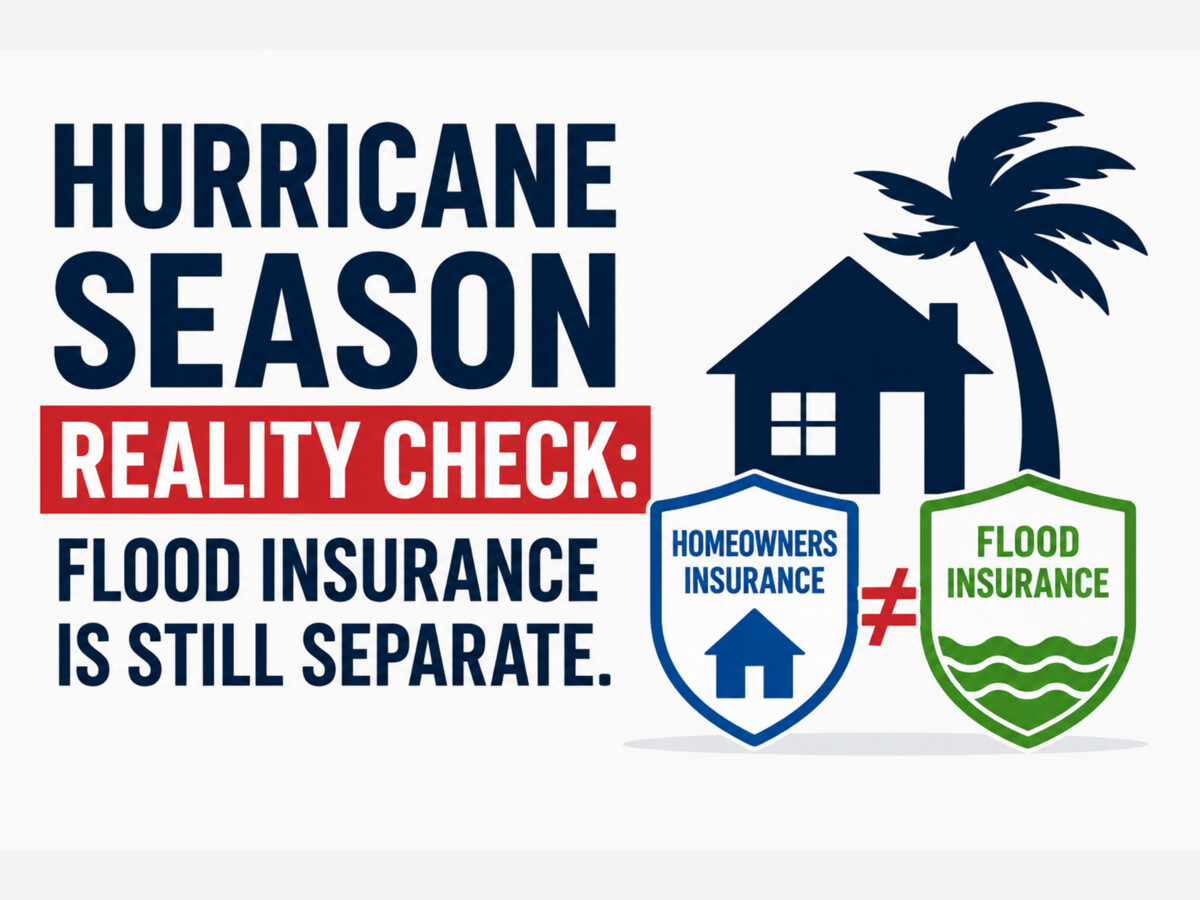
A homeowners insurance policy is not the same thing as flood insurance.
That sounds simple, but after every major storm, Floridians learn the hard way that hurricane damage can be split into different insurance categories. Wind damage may fall under a homeowners policy. Flood damage usually does not. Storm surge, rising water, overflowing canals, street flooding and water entering from the ground up are typically flood problems, not standard homeowners insurance problems.
The Florida Office of Insurance Regulation says it plainly: “Flood damages are not typically covered in a homeowners’ insurance policy and flood coverage must be purchased separately or as an endorsement to their current policy.” The agency also warns that even a small amount of water in a home can be very costly.[1]
FEMA gives the same warning at the federal level. “Most homeowners insurance does not cover flood damage,” FEMA says. “Flood insurance is a separate policy that can cover buildings, the contents in a building, or both.”[2]
That distinction matters across Florida, not just on the beach.
A homeowner in Tampa Bay may worry about storm surge. A homeowner in Port St. Lucie may worry about canal flooding or heavy rain. A homeowner in Orlando may be miles from the coast but still face neighborhood flooding from a slow-moving tropical system. A homeowner in Jacksonville, Tallahassee, Cape Coral, Hialeah, Hollywood, Pembroke Pines or Zephyrhills may not think of the property as “coastal,” but heavy rain and drainage failure can still flood a home.
The National Hurricane Center warns that storm surge can travel several miles inland, especially along bays, rivers and estuaries. NOAA also explains that storm surge is water pushed toward shore by the winds of a hurricane or tropical storm, and that rise in water level can cause severe flooding in coastal areas.[3]
But storm surge is not the only flood threat. Hurricanes and tropical storms can dump extreme rainfall far from landfall. Water does not care whether a house is in a mandatory evacuation zone, a FEMA high-risk flood zone, or a neighborhood where nobody has flooded before.
That is why the “I’m not in a flood zone” argument can be dangerous. In insurance terms, every property is in some kind of flood zone. Some are high-risk zones. Some are lower-risk zones. But lower risk does not mean no risk.
The Florida Department of Financial Services says Florida law does not require every homeowner to carry flood insurance, although a lender may require it if the property has a mortgage and is in a higher-risk flood area. The department also notes that a flood policy is usually separate from homeowners coverage, though some private homeowners insurance companies may offer flood coverage as an endorsement.[4]
For many Florida families, that creates a dangerous gap.
A homeowner may have a mortgage, homeowners insurance, a hurricane deductible and even windstorm coverage, but still have no flood coverage. After a storm, that homeowner may discover that the most expensive part of the damage — the water line on the wall, ruined flooring, soaked cabinets, mold, appliances and contents — is not covered by the policy they thought would protect them.
This is where the hurricane deductible can also confuse people.
Florida’s Chief Financial Officer explains that insurance companies must offer hurricane deductible options, and that the deductible must be listed as a dollar amount even if it is based on a percentage of the policy limits.[5] But a hurricane deductible does not magically turn a homeowners policy into a flood policy. It applies to covered hurricane damage under that policy. If the loss is excluded because it is flood damage, the deductible is not the issue. The missing coverage is.
For homeowners, the practical step is not to guess. Pull out the policy. Ask the agent directly.
The question should be blunt: “Do I have flood coverage, and if so, is it through the National Flood Insurance Program, a private flood policy or an endorsement on my homeowners policy?”
Then ask the follow-up questions: What is the building limit? What is the contents limit? Is there a waiting period? Are temporary living expenses covered? What is excluded? Does the policy cover storm surge? Does it cover water entering from heavy rain or rising water? Does it cover detached structures? Is the coverage enough to rebuild or only enough to satisfy the mortgage lender?
Those questions matter because National Flood Insurance Program policies generally have separate building and contents limits. Private flood policies may offer different limits or features. Some endorsements may not be as broad as a separate flood policy. A homeowner should not assume all flood coverage is the same.
Timing also matters. Flood insurance is not something to buy when a named storm is already in the Gulf or moving toward Florida. FEMA’s National Flood Insurance Program generally has a waiting period before coverage takes effect, with limited exceptions.[6] Private flood policies may also have waiting periods or underwriting rules.
That means hurricane preparation is not only about shutters, generators and bottled water. It is also about paperwork.
Before the next storm threat appears, Floridians should make a home inventory, photograph rooms, keep receipts for major purchases, review insurance declarations pages, save digital copies of policies and know which company handles each type of coverage. Homeowners should also document the condition of the property before a storm, including the roof, exterior, windows, doors, drainage areas and important personal property.
This is not just a coastal homeowner issue. It is a Florida homeowner issue.
Hurricane Ian, Hurricane Idalia, Hurricane Helene, Hurricane Milton and many other storms have reminded Floridians that water is often the most destructive part of a hurricane. Wind may tear the roof. Water can destroy the inside of the house.
The state’s message, FEMA’s message and NOAA’s message all point in the same direction: know your risk before the storm, not after it.
For Florida families, the reality check is simple.
Your homeowners policy may cover wind. It may cover certain rain damage if wind creates an opening. It may carry a hurricane deductible. But that does not mean it covers flooding.
Flood insurance is still separate.
And by the time water is coming down the street, it is too late to fix that mistake.
Stay connected with Tidings Media: Tidings Media offers local curated news for Tampa, Tallahassee, Miami, Jacksonville, Orlando, Port St. Lucie, Fort Lauderdale, Cape Coral, Hialeah, Hollywood, Pembroke Pines, and Zephyrhills. Subscribe free at tidings.town.news for local headlines, weather alerts, civic updates, practical Florida news, and community stories without the clutter.
Footnotes
[1] Florida Office of Insurance Regulation, “Hurricane Season Resources,” Flood Insurance Information.
[2] Federal Emergency Management Agency, “Flood Insurance,” updated January 2, 2026.
[3] National Hurricane Center, “Hurricane Preparedness — Hazards”; NOAA, “Storm Surge Overview.”
[4] Florida Department of Financial Services, Insurance Consumer Advocate, “Flood Insurance | Full Coverage.”
[5] Florida Department of Financial Services, “Florida’s Hurricane Deductible.”
[6] FEMA / National Flood Insurance Program, FloodSmart.gov, flood insurance purchasing and coverage information.

Sunny, with a high of 80 and low of 61 degrees. Sunny in the morning, clear in the afternoon and evening,