Image
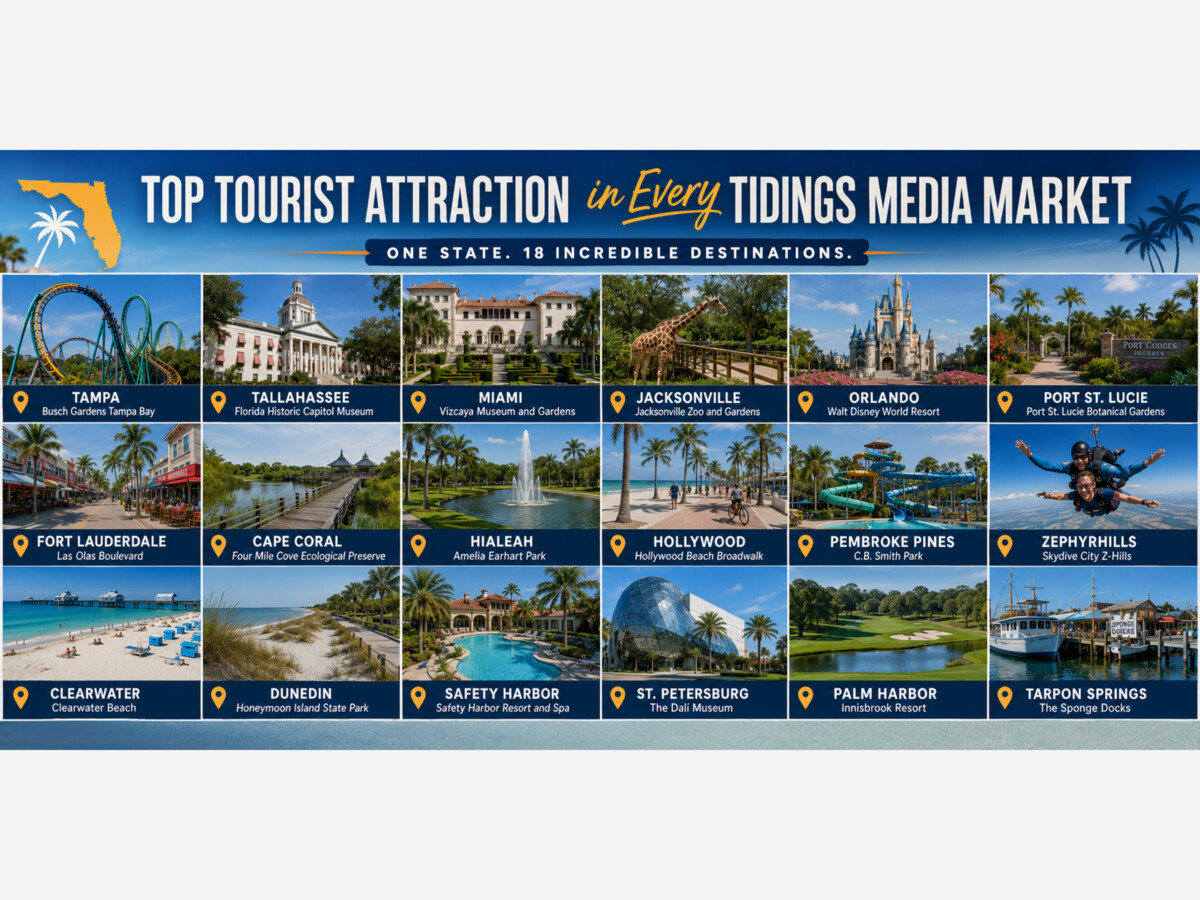



Florida tourism is often reduced to a handful of famous images: a castle in Orlando, a cruise ship in Miami, a beach sunset on the Gulf. But the real Florida travel map is broader than that. It runs through historic state capitals, working sponge docks, botanical gardens, beach boardwalks, skydiving centers, riverfront zoos, art museums, downtown promenades and neighborhood parks that locals use as much as visitors do.
For this statewide Tidings Media guide, we picked one signature tourist attraction from each Tidings market. This is not a claim that every city has only one thing worth seeing. It is a practical starting point: the one place a first-time visitor should know about, and the one place locals can point to when someone asks, “What should I see while I’m here?”
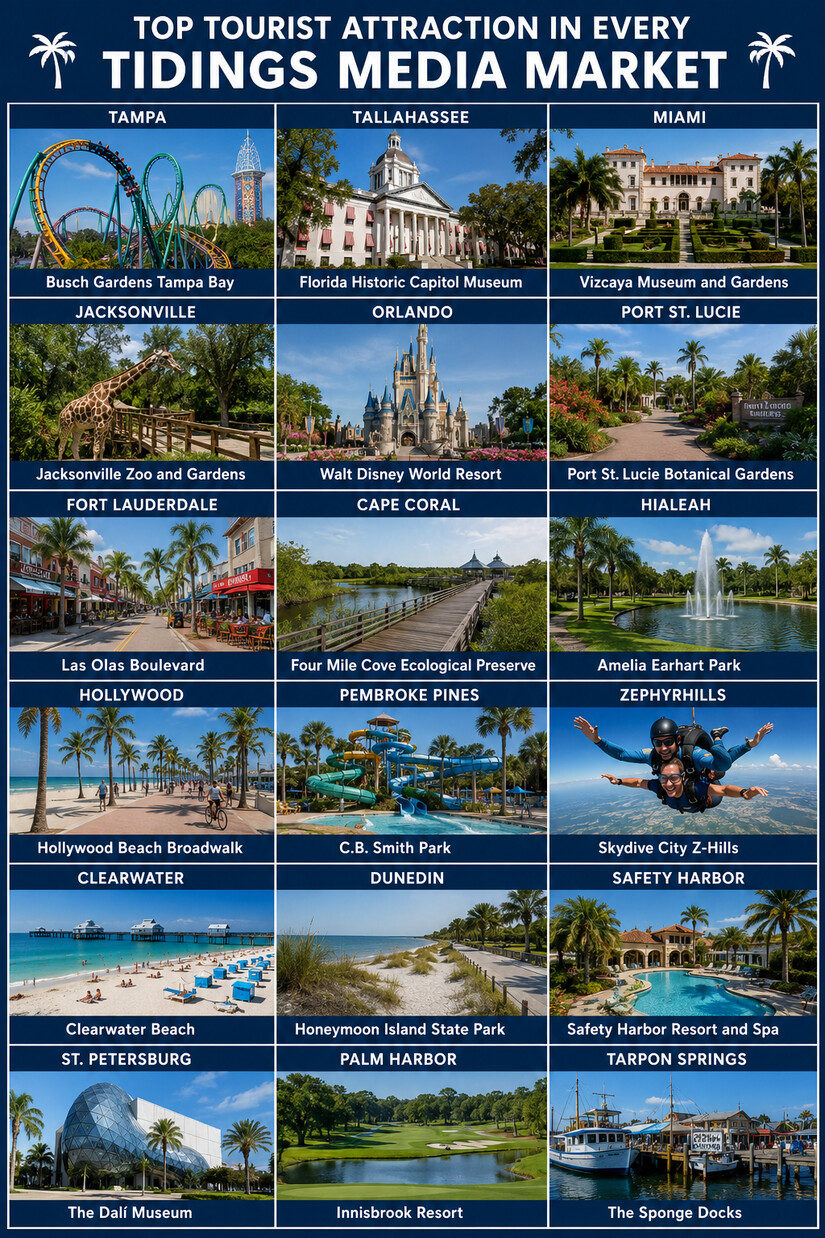
Tampa’s signature attraction is still Busch Gardens Tampa Bay, a rare hybrid of major theme park, roller-coaster destination and large-scale animal attraction. The park describes itself as combining thrill rides, award-winning roller coasters and one of North America’s largest zoos, with more than 200 species. For Tampa, that mix matters. Busch Gardens is not just a place to ride coasters. It is one of the attractions that helped define Tampa Bay as a family vacation market separate from Orlando, with a stronger animal, garden and old-Florida adventure identity.[1]
Tallahassee’s essential stop is the Florida Historic Capitol Museum. Restored to its 1902 appearance, with its stained-glass dome and familiar red-and-white striped awnings, the Historic Capitol gives visitors a compact, walkable lesson in Florida political history. Exhibits include the former House and Senate chambers, Supreme Court and Governor’s suite. For visitors who know Florida mostly through beaches and theme parks, Tallahassee offers a different story: statehood, lawmaking, political fights and the architecture of public power.[2]
Miami’s top attraction for this list is Vizcaya Museum and Gardens. The estate, completed in 1916 as the winter residence of industrialist James Deering, blends European-inspired architecture, formal gardens, period furnishings and Biscayne Bay scenery. Miami has beaches, nightlife, food and professional sports, but Vizcaya gives visitors something more lasting: a look at the city’s early 20th-century ambition, wealth and design before Miami became the global brand it is today.[3]
Jacksonville’s pick is Jacksonville Zoo and Gardens. The attraction features more than 2,000 animal species and 1,000 rare plants, positioning it as both a zoo and botanical garden. That makes it a fitting selection for a sprawling river city that is often misunderstood by visitors as simply big, spread out and highway-driven. The zoo gives families a clear destination and a reason to see Jacksonville as a nature, conservation and education market, not just a stop on I-95.[4]
There is no serious way to write a Florida tourist-attraction list without naming Walt Disney World Resort as Orlando’s defining attraction. Disney’s official site describes the resort as offering theme parks, resorts, dining and vacation planning in the Orlando area. Universal’s growth, including Epic Universe, has made Central Florida more competitive and more interesting, but Disney remains the global shorthand for Orlando tourism. It is the reason millions of families first learned to point to Central Florida on a map.[5]
Port St. Lucie’s signature visitor stop is the Port St. Lucie Botanical Gardens. The city describes the gardens as a 21-acre site with themed landscapes, a butterfly garden, orchid room, rose garden, lake, fountain, paved paths, gift shop and event space. For a market that sits between the heavier tourism machines of South Florida and Orlando, the gardens offer something quieter and more local: a half-day visit built around plants, water, walking and Treasure Coast pace.[6]
Fort Lauderdale’s top attraction is Las Olas Boulevard. Visit Florida describes Fort Lauderdale as famous for beaches, arts, culture and events, with highlights that include shopping on Las Olas Boulevard, canal rides and the city’s historic riverfront. Las Olas is the best single expression of that identity. It connects dining, shopping, galleries, nightlife, walkability and the beach-town economy that made Fort Lauderdale more than a spring-break stereotype.[7]
Cape Coral’s pick is Four Mile Cove Ecological Preserve. The city describes it as a 365-acre brackish-water wetland area with a walking trail, visitor center, Veterans Memorial Area and potential wildlife sightings including eagles, ibis, herons and other wading birds. In a city known for canals and waterfront living, Four Mile Cove gives visitors the ecological side of Cape Coral: mangroves, birds, boardwalks and a slower look at Southwest Florida.[8]
Hialeah’s top attraction is Amelia Earhart Park. Miami-Dade County describes it as a 515-acre park with five lakes and numerous amenities. The Greater Miami tourism site places it at 401 East 65th Street in Hialeah and notes daily public access. Hialeah is often discussed as a working city, a Cuban-American city and a dense residential city. Amelia Earhart Park adds another piece to that identity: open space, family recreation and one of the strongest park experiences in inland Miami-Dade.[9]
Hollywood’s signature attraction is the Hollywood Beach Broadwalk. Visit Florida calls it a must-see, describing a 2.5-mile stretch of beach, shops and restaurants. The city’s own tourism language emphasizes beachfront restaurants, bars, shopping, water sports, live music and year-round activity along the Broadwalk. In a region wedged between Miami and Fort Lauderdale, Hollywood’s Broadwalk gives the city its own tourism identity: relaxed, walkable, oceanfront and distinctly local.[10]
Pembroke Pines’ pick is C.B. Smith Park. Visit Lauderdale describes the park as a place with batting cages, a driving range, tennis, squash, pickleball, a fitness facility, trails and rentable pavilions. Broward County also highlights Paradise Cove water park, waterslides, a lazy river, campground and AllGolf family golf center. For a suburban market, C.B. Smith Park is more than a park. It is the city’s family recreation anchor.[11]
Zephyrhills’ top attraction is Skydive City Z-Hills. The drop zone markets itself as a premier skydiving center serving Tampa, St. Petersburg and Orlando, and says jumpers from more than 80 countries, all 50 states and all Canadian provinces have made it a destination. That gives Zephyrhills something many small Florida cities do not have: an international adventure-tourism identity. For locals, the city name may mean bottled water and Pasco County growth. For skydivers, Z-Hills means the sky.[12]
Clearwater’s obvious pick is Clearwater Beach. The City of Clearwater describes sugar-white sand, warm Gulf waters and fiery sunsets as part of the beach experience. Visit Florida notes Clearwater Beach’s national recognition and the draw of nearby Caladesi Island. Clearwater has many attractions, from the marine aquarium to dolphin cruises, but the beach remains the brand. It is one of the clearest examples in Florida of a city where the attraction and the identity are almost the same thing.[13]
Dunedin’s top attraction is Honeymoon Island State Park. Florida State Parks describes the island, just two miles west of Dunedin, as offering Gulf views, sandy beaches and nature trails through one of Florida’s last remaining virgin slash pine forests. The destination is easy to understand: a barrier island experience without needing a boat. For Dunedin, Honeymoon Island is both a tourism engine and a reminder that the best Florida attractions are sometimes the least complicated: beach, trail, birds, water and sky.[14]
Safety Harbor’s signature attraction is Safety Harbor Resort and Spa. Visit St. Pete-Clearwater notes that the resort features Florida’s only natural mineral springs spa, while the resort itself markets the property around mineral springs, waterfront relaxation and a long hospitality tradition. Safety Harbor also has Main Street, parks and a strong small-town waterfront feel, but the resort is the attraction that gave the city its name recognition beyond Tampa Bay.[15]
St. Petersburg’s top attraction is The Dalí Museum. The museum describes itself as offering an unparalleled collection of works by Salvador Dalí, while Visit St. Pete-Clearwater highlights its downtown waterfront setting, distinctive gardens, Café Gala and world-class collection. The museum works because it fits the modern St. Petersburg story: art-forward, walkable, waterfront, a little strange and increasingly confident as a cultural destination.[16]
Palm Harbor’s top attraction is Innisbrook Resort. Visit Florida calls Innisbrook Palm Harbor’s top attraction and notes that it hosts the PGA Tour’s Valspar Championship on the Copperhead Course. Visit St. Pete-Clearwater similarly describes Innisbrook as Palm Harbor’s biggest attraction. That makes the pick straightforward. Innisbrook gives Palm Harbor a national golf identity and a tourism anchor that reaches well beyond north Pinellas County.[17]
Tarpon Springs’ signature attraction is the Sponge Docks. Visit Florida tells visitors to stroll along Dodecanese Boulevard, walk past the sponge docks, stop for Greek food, shop local stores and see the famous sponge boats. The Sponge Docks are not a manufactured attraction. They are a living tourist district built around real history, Greek immigration, sponge diving and waterfront commerce. In a state filled with beaches and theme parks, Tarpon Springs offers something rarer: a cultural district that still feels tied to the work that created it.[18]
Taken together, these attractions tell a better story about Florida than any single travel brochure. There is a Florida of theme parks and coasters. There is a Florida of beaches, boardwalks and resort towns. There is a Florida of government buildings, art museums, immigrant districts, wetlands, gardens, parks and small-town adventure.
That is the point of a statewide local news network. Tidings Media markets are not interchangeable dots on a map. Each one has its own front door. For some cities, that front door is a beach. For others, it is a museum, a park, a golf course, a historic district or a plane ride followed by a parachute.
Florida is still one of the easiest states in America to underestimate because the postcard version is so loud. The better version is found market by market, one local landmark at a time.
[1] Busch Gardens Tampa Bay official visitor information.
[2] Visit Tallahassee, Florida Historic Capitol Museum.
[3] Greater Miami Convention & Visitors Bureau, Vizcaya Museum and Gardens.
[4] Jacksonville Zoo and Gardens official visitor information.
[5] Walt Disney World Resort official visitor information.
[6] City of Port St. Lucie, Botanical Gardens.
[7] Visit Florida, Fort Lauderdale visitor information; Las Olas Boulevard visitor information.
[8] City of Cape Coral, Four Mile Cove Ecological Preserve.
[9] Miami-Dade County Parks, Amelia Earhart Park; Greater Miami visitor information.
[10] Visit Florida and City of Hollywood visitor information for Hollywood Beach and the Broadwalk.
[11] Visit Lauderdale and Broward County Parks, C.B. Smith Park.
[12] Skydive City Z-Hills official visitor information.
[13] City of Clearwater and Visit Florida, Clearwater Beach visitor information.
[14] Florida State Parks, Honeymoon Island State Park.
[15] Visit St. Pete-Clearwater and Safety Harbor Resort and Spa visitor information.
[16] The Dalí Museum and Visit St. Pete-Clearwater visitor information.
[17] Visit Florida and Visit St. Pete-Clearwater, Palm Harbor/Innisbrook visitor information.
[18] Visit Florida, Tarpon Springs Sponge Docks visitor information.
Stay connected with Tidings Media: Tidings Media offers local curated news for Tampa, Tallahassee, Miami, Jacksonville, Orlando, Port St. Lucie, Fort Lauderdale, Cape Coral, Hialeah, Hollywood, Pembroke Pines, Zephyrhills, Clearwater, Dunedin, Safety Harbor, St. Petersburg, Palm Harbor and Tarpon Springs. Subscribe free at tidings.town.news for local headlines, weather alerts, civic updates, practical Florida news, and community stories without the clutter.


Overcast, with a high of 88 and low of 77 degrees. Overcast during the morning, patchy rain nearby in the afternoon, overcast in the evening, clear overnight.