84° and Patchy rain nearby
Image



Florida is not in a tourism crisis. That would be the wrong word, and the wrong story.
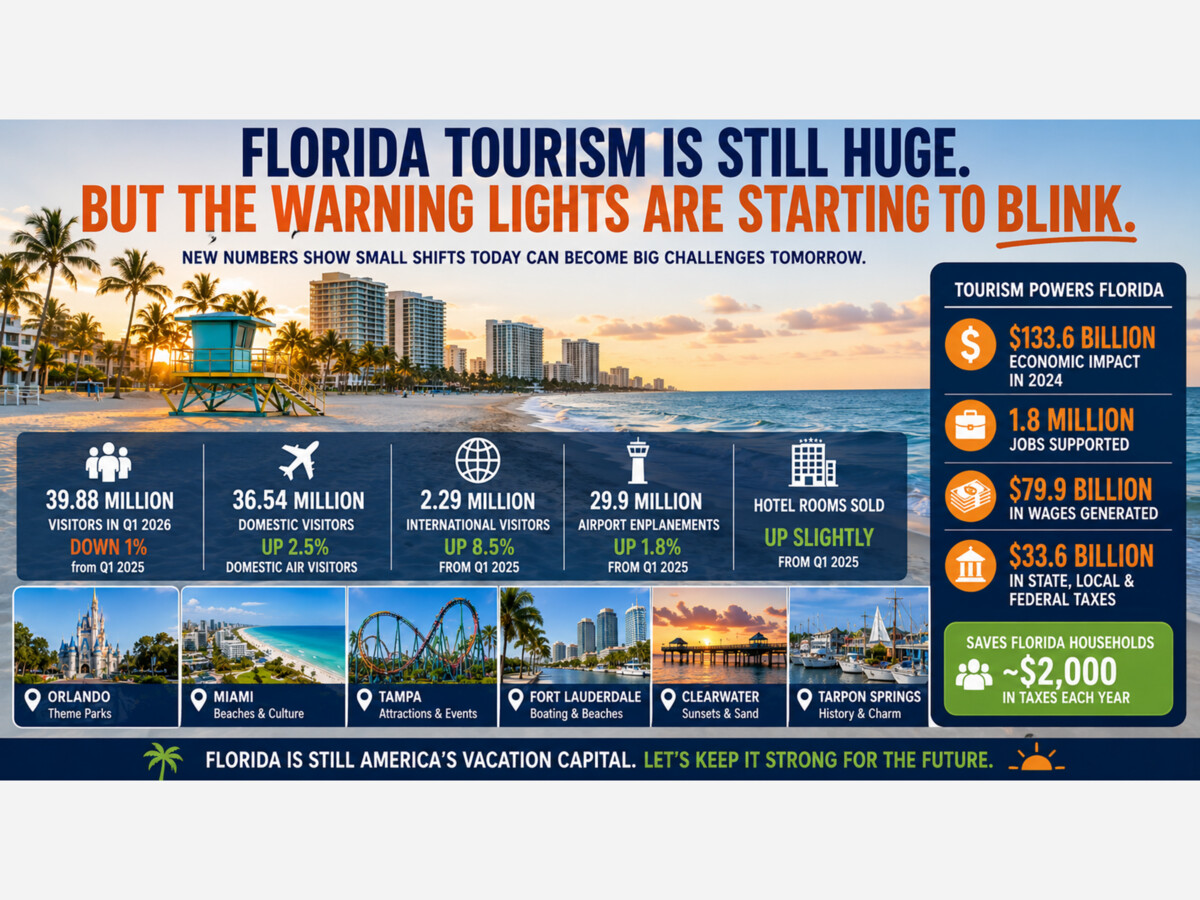
The state still welcomed an estimated 39.88 million travelers in the first quarter of 2026. Florida still drew a record 143.33 million visitors in 2025. Tourism still supports jobs, restaurants, hotels, attractions, airports, beaches, museums, local governments and small businesses across the state.
But the newest numbers from VISIT FLORIDA contain something worth watching: total first-quarter visitation was down 1 percent compared with the same period in 2025.
One percent is not a collapse. It is not even close. But in Florida, where tourism is not just a leisure industry but an economic foundation, small changes can matter. A little softness in statewide travel can ripple through beach towns, theme-park corridors, airport cities, downtown districts and hospitality-heavy local economies.
That is why the story is not “Florida tourism is falling apart.”
The better question is simpler: Has Florida tourism reached the point where growth can no longer be assumed?
VISIT FLORIDA’s updated estimates show Florida welcomed a revised 143.33 million visitors in 2025, a slight increase over the previous year and a record for the state. That is the headline tourism officials would understandably prefer to lead with.
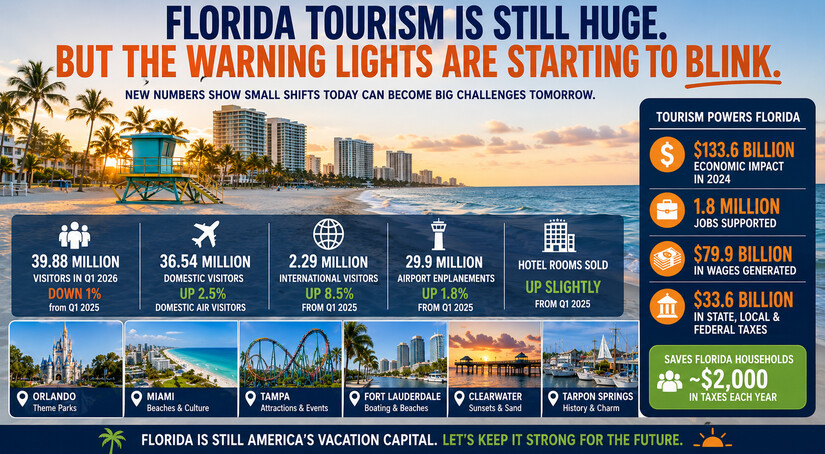
But the first quarter of 2026 was more complicated. Florida welcomed an estimated 39.88 million visitors from January through March, down 1 percent from the first quarter of 2025.
The numbers were not weak across the board. Domestic visitation remained enormous at an estimated 36.54 million visitors, accounting for more than nine out of every ten visitors to the state. Domestic air visitation increased 2.5 percent year over year. Overseas visitation rose 8.5 percent to an estimated 2.29 million visitors. Florida’s 19 commercial airports handled 29.9 million total enplanements, up 1.8 percent from the prior year.
Hotels also saw a slight increase in rooms sold.
So where was the softness?
VISIT FLORIDA said the year-over-year decline was tied to domestic non-air visitation calculations. In plain English, the issue appears to be the drive-in and non-air travel side of the equation. VISIT FLORIDA also cautioned that preliminary domestic estimates can shift because traveler behavior is changing, especially if more visitors drive, stay with friends and family, or use lodging patterns that are harder to capture immediately.
That caveat matters. The number may be revised. But the warning is still real enough to watch.
Tourism is often discussed as if it belongs only to Orlando, Miami, Tampa Bay and the beaches. That is too narrow.
In the Tidings Media network, tourism touches nearly every market.
In Tampa, Busch Gardens, conventions, sports, concerts and the cruise economy all depend on visitors. In Orlando, tourism is the foundation of the regional economy. In Miami and Fort Lauderdale, international travel, hotels, restaurants, ports and beaches are all connected. In Clearwater, Dunedin, Safety Harbor, St. Petersburg, Palm Harbor and Tarpon Springs, tourism helps support restaurants, shops, downtown districts, beach services, museums, boat tours, resorts and seasonal employment.
Even markets that are not traditional national tourism brands have a stake in the numbers. Port St. Lucie, Cape Coral, Hialeah, Hollywood, Pembroke Pines and Zephyrhills all benefit when Florida remains a place people want to visit, move through, retire to, invest in or explore.
Tourism is not just Mickey ears and beach towels. It is sales tax. It is bed tax. It is restaurant traffic. It is airport volume. It is museum attendance. It is small-business survival during shoulder seasons. It is the difference between a downtown that feels active and one that feels like it is waiting for next year.
Tourism also affects people who never book a hotel room.
According to the Governor’s Office and VISIT FLORIDA’s 2024 economic-impact data, travel and tourism generated $133.6 billion in economic impact in Florida in 2024. Out-of-state visitors spent $134.9 billion. Tourism supported 1.8 million jobs and generated $79.9 billion in wages. Tourism-related activity produced $33.6 billion in federal, state and local taxes.
The same release said tourism saves Florida households nearly $2,000 each in taxes, with state and local tax savings alone estimated at $1,730 per household.
That is why a 1 percent decline deserves more attention than the number might suggest. Florida’s tourism machine is so large that even small percentage changes can represent large real-world consequences.
The issue is not whether Florida remains popular. It does.
The issue is whether the state and local communities have become too comfortable assuming that visitors will always come, spend and return at higher levels.
One encouraging sign is overseas visitation. VISIT FLORIDA reported overseas visitation increased 8.5 percent in the first quarter of 2026, with the United Kingdom and Ireland performing especially well. UK visitation was up again in Q1 2026 after a strong 2025, and Irish visitation was also up.
Canadian visitation remains a more complicated story. VISIT FLORIDA revised its 2025 Canadian visitation estimate upward, saying Florida welcomed 3.17 million Canadian visitors in 2025, about 270,000 more than initially estimated. The agency attributed the revision partly to delayed final reporting tied to kiosk issues at Ontario ports and changing Canadian travel patterns.
For Florida, Canada matters. Canadian visitors fill condos, beaches, rental homes, restaurants, golf courses and seasonal communities. When Canadians come, many Florida communities feel it. When they do not, those same communities feel that too.
Florida has advantages other states cannot easily copy: climate, beaches, theme parks, airports, cruise ports, year-round events and a globally recognized brand.
But it also has pressure points.
Hotels are expensive. Theme-park vacations can be expensive. Insurance costs have changed the economics of hotels, rentals and small businesses. Restaurant prices are higher. Airfare fluctuates. Beach communities are still dealing with storm recovery, resiliency costs and infrastructure strain. Summer heat is no longer just a weather complaint; it can change how families plan their days, how long they stay outdoors and what kind of vacations they choose.
Florida is still a bargain compared with some international destinations. But for many families, a Florida trip is no longer casual spending. It is a major household purchase.
That changes the psychology of tourism. Families compare Disney with a cruise. They compare Clearwater Beach with the Carolinas. They compare Miami with the Caribbean. They compare a Florida rental house with staying closer to home.
If the state becomes too expensive, too crowded, too hot, too difficult to navigate or too ordinary in customer experience, some visitors will still come. Others will wait, shorten the trip or go somewhere else.
Florida has spent decades building one of the strongest travel brands in the world. The state does not need panic. It does need discipline.
That means clean beaches. Safe downtowns. Reliable airports. Clear roadways. Well-run attractions. Fair pricing. Good service. Honest marketing. Local events that feel worth attending. Public spaces that feel maintained. Tourism districts that do not look like they are coasting on yesterday’s reputation.
The best tourism markets are not just famous. They are cared for.
That matters in every Tidings Media market. Tampa cannot coast on Busch Gardens and sports. Orlando cannot assume families will pay any price forever. Miami cannot ignore affordability and congestion. Clearwater cannot let beach access and infrastructure become afterthoughts. Tarpon Springs has to protect the authenticity of the Sponge Docks. St. Petersburg has to maintain the arts-and-waterfront experience that made it a destination. Smaller markets have to give visitors a reason to stop, not just pass through.
Tourism is competitive. Florida is still winning. But winning streaks do not maintain themselves.
The next few quarters will matter.
If the first-quarter softness is revised away, Florida officials will have a stronger case that the tourism engine remains steady. If softness continues, local governments and tourism boards will need to ask harder questions about pricing, marketing, air service, international travel, beach conditions, customer experience and whether Florida’s cost structure is starting to change visitor behavior.
The point is not to root against tourism. The point is to take the numbers seriously while there is still time to adjust.
Florida remains one of the most powerful tourism economies in the world. But even powerful brands can lose momentum if they confuse past success with future entitlement.
The tourists are still coming.
The question is whether Florida is still doing everything necessary to make sure they keep coming back.
[1] VISIT FLORIDA, “Q1 2026 Florida Tourism Remains Strong; Updated Data Shows Higher-Than-Previously-Estimated Canadian Visitation in 2025,” May 22, 2026.
[2] VISIT FLORIDA reported an estimated 39.88 million travelers visited Florida in Q1 2026, down 1.0 percent from Q1 2025.
[3] VISIT FLORIDA reported domestic visitation of 36.54 million visitors in Q1 2026, domestic air visitation up 2.5 percent year over year, and domestic non-air visitation down 3.4 percent.
[4] VISIT FLORIDA reported overseas visitation of approximately 2.29 million visitors in Q1 2026, up 8.5 percent year over year.
[5] VISIT FLORIDA reported Florida’s 19 commercial airports handled 29.9 million total enplanements in Q1 2026, up 1.8 percent year over year.
[6] Executive Office of the Governor / VISIT FLORIDA, “Tourism in Florida Delivers $133.6 Billion in Economic Impact, Nearly $2,000 per Household in Tax Savings in 2024,” Nov. 25, 2025.
[7] The Governor’s Office and VISIT FLORIDA reported that travel and tourism generated $133.6 billion in economic impact in 2024, supported 1.8 million jobs, generated $79.9 billion in wages and produced $33.6 billion in federal, state and local taxes.
[8] VISIT FLORIDA reported revised 2025 Canadian visitation of 3.17 million, about 270,000 more than initially estimated.
Stay connected with Tidings Media: Tidings Media offers local curated news for Tampa, Tallahassee, Miami, Jacksonville, Orlando, Port St. Lucie, Fort Lauderdale, Cape Coral, Hialeah, Hollywood, Pembroke Pines, Zephyrhills, Clearwater, Dunedin, Safety Harbor, St. Petersburg, Palm Harbor and Tarpon Springs. Subscribe free at tidings.town.news for local headlines, weather alerts, civic updates, practical Florida news, and community stories without the clutter.



Sunny, with a high of 88 and low of 77 degrees. Sunny during the morning, patchy rain nearby during the afternoon, clear overnight.