64° and Clear
Image

Tidings Media Plays "Follow The Money" in Pinellas County, Florida.



The First Amendment to the United States Constitution protects the right of citizens “to petition the Government for a redress of grievances.” That right is not theoretical. It is meant to be used.[1]
For Pinellas County residents who have concerns about county spending, commissioner travel, public oversight, property-tax collections or the power of unelected county administration, the next scheduled opportunity to speak directly to county government is the Pinellas County Board of County Commissioners regular meeting on Tuesday, June 16, 2026, at 9:30 a.m.
Pinellas County’s public-comment sign-up page lists the June 16, 2026, 9:30 a.m. Board of County Commissioners meeting as available for public comment at 333 Chestnut Street, Palm Room, Clearwater, FL 33756.[2]
Citizens who wish to speak should review the posted agenda, public-comment rules and sign-up procedures before attending. The point of public comment is not performance. It is accountability. If taxpayers believe county government is drifting away from discipline, restraint and transparency, the First Amendment gives them the right to say so directly, on the record, to the people elected to represent them.
Pinellas County voters elect seven county commissioners. They do not elect the county administrator. Many believe the county administrator to be the most powerful person in the county.
That distinction matters more every year.
County Administrator Barry A. Burton is not the public face of Pinellas County politics. Commissioners cast the votes, appear at public events, defend the budgets and answer to voters. Burton works behind the screen, running the administrative machinery that prepares recommendations, manages departments and carries out the decisions commissioners ultimately approve.
That makes him one of the most powerful unelected officials in Pinellas County government.
It also makes his record a fair subject of public scrutiny.
Pinellas County says Burton serves as chief administrative officer and is responsible for leading more than 1,900 county employees.[4] Public salary data lists Burton’s 2025 Pinellas County salary at $349,940.[5] Based on available public salary databases and published employment reports, that reported salary appears to place Burton among the top five highest-paid appointed county administrators or county managers in Florida.[6] That doesn't include his cell phone and allowance, car allowance, and deferred compensation. His total package before benefits is approaching $400k/year.
That sentence requires care. Florida counties use different executive titles, including county administrator, county manager, chief administrative officer and county mayor. Some third-party databases report “annual salary,” others report hourly rates, annualized rates or prior-year compensation. For that reason, Tidings Media is not stating that Burton is definitively one of the five highest-paid county administrators in Florida without direct confirmation from all 67 county payroll offices.
But the available comparison is still notable. Broward County Administrator Monica Cepero is listed by GovSalaries at $502,452 in 2025.[7] Palm Beach County’s administrator compensation was reported above Burton’s level, with local reporting stating that incoming County Administrator Joseph Abruzzo’s contract was set at $425,000 and that retiring Administrator Verdenia Baker had been making about $463,000.[8] Burton’s reported $349,940 salary appears higher than several large-county comparables reviewed, including Orange County Administrator Byron Brooks at $329,988 in 2025 and other large Florida county administrators or managers whose reported salaries were below Burton’s or could not be directly verified from the records reviewed.[9]
The issue is not merely what Burton is paid. The issue is what taxpayers receive in return: financial controls, budget discipline, transparent travel oversight and a clear line of accountability in a county where the administrator is unelected and commissioners serve as elected policymakers rather than day-to-day managers.
That is the real question for Pinellas taxpayers.
Who is watching the watcher?
Barry Burton was selected in August 2018 after a national search. At the time, Ken Welch was chairman of the Pinellas County Commission and led negotiations with Burton after the board voted unanimously to pursue him.[10]
Welch, now mayor of St. Petersburg, praised Burton at the time as a leader who brought “decades of leadership and accomplishments in county government administration.”[11] The public pitch was experience, professionalism and continuity after retiring administrator Mark Woodard.
But Burton’s move from Lake County, Illinois, to Pinellas County came at an awkward moment. Lake County government was under public scrutiny over procurement-card use and expense oversight involving then-County Board Chairman Aaron Lawlor.
The available reporting does not show that Burton was personally accused of criminal wrongdoing. But it does show that the controversy touched the financial-control environment of the government he administered.
That distinction is important. It is also exactly why the story matters.
The Pinellas County Commission was not merely hiring a department head. It was hiring an unelected chief administrative officer for day-to-day county operations. The board’s duty was not only to ask whether Burton had experience. It was to ask what kind of oversight culture he was leaving behind.
In August 2018, Lake County, Illinois, was dealing with a public controversy involving county-issued procurement cards, often called P-cards. Reporting by the Daily Herald said Burton’s job offer from Pinellas came while Burton, his staff and the Lake County Board faced public criticism over how board expense accounts and county credit cards had been managed.[12]
The scrutiny was triggered by revelations about Aaron Lawlor, then the Lake County Board chairman. The Daily Herald reported that an unspecified law-enforcement agency had asked to investigate Lawlor’s use of the county card and that Lawlor was on indefinite leave while receiving treatment for drug addiction.[13] CBS Chicago later reported that Lawlor had resigned, entered rehab and was under criminal investigation for misspending county money.[14]
The Daily Herald also reported that Burton’s signature had accompanied Lawlor’s invoices in the past, but that Burton said he had not signed off on Lawlor’s May and June invoices because receipts were missing and accounting could not reconcile them.[15]
That is not proof of misconduct by Burton. It is proof that the Pinellas County Commission was hiring a county administrator from a government facing public questions about financial oversight, documentation and internal controls.
Other local reporting said Lake County officials moved to overhaul board credit-card rules after Lawlor was accused of improperly and repeatedly using a county-issued card for personal purchases.[16] ABC7 Chicago reported that the Lake County State’s Attorney announced an independent investigation into Lawlor’s spending, and that the county board had begun reviewing its P-card and expense-account procedures.[17]
The lesson for Pinellas is not that Burton should be judged for Lawlor’s conduct. Elected officials are responsible for their own choices. The lesson is that weak administrative controls can become a taxpayer problem long before voters understand what happened.
The Lake County controversy was not only a story about one elected official’s alleged misuse of a county card. It was a story about financial oversight.
Who reviewed the charges? Who required receipts? Who approved reimbursements? Who noticed the pattern? Who stopped it? Who was supposed to say no?
Those are not small questions. They go to the center of what a county administrator is supposed to do.
That is why Burton’s Lake County history is relevant in Pinellas County today. The available reporting does not establish that Burton personally misused funds in Illinois. It does establish that Pinellas hired an administrator from a government that was already facing public questions about expense oversight, missing receipts, credit-card procedures and internal controls, and then placed him in charge of a much larger Florida county government with billions of dollars moving through the system.
Pinellas does not face the identical issue. The Lake County controversy involved county procurement cards, missing receipts and allegations involving one elected official’s spending. Pinellas’ current oversight questions are different. They involve budgets, travel approvals, public-purpose justifications, tourism and economic-development spending, and whether taxpayers can clearly see who approved what, who benefited, what it cost and what public return was produced.
Tidings Opinion is that the connection is not an accusation of identical conduct. It is a warning about the same category of public concern: financial oversight.
The Lake County controversy involved procurement cards, receipts, approvals and the internal controls around elected-official spending. In Pinellas County, the same oversight principle should apply to commissioner travel, senior-official travel, trade missions, economic-development trips, tourism-funded trips, staff-supported trips and quasi-public travel involving public resources.
Tidings Media is not alleging that any specific commissioner travel expense was unlawful. The issue is whether the approval, funding, purpose and public benefit of such travel are clear enough for taxpayers to evaluate.
Recent public reporting, public-facing economic-development materials and records obtained by Tidings Media show why the question is timely. In May 2026, ITTN reported that Global Tampa Bay’s second visit to Dublin included a tourism luncheon in Ireland, where Pinellas County Commissioner Dave Eggers spoke about Ireland, the Tampa Bay region and Clearwater Beach tourism.[18] Tampa Bay EDC’s 2025 annual report said Pinellas County Commissioner Brian Scott traveled with Tampa Bay officials to London for a United Kingdom foreign-direct-investment mission.[19] Global Tampa Bay also reported that Pinellas County Commissioner Kathleen Peters participated in a four-day international business mission to Vancouver, British Columbia, where the delegation met with business, government and institutional leaders.[20] Records produced in response to Tidings Media’s public-records request also show county-connected European travel involving Commissioner Chris Scherer.[21]
Those trips may have legitimate tourism, air-service, business-recruitment, trade, foreign-direct-investment or economic-development purposes. International promotion can be a valid public function when it is transparent, measurable and tied to a clear public return. But the existence of a public purpose does not end the oversight question. It starts it.
The public should be able to see a business case before the trip, a clear approval process, a complete accounting afterward and a measurable public benefit when officials return.
Who approved the travel? Who reviewed the expenses? Who determined the public purpose? Who measured the return on investment? Who tells an elected official no?
That is where the Lake County parallel should be drawn carefully. Pinellas is not Lake County. The facts are different. The spending category is different. The officials are different. The oversight principle is the same.
In Lake County, Illinois, the public controversy centered on whether county financial controls were strong enough when an elected official used county purchasing tools. In Pinellas County, the public concern is whether financial controls are strong enough whenever elected officials or senior officials travel under county-connected, tourism-funded, economic-development, trade-mission or public-agency banners.
This is the uncomfortable question Pinellas County needs to answer: if the county administrator is the chief administrative officer responsible for the machinery of government, and the commissioners are the elected officials who supervise the administrator, who is watching the watcher?
That phrase is not a slogan. It is the taxpayer’s core problem.
The administrator oversees departments, budgets, policies, staff recommendations, procurement systems and the internal controls that are supposed to protect public money. Commissioners oversee the administrator. But the structure can create political cover: commissioners can point to staff recommendations, staff can point to board approval, and taxpayers can be left trying to determine who was responsible for the original judgment call.
The public is left outside the room.
That is why Pinellas County should publish a plain-language travel accountability report for every commissioner and senior-official trip involving public funds, public staff support, public agencies, tourism-development funds, economic-development partners, trade missions or quasi-public organizations.
The report should include the stated purpose before travel, the approving authority, the funding source, the total cost, the names and titles of all travelers, whether spouses or guests participated, the itinerary, the public meetings held, and the measurable result after the trip.
If the trip is legitimate, that transparency should be easy.
If the county does not make that information easy for taxpayers to find, then the problem is not merely optics. It is oversight.
Lake County, Illinois, is not just any prior stop on a resume. It is one of the most heavily taxed places in the country for homeowners.
ATTOM’s 2024 property-tax analysis ranked Lake County, Illinois, among the 10 large U.S. counties with the highest effective property-tax rates, listing Lake County at a 2.13% effective rate and an average 2024 tax amount of $10,370 for single-family homes.[22] SmartAsset separately describes Lake County as having one of Illinois’ highest effective property-tax rates and says Lake County homeowners pay more in absolute property taxes than anyone else in the state.[23]
Lake County government notes that it receives only about 7% of the average property-tax bill, with school districts receiving the largest share.[24] That is a fair distinction. County administrators do not control every taxing body on a property-tax bill.
But taxpayers are also entitled to ask a broader management question: why does Pinellas County keep expanding and spending like growth is guaranteed when the population has recently declined and residents are already under pressure from insurance, housing, utilities and inflation?
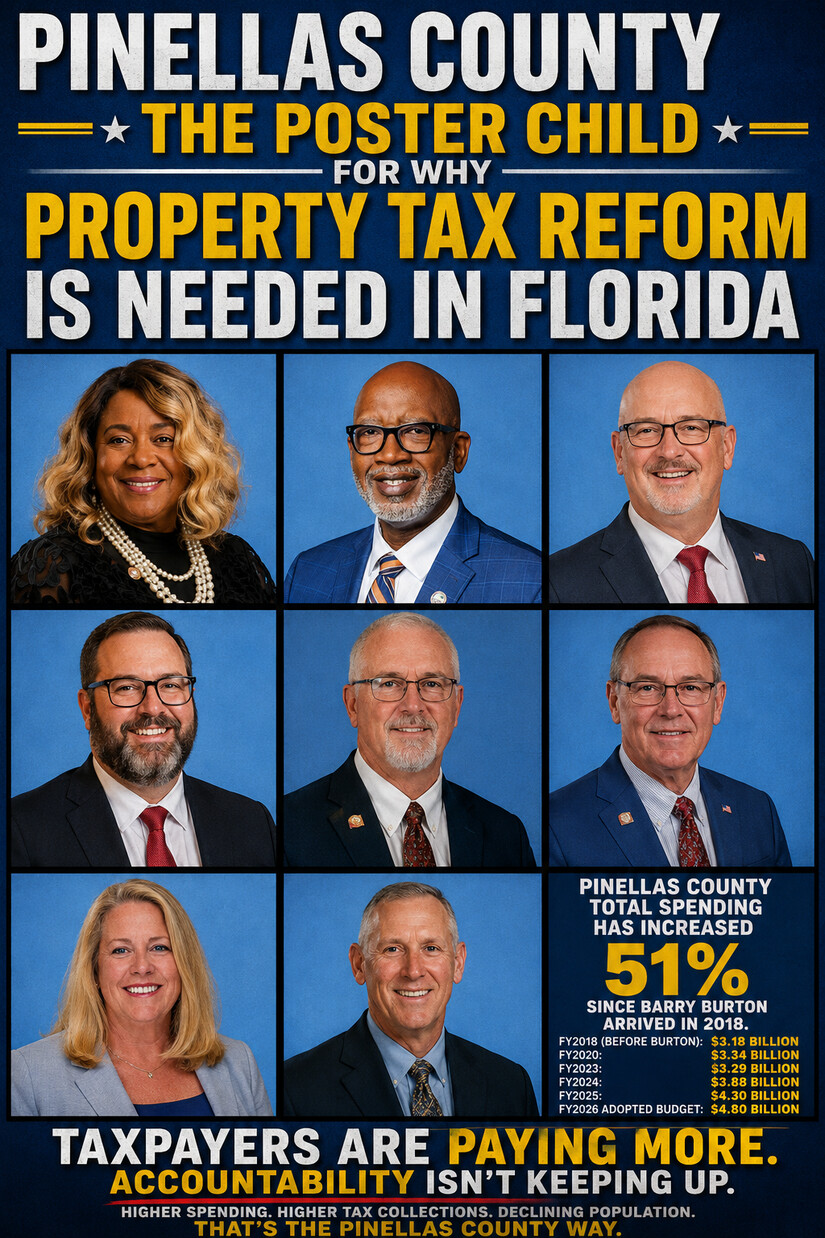
Burton began work in Pinellas County in October 2018. His initial compensation package was reported at $289,700, including a $267,500 base salary plus deferred compensation and a car allowance.[25] Reporting at the time said he originally requested a $302,100 package, roughly $50,000 more than retiring administrator Mark Woodard earned.[26]
Since then, Pinellas County’s total budget has grown sharply.
The county’s FY2023 proposed budget was described as $2.5 billion for operations and $794 million for capital improvements, or about $3.294 billion combined.[27] The FY2024 adopted budget totaled $3.881 billion.[28] The FY2025 budget was reported at roughly $4.3 billion.[29] The final FY2026 budget was adopted at $4.8 billion.[30]
That is a significant expansion in county government’s financial footprint.
County officials can point out, correctly, that millage rates have been reduced in recent years. For FY2026, the county said the general-fund property-tax rate was reduced to 4.5423 mills, its lowest level since 1990.[31] But a lower millage rate does not automatically mean taxpayers are getting relief when assessed values and total collections keep rising.
Pinellas County’s own response to the state DOGE inquiry acknowledged that General Fund ad valorem property-tax collections increased by $144 million, or 31%, since FY2020. The county also said taxable values increased by $38 billion, or 45%, during the same period.[32]
That is the point taxpayers feel in their mortgage escrow statements. Government can reduce the rate and still collect much more money.
Burton’s compensation deserves public attention because it reflects how Pinellas treats the top unelected administrative office.
Public salary databases list Burton as the county’s highest-paid employee in recent years. GovSalaries lists his 2025 Pinellas County salary at $349,940.[33] OpenPayrolls lists his 2024 Pinellas County pay at $315,203.20.[34] His original employment package included deferred compensation and a car allowance, according to contemporaneous reporting.[35]
That makes it fair to ask what the fully loaded taxpayer cost of the administrator’s office is when salary, benefits, deferred compensation, vehicle allowance, pension contributions and any other executive benefits are included.
The optics matter, but they should be discussed carefully. Publicly visible personal social-media posts may become part of the public conversation when a highly compensated public executive is overseeing a county budget funded by taxpayers. That does not make a motorcycle, vacation photo or personal lifestyle post evidence of wrongdoing. It does not mean a public employee has no private life. It means senior public officials should expect taxpayers to judge public-facing images through the lens of confidence, restraint and stewardship.
The issue is not a motorcycle. The issue is tone, transparency and trust.
Even some commissioners have recognized the structural problem.
In 2025, Commissioner Chris Latvala proposed exploring whether Pinellas should move toward a countywide elected mayor. WUSF reported that Latvala argued the person making day-to-day decisions in a county like Pinellas should be elected and accountable to voters.[36]
That is the heart of the issue.
Latvala said his proposal had nothing to do with Burton’s performance. But the premise still applies. During emergencies, Latvala said, the administrator becomes “the most important person in the county.”[37] If that is true, then Pinellas residents deserve to ask whether the office has outgrown the accountability structure around it.
Burton himself reportedly said that with any form of government, there are pluses and minuses, and that the elected board should ultimately make the decision.[38]
That may be true. But taxpayers should be part of that conversation.
The next budget cycle should be judged by more than press releases about millage rates.
Pinellas has already adopted a $4.8 billion FY2026 budget.[39] The county’s Office of Management and Budget listed a June 12, 2026, Board of County Commissioners budget information session as part of the current budget calendar.[40] Any proposed millage increase, spending increase or increase in total property-tax collections should be evaluated against the county’s spending growth and population trend.
The latest available Census reporting shows Pinellas County has recently experienced population decline. WUSF reported in March 2026 that the U.S. Census Bureau said Pinellas County lost nearly 12,000 residents between 2024 and 2025, the second-largest numeric county population decline in the country.[41] Spectrum Bay News 9 reported the same broad finding in April 2026.[42]
A declining population does not automatically mean government costs fall. Hurricanes, infrastructure needs, public safety, beach protection, wastewater systems and inflation are real pressures. But declining population does mean county leaders should explain why record-level budgets remain necessary, why staffing and administrative costs keep rising, and why taxpayers should trust the same bureaucracy to keep expanding.
Barry Burton’s record should be debated on facts, not slogans.
He came to Pinellas with long county-government experience. He has served during COVID, hurricanes and major infrastructure and redevelopment debates. Commissioners have publicly credited him with steady leadership.[43]
But public leadership is not measured only by résumé length or crisis-management talking points. It is measured by whether taxpayers receive accountability in proportion to the power being exercised over them.
The Burton record raises five questions Pinellas County should answer before approving another major budget.
First, what did Pinellas commissioners know in 2018 about the Lake County P-card controversy, and what questions did they ask about administrative controls before finalizing Burton’s contract?
Second, what is the full current taxpayer cost of Burton’s compensation package, including salary, benefits, deferred compensation, vehicle allowance, cell-phone reimbursement, pension contributions and any other executive benefits?
Third, why has total county spending risen so sharply since Burton arrived, even as the county now faces population decline?
Fourth, what financial controls exist for commissioner travel, international trade missions, tourism-funded travel, economic-development travel, staff-supported travel and related public expenses?
Fifth, if the county administrator is powerful enough to run day-to-day government and become central in emergencies, why should that office remain insulated from direct voter accountability?
Pinellas County’s unelected oversight problem is not only about Barry Burton. It is about a recurring public-accountability concern: Lake County’s expense-card controversy, followed years later by Pinellas questions about budgets, travel accountability, executive compensation and the difficulty of determining who owns major administrative decisions.
Tidings Opinion is that the pattern deserves scrutiny because financial oversight is not only about catching wrongdoing after it happens. It is about building systems that make questionable spending, weak documentation and blurred accountability harder to defend in the first place.
Burton is the wizard behind the screen in Pinellas County government: not because he secretly controls commissioners, but because the administrator’s office shapes the choices commissioners see, manages the departments that execute those choices and sits at the center of the county’s financial-control system.
The commissioners are elected. The administrator is not. The budget is real. The tax bills are real. The travel records are public records. And the voters deserve more than assurances that everything is under control.
Stay connected with Tidings Media: Tidings Media offers local curated news for Tampa, Tallahassee, Miami, Jacksonville, Orlando, Port St. Lucie, Fort Lauderdale, Cape Coral, Hialeah, Hollywood, Pembroke Pines, and Zephyrhills. Subscribe free at tidings.town.news for local headlines, weather alerts, civic updates, practical Florida news, and community stories without the clutter.
[1] National Archives, “Bill of Rights: A Transcription,” First Amendment text. Source: https://www.archives.gov/founding-docs/bill-of-rights-transcript
[2] Pinellas County Public Comment Speaking Sign-up page, listing “June 16, 2026 @ 9:30 am” for the Board of County Commissioners at 333 Chestnut Street, Palm Room, Clearwater, FL 33756. Source: https://comment.pinellas.gov/
[3] Pinellas County, “Participating in a Board of County Commissioners Meeting,” stating regular Board meetings are usually held at either 315 Court Street or the Palm Room at 333 Chestnut Street, Clearwater, and that meetings are held in the Palm Room until further notice unless otherwise indicated. Source: https://pinellas.gov/participating-in-a-board-of-county-commissioners-meeting/
[4] Pinellas County, “County Administrator,” official county biography page. Source: https://pinellas.gov/county-administrator/
[5] GovSalaries, “Barry Alan Burton,” listing Burton’s 2025 Pinellas County salary at $349,940. Source: https://govsalaries.com/burton-barry-alan-209104202
[6] Florida-Demographics.com, “Florida Counties by Population,” used to identify the largest Florida counties for comparison; GovSalaries and OpenPayrolls pages reviewed for county administrator and county manager salary comparisons. Source: https://www.florida-demographics.com/counties_by_population
[7] GovSalaries, “County Administrator salary at Broward County,” listing Broward County Administrator Monica Cepero at $502,452 in 2025. Source: https://govsalaries.com/salaries/FL/broward-county/j/county-administrator
[8] Stet News, “Abruzzo pay set at $425,000 and a Chevy Tahoe,” reporting Palm Beach County Administrator Joseph Abruzzo’s contract and prior Administrator Verdenia Baker’s compensation. Source: https://stetnews.org/2025/07/24/abruzzo-pay-set-at-425000-and-a-chevy-tahoe/
[9] GovSalaries, “Byron W. Brooks,” listing Orange County Administrator Byron Brooks at $329,988 in 2025; additional GovSalaries county-manager comparison pages reviewed for Lee, Polk, Brevard, Volusia, Seminole and other counties. Source: https://govsalaries.com/brooks-byron-w-216972565
[10] Patch, “Pinellas County Recruits New Administrator From Illinois,” reporting that the Pinellas Commission voted to offer Burton the job and that then-Chairman Kenneth T. Welch would begin negotiations. Source: https://patch.com/florida/stpete/pinellas-county-recruits-new-administrator-illinois
[11] Patch, “Pinellas County Recruits New Administrator From Illinois,” quoting Welch’s praise of Burton’s county-government experience. Source: https://patch.com/florida/stpete/pinellas-county-recruits-new-administrator-illinois
[12] Daily Herald, “Lake County administrator offered job in Florida,” reporting that Burton’s Pinellas offer came while Burton, his staff and the Lake County Board faced criticism over how board expense accounts and county credit cards had been managed. Source: https://www.dailyherald.com/20180820/news/lake-county-administrator-offered-job-in-florida/
[13] Daily Herald, “Lake County administrator offered job in Florida,” reporting that a law-enforcement agency had asked to investigate Lawlor’s use of the county card and that no charges had been filed at that time. Source: https://www.dailyherald.com/20180820/news/lake-county-administrator-offered-job-in-florida/
[14] CBS Chicago, “Lawlor Quietly Submitting FOIA During His Investigation,” reporting that former Lake County Board Chairman Aaron Lawlor had resigned, entered rehab and was under criminal investigation for misspending county money. Source: https://www.cbsnews.com/chicago/news/aaron-lawlor-lake-county-board-p-cards-sandy-hart/
[15] Daily Herald, “Lawlor frequently used county card for personal expenses,” reporting that Burton’s signature had accompanied Lawlor’s invoices in the past and quoting Burton saying he did not sign May and June invoices because receipts were missing and accounting could not reconcile them. Source: https://www.dailyherald.com/20180808/news/lawlor-frequently-used-county-card-for-personal-expenses/
[16] Daily Herald, “Lake County officials to overhaul rules for board credit cards,” reporting proposed changes after Lawlor’s alleged personal purchases. Source: https://www.dailyherald.com/20180808/news/lake-county-officials-to-overhaul-rules-for-board-credit-cards/
[17] ABC7 Chicago, “Lake County, Ill. board chairman not running for re-election amid investigation,” reporting the independent investigation and the county board’s review of P-card and expense-account procedures. Source: https://abc7chicago.com/post/lake-county-ill-board-chairman-not-running-for-re-election-amid-investigation/3908619/
[18] ITTN, “Global Tampa Bay Tourism Luncheon Highlights Growing Ireland-Florida Connection,” reporting that Global Tampa Bay’s second visit to Dublin included a tourism luncheon and that Pinellas County Commissioner Dave Eggers spoke at the event. Source: https://ittn.ie/travel-news/global-tampa-bay-tourism-luncheon-highlights-growing-ireland-florida-connection/
[19] Tampa Bay EDC, 2025 Annual Report, reporting that Pinellas County Commissioner Brian Scott traveled with regional officials to London for a United Kingdom foreign-direct-investment mission. Source: https://tampabayedc.com/wp-content/uploads/2026/01/2025-UNCHARTED-AnnualReport.pdf
[20] Tampa Bay EDC, “Global Tampa Bay completes successful international business mission to Vancouver, British Columbia,” reporting that Pinellas County Commissioner Kathleen Peters participated in the Vancouver mission. Source: https://tampabayedc.com/global-tampa-bay-completes-successful-international-business-mission-to-vancouver-british-columbia/
[21] Pinellas County public records produced to Tidings Media in response to a public-records request regarding county-connected European travel involving Commissioner Chris Scherer. Records on file with Tidings Media.
[22] ATTOM, “Top 10 U.S. Counties With Highest Effective Property Tax Rates in 2024,” listing Lake County, Illinois, among the 10 large U.S. counties with the highest effective property-tax rates. Source: https://www.attomdata.com/news/market-trends/figuresfriday/top-10-u-s-counties-with-highest-effective-property-tax-rates-in-2024/
[23] SmartAsset, “Illinois Property Tax Calculator,” discussing Lake County’s effective property-tax rate and homeowner property-tax burden. Source: https://smartasset.com/taxes/illinois-property-tax-calculator
[24] Lake County, Illinois, “Property Taxes,” stating county government receives about 7% of the average property-tax bill, with schools receiving the largest share. Source: https://www.lakecountyil.gov/199/Property-Taxes
[25] Patch, “New Pinellas County Administrator Begins Duties,” reporting Burton’s initial $289,700 package, including $267,500 base salary plus deferred compensation and a car allowance. Source: https://patch.com/florida/clearwater/new-pinellas-county-administrator-begins-duties
[26] Patch, “New Pinellas County Administrator Begins Duties,” reporting Burton originally requested a $302,100 salary package. Source: https://patch.com/florida/clearwater/new-pinellas-county-administrator-begins-duties
[27] Pinellas County, “County releases Fiscal Year 2023 proposed budget,” reporting $2.5 billion for operations and $794 million for capital improvements. Source: https://pinellas.gov/news/county-releases-fiscal-year-2023-proposed-budget/
[28] Pinellas County, FY2024 Adopted Operating and Capital Budget, showing adopted budget total of $3.881 billion. Source: https://pinellas.gov/wp-content/uploads/2023/10/FY24.AdoptedOperatingCapitalBudget.pdf
[29] St. Pete Catalyst, “County commission approves $4.3 billion budget, tax cuts,” reporting the FY2025 budget and noting revenues would continue to increase because of rising property values. Source: https://stpetecatalyst.com/county-commission-approves-4-3-billion-budget-tax-cuts/
[30] Pinellas County, “County Commission adopts final FY26 budget with lower rate,” reporting the adopted FY2026 budget of $4.8 billion. Source: https://pinellas.gov/news/county-commission-adopts-final-fy-26-budget-with-lower-rate/
[31] Pinellas County, “County Commission adopts final FY26 budget with lower rate,” reporting the FY2026 general-fund property-tax rate of 4.5423 mills and describing it as the lowest level since 1990. Source: https://pinellas.gov/news/county-commission-adopts-final-fy-26-budget-with-lower-rate/
[32] Pinellas County, “Pinellas County response to Florida DOGE letter,” stating General Fund ad valorem revenue increased by $144 million, or 31%, since FY2020, and taxable values increased by $38 billion, or 45%. Source: https://pinellas.gov/news/pinellas-county-response-to-florida-doge-letter/
[33] GovSalaries, “Barry Alan Burton,” listing Burton’s 2025 Pinellas County salary. Source: https://govsalaries.com/burton-barry-alan-209104202
[34] OpenPayrolls, “Barry Alan Burton,” listing Burton’s 2024 Pinellas County pay at $315,203.20. Source: https://openpayrolls.com/employee/barry-alan-burton-513
[35] Patch, “New Pinellas County Administrator Begins Duties,” reporting Burton’s original base salary, deferred compensation and car allowance. Source: https://patch.com/florida/clearwater/new-pinellas-county-administrator-begins-duties
[36] WUSF, “Pinellas County could have its first countywide mayor,” reporting Commissioner Chris Latvala’s argument that the person making day-to-day county decisions should be elected and accountable. Source: https://www.wusf.org/text/politics-issues/2025-04-09/pinellas-county-could-have-its-first-countywide-mayor
[37] WUSF, “Pinellas County could have its first countywide mayor,” reporting Latvala’s statement about the administrator’s importance during emergencies. Source: https://www.wusf.org/text/politics-issues/2025-04-09/pinellas-county-could-have-its-first-countywide-mayor
[38] WUSF, “Pinellas County could have its first countywide mayor,” reporting Burton’s comments on the form-of-government discussion. Source: https://www.wusf.org/text/politics-issues/2025-04-09/pinellas-county-could-have-its-first-countywide-mayor
[39] Pinellas County, “County Commission adopts final FY26 budget with lower rate,” reporting the adopted FY2026 budget. Source: https://pinellas.gov/news/county-commission-adopts-final-fy-26-budget-with-lower-rate/
[40] Pinellas County, “Board of County Commissioners Budget Information Session,” listing the June 12, 2026 budget information session. Source: https://pinellas.gov/event/board-of-county-commissioners-budget-information-session-24/
[41] WUSF, “Pinellas lost second-most residents of any county in 2025,” reporting that the U.S. Census Bureau said Pinellas lost nearly 12,000 residents and had the second-largest numeric county population loss. Source: https://www.wusf.org/economy-business/2026-03-27/census-pinellas-lost-second-most-residents-of-any-county-2025
[42] Spectrum Bay News 9, “Census: Pinellas County sees second-largest population drop in U.S.,” reporting the population decline. Source: https://baynews9.com/fl/tampa/news/2026/04/08/census--pinellas-county-sees-second-largest-population-drop-in-u-s--
[43] FOX 13, “Voters may get chance to decide whether there should be a mayor in Pinellas County,” reporting Latvala’s comments that Burton had done “a tremendous job” and that the mayor proposal was about voter accountability rather than Burton’s performance. Source: https://www.fox13news.com/news/voters-may-get-chance-decide-whether-should-be-mayor-pinellas-county


Sunny, with a high of 80 and low of 61 degrees. Sunny during the morning, clear in the afternoon and evening,