Image
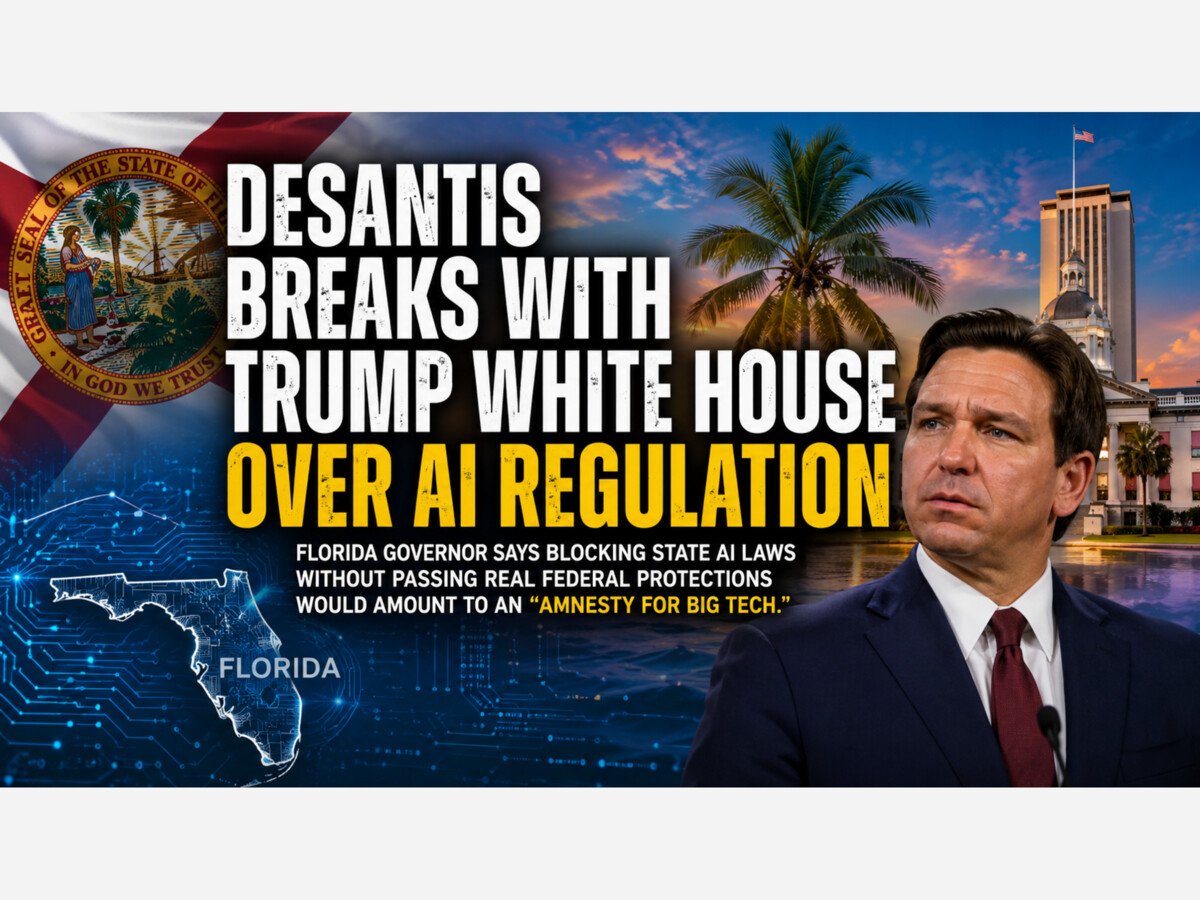



Florida’s governor says blocking state AI laws without passing real federal protections would amount to an “amnesty for Big Tech.”
This article was originally posted at https://chalktalkai.substack.com/ and is reprinted here with permission.
Florida Gov. Ron DeSantis has opened a direct fight with the Trump White House over artificial intelligence regulation, accusing the administration of siding with Big Tech at the expense of states, parents, consumers, and children.
The clash centers on whether Washington should block states from passing their own AI laws before Congress has enacted a meaningful national framework. DeSantis says that would leave Americans exposed while giving the largest technology companies the one thing they want most: protection from accountability.
“Preempting states re: AI without enacting a sensible federal framework is just an amnesty for Big Tech,” DeSantis wrote on X. “Combined with a potential de facto bailout of OpenAI, it represents bad policy and even worse politics.”¹
The White House has taken the opposite view. In a December executive order, President Trump called for a national AI policy framework and warned that state-by-state regulation could create a patchwork of rules that slows American innovation.²
That argument has support inside the technology industry, where companies fear that 50 different state laws could create a compliance nightmare. But DeSantis is making a different point. He is not arguing against federal regulation. He is arguing against Washington blocking the states before Washington has done the job itself.
Florida already tried to move.
During the 2026 legislative session, DeSantis backed an “Artificial Intelligence Bill of Rights” that would have created new protections for Floridians dealing with AI systems. The proposal included restrictions on companion chatbots marketed to minors, stronger parental consent rules, disclosures when consumers are interacting with AI, limits on the use of personal data, and protections against the unauthorized commercial use of someone’s AI-generated likeness.³
The Florida Senate passed the regular-session version of the bill by a 35-2 vote. When the bill stalled, the Senate tried again during the special session, passing SB 2-D by a 37-1 vote. That bill died in the House without making it out of committee.⁴
The political tension is hard to miss. Florida House Speaker Daniel Perez opposed the state-level approach and argued that AI should be handled through a national framework. Perez has since been nominated by Trump to serve as U.S. ambassador to Brazil.⁵
For DeSantis, the issue is now both policy and politics. Florida passed data center ratepayer protections, but the broader AI consumer protections he wanted never became law. Now, Washington is considering whether to prevent states from filling that gap.
That is why the governor’s criticism matters.
Artificial intelligence is no longer a theoretical technology debate. AI systems are already interacting with children, simulating companionship, producing deepfakes, collecting personal information, and generating content that can damage reputations, families, businesses, and elections. The law is behind the technology, and everyone knows it.
The question is who gets to catch up first.
Big Tech prefers one federal standard. That is understandable. It is easier, cleaner, and cheaper than navigating state-by-state rules. But the risk is that “federal standard” becomes a slogan for delay. If Congress blocks the states and then fails to pass serious protections, consumers are left with nothing.
That is the weakness in the White House position. A national framework may be the best long-term answer, but preemption without protection is not a framework. It is a shield.
The OpenAI issue adds another layer. Reuters has reported that Trump has floated the idea of companies “giving back” to the public through possible government equity stakes in leading AI firms.⁶ DeSantis called that a potential “de facto bailout,” raising the uncomfortable possibility that Washington could become financially entangled with the same companies it is supposed to regulate.
That should concern people across the political spectrum.
AI regulation is quickly becoming one of the least predictable issues in American politics. It cuts across the usual party lines. Conservatives worry about censorship, child safety, privacy, deepfakes, and Big Tech power. Progressives worry about bias, labor displacement, surveillance, and consumer harm. Parents worry about what their children are talking to online. Businesses worry about fraud, impersonation, and legal uncertainty.
Meanwhile, the companies building the most powerful AI systems in the world are trying to shape the rules while the rules are still being written.
DeSantis is betting that voters will not like the idea of Washington protecting AI companies before protecting families. The Trump White House is betting that voters will reward a pro-innovation national strategy that keeps America ahead of China and prevents regulatory chaos at home.
Both sides can claim a piece of the argument. America does need to win the AI race. But it also needs rules that protect real people from real harms that are already happening.
The danger is not that the states move too quickly. The danger is that Washington tells the states to stand down, promises to act later, and leaves the public waiting while Big Tech gets the certainty it wanted all along.
That is the fight DeSantis just forced into the open.
ChalkTalk.ai will continue tracking the collision between artificial intelligence, government power, consumer safety, and Big Tech influence. Subscribe free at ChalkTalk.ai for plain-English deep dives without the clutter.



Sunny, with a high of 80 and low of 61 degrees. Sunny during the morning, clear in the afternoon and evening,