Image



Florida’s food stamp rolls are shrinking fast.
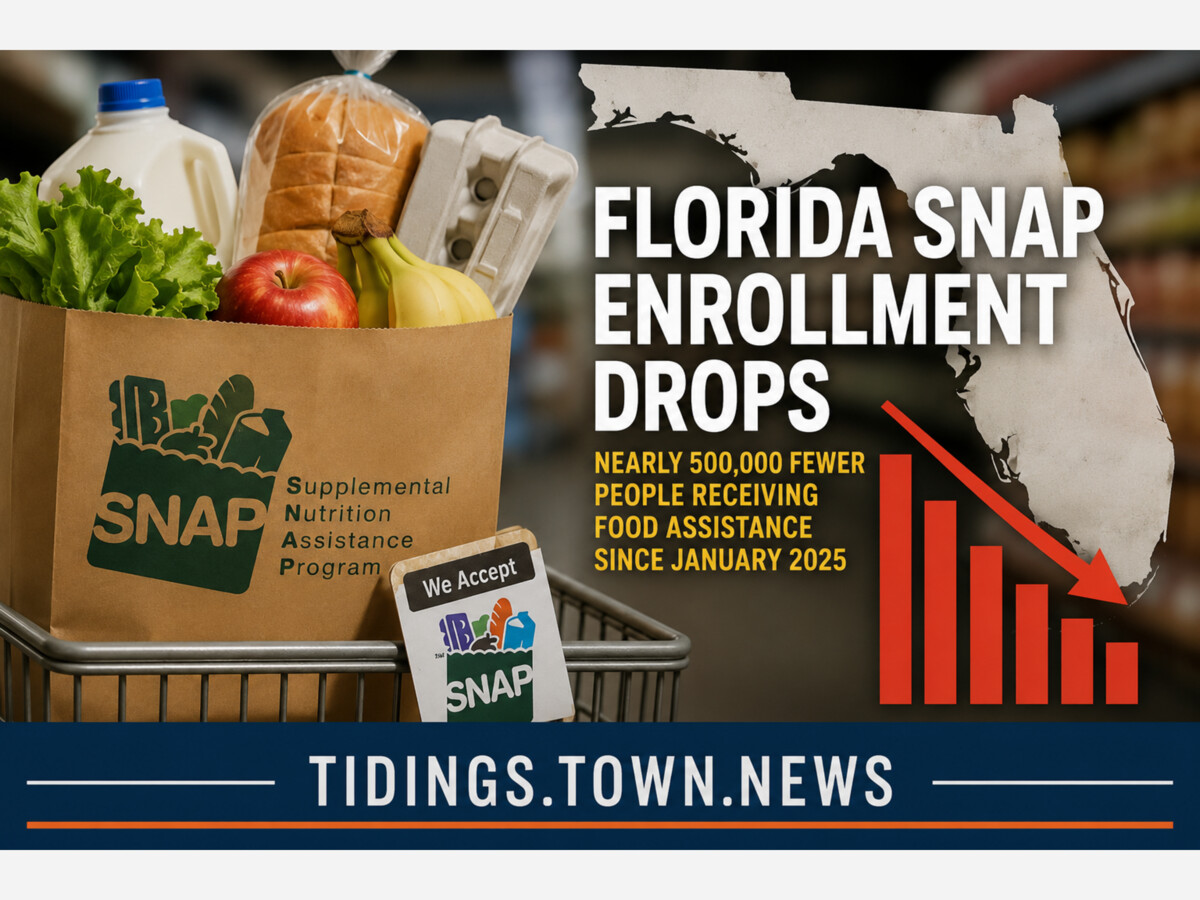
According to the Food Research & Action Center, Florida had 489,321 fewer people receiving SNAP benefits in February 2026 than it did in January 2025. That is nearly half a million Floridians no longer receiving federal food assistance in just over a year.¹
The decline accelerated after Congress passed the One Big Beautiful Bill Act in July 2025, which included major changes to the Supplemental Nutrition Assistance Program, commonly known as SNAP or food stamps.
The Florida Policy Institute reported that Florida’s SNAP caseload fell from 2,886,838 people in July 2025 to 2,609,325 in December 2025. That is a drop of 277,513 people in five months.²
The new federal rules expanded work requirements for many able-bodied adults. Under USDA rules, able-bodied adults without qualifying dependents must generally work, volunteer, attend approved education or training, participate in a work program, or take part in SNAP Employment and Training for at least 80 hours per month. Those who do not meet the requirement may be limited to three months of SNAP benefits in a 36-month period unless they qualify for an exemption.³
That makes Florida one of the largest case studies in the country for a basic public policy question: should taxpayer-funded food assistance come with a stronger work expectation for adults who are able to work?
Supporters of the change argue the answer is yes. They say public assistance should be a temporary safety net, not a long-term substitute for employment, and that taxpayers have a right to expect work, training, volunteering, or another productive activity from able-bodied adults receiving benefits.
Critics argue the numbers should be read more carefully. They warn that a decline in enrollment does not automatically mean that nearly half a million Floridians found stable work or no longer need help. Some may have lost benefits because of paperwork, documentation problems, eligibility confusion, transportation challenges, or difficulty meeting the new reporting requirements.
Even the American Enterprise Institute, which has analyzed the national SNAP decline, noted that Florida is one of the states driving a large share of the national reduction. AEI reported that Arizona, Florida, and Georgia together accounted for almost one-third of the national SNAP decline from January 2025 to January 2026.⁴
That matters because Florida’s decline is not small, symbolic, or theoretical. It is already showing up in the data.
Florida is also moving in another direction on SNAP reform. The state received federal approval to restrict SNAP purchases of certain products, including soda, candy, energy drinks, and some ultra-processed desserts. That policy is part of Florida’s Healthy SNAP initiative and is scheduled to take effect in 2026.⁵
Taken together, the work rules and food-purchase restrictions signal a broader shift in Florida’s approach to public assistance. The state is no longer simply asking who qualifies for benefits. It is asking what conditions should be attached to receiving them.
For Florida taxpayers, the issue is straightforward.
If the decline means more able-bodied adults are working, training, or leaving assistance because they no longer need it, supporters will call the policy a success.
If the decline means eligible Floridians are losing food assistance because of red tape or stricter administrative hurdles, critics will call it a warning sign.
Either way, nearly half a million fewer Floridians receiving SNAP benefits is not a small policy footnote. It is the story.
Stay connected with Tidings Media: Tidings Media offers local curated news for Tampa, Tallahassee, Miami, Jacksonville, Orlando, Port St. Lucie, Fort Lauderdale, Cape Coral, Hialeah, Hollywood, Pembroke Pines, and Zephyrhills. Subscribe free at tidings.town.news for local headlines, weather alerts, civic updates, practical Florida news, and community stories without the clutter.



Sunny, with a high of 81 and low of 61 degrees. Sunny during the morning, partly cloudy for the afternoon and evening, clear overnight.