Image



By David Happe | Editor, Tidings Media
CLEARWATER, Fla. —Thousands of Scientology members and affiliates, estimated at more than 2,000 people, flooded Clearwater, Florida City Hall tonight as the City Council considered vacating the publicly owned Garden Avenue for the benefit of the Church of Scientology. The group registered roughly 250 speakers in support of the proposal and took nearly every seat in the council chambers, leaving opponents largely unable to attend the hearing in person. Before the final vote, the City Council made special arrangements to allow 10 opponents into the chambers so they could speak and be heard.
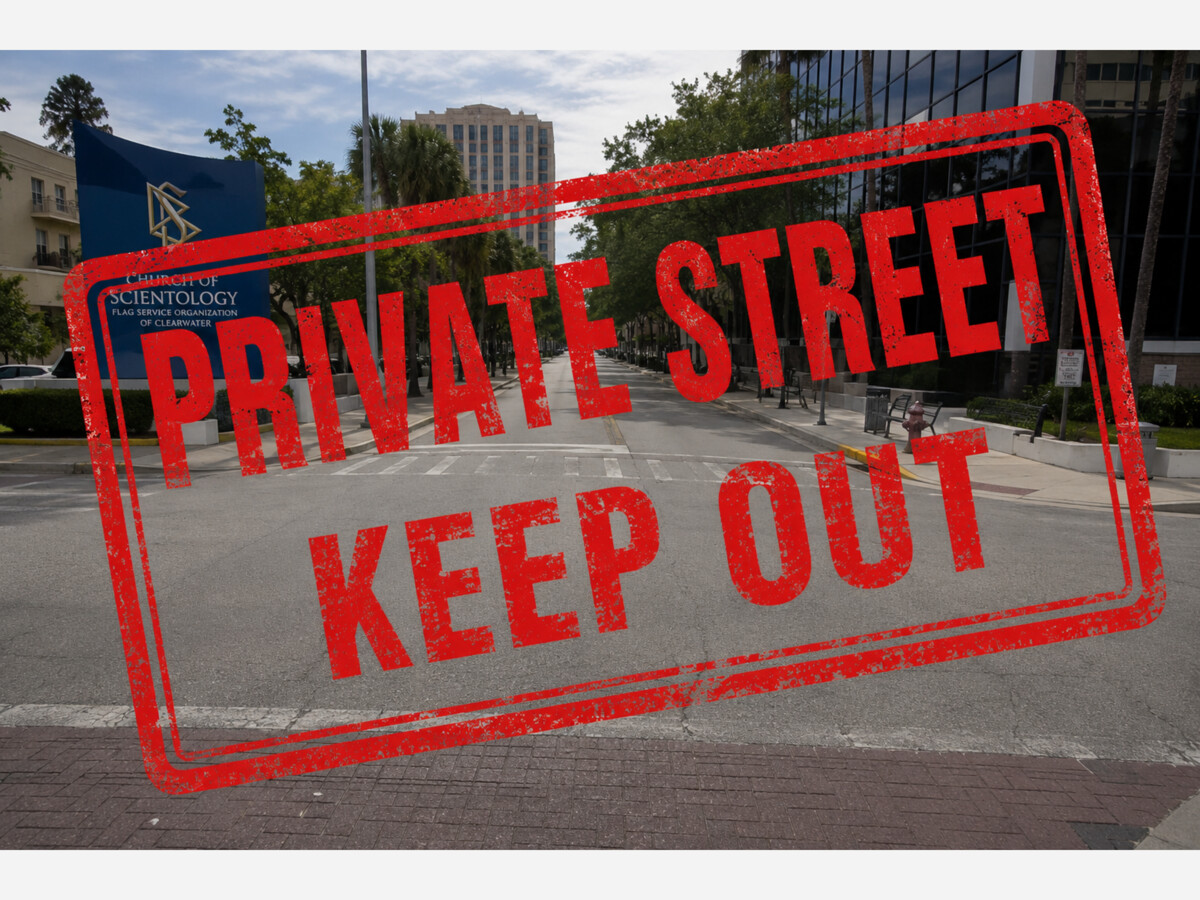
The Clearwater City Council voted 3-2 Thursday night to vacate a public block of South Garden Avenue and turn it over for use by the Church of Scientology, approving one of the most controversial downtown land decisions in recent city history.
Council members David Allbritton, Ryan Cotton and Mike Mannino voted in favor of the street vacation. Mayor Bruce Rector and Council member Lina Teixeira voted against it.
The decision clears the way for the Church of Scientology Flag Service Organization to absorb the southern portion of South Garden Avenue between Court Street and Franklin Street into its long-planned L. Ron Hubbard Hall project, a proposed 3,500-seat venue and plaza in the heart of downtown Clearwater.
The council’s vote did more than settle a dispute over one block of pavement. It forced Clearwater’s elected officials to choose between the city’s adopted downtown planning principles and the demands of the most powerful institutional landowner in downtown Clearwater.
Three council members chose the landowner.
Clearwater’s own staff analysis had already identified the problem in plain language. The city agenda for the Garden Avenue vacation said the proposal was inconsistent with the Clearwater 2045 Comprehensive Plan mobility policies and with the city’s Downtown Redevelopment Plan, specifically Goal 2 and Objective 2A, which promote a connected downtown street network and discourage the vacation of streets unless replacement public streets and alleys are constructed to preserve the function of the street being removed.[1]
That 2018 Downtown Redevelopment Plan was not an obscure advisory memo. It was the city’s long-term vision for downtown Clearwater, updated to make existing properties and buildings more viable while preserving neighborhood character.[2] At the center of that vision was a connected, walkable downtown. Vacating Garden Avenue cuts against that premise.
The city’s staff report acknowledged that the site plan may preserve some pedestrian movement across the former street, but also noted that the space would become privatized and that the plan did not necessarily show whether the public would be able to use or traverse it.[3] In other words, the public street may be replaced by something that looks public, but no longer belongs to the public.
Supporters of the request argued that the project will add green space, improve the church’s downtown campus and complete a long-planned venue. Scientology representatives have said the plaza and hall would be pedestrian-friendly and open to the public. The church has also argued that the street segment is lightly used and that much of the traffic on it is already tied to church activity.
But the issue before the council was never simply whether Scientology could build an attractive plaza. The question was whether Clearwater should surrender a public right-of-way in the middle of its downtown core to a private religious organization whose role in the city has been disputed for decades.
That history is what made Thursday’s vote so combustible.
The Church of Scientology has called Clearwater its spiritual headquarters for nearly half a century. Its presence downtown has long been a defining civic issue, dating back to its secretive arrival in 1975 and the conflicts that followed with city leaders and residents.[4] In 2019, a Tampa Bay Times investigation found that the church, its members and companies they controlled owned 185 properties covering 101 acres in the center of downtown Clearwater.[5] More recent accounts have placed the number of church-owned or affiliated downtown properties above 200.[6]
That level of concentration would be controversial in any city. In Clearwater, it is inseparable from a downtown redevelopment debate that has gone on for years: Can the city build a normal, lively downtown when so much land is controlled by one institution?
Garden Avenue became the line in the pavement.
Opponents organized under the name Save the Garden, collected thousands of petition signatures and pushed for a citywide vote before public rights-of-way downtown could be transferred to private hands. The ACLU of Florida sued Clearwater after the city rejected thousands of those signatures, arguing that the city violated the law and the First Amendment by blocking the citizen initiative from reaching voters.[7]
For opponents, Thursday’s vote confirmed the very concern behind the petition drive: that decisions about public land in downtown Clearwater are being handled inside City Hall rather than by the citizens who own the asset.
The city’s own record also showed practical concerns beyond symbolism. The Garden Avenue right-of-way contains 0.65 acres, 22 paid city parking spaces, stormwater infrastructure, a 48-inch gravity-fed pipe, sanitary sewer infrastructure and utility interests. Staff also noted that PSTA had contemplated using the street segment for a proposed multimodal transit center routing option.[8]
Those are not trivial details. They are the kind of public functions a street performs before anyone bothers to count cars.
The original 2025 version of the deal contemplated a conditional sale of the right-of-way for $1.375 million. That proposal was later withdrawn after Florida Attorney General James Uthmeier weighed in on the underlying ownership issue, and the city’s path shifted from a sale toward a (free) vacation of the public right-of-way.[9]
That shift only sharpened the policy question. If Clearwater’s adopted redevelopment plan says downtown should retain its connected street grid, and if city staff says this vacation is inconsistent with that plan, then the council members voting yes were not merely approving a land-use request. They were setting aside the planning framework Clearwater already adopted for its downtown.
Teixeira made that point during the earlier council debate, warning that vacating a street in the urban core runs against downtown development and undermines accessibility and maneuverability. Rector also voted no, previously raising concerns about whether removing a street was consistent with a serious downtown revitalization strategy.
Allbritton, Cotton and Mannino saw it differently. Their votes treated the church’s project as an acceptable redevelopment tradeoff, despite the city’s own planning language and despite organized public opposition.
That is why the Garden Avenue decision will not end with Thursday night’s vote.
The council has now established that Clearwater’s downtown plan can be bent when the applicant is powerful enough, patient enough and positioned on enough surrounding land. The city can still describe downtown as a place it wants to make more connected, more walkable and more accessible. But on Garden Avenue, it voted to do the opposite.
A downtown plan is only a plan until it is tested.
[1] City of Clearwater, Legistar File 9812-25, staff agenda item for South Garden Avenue right-of-way vacation. The staff summary states that the vacation is inconsistent with Clearwater 2045 Comprehensive Plan Mobility Policies M 1.1.14 and M 1.1.15 and the Downtown Redevelopment Plan, Goal 2 and Objective 2A.
[2] City of Clearwater, Downtown Redevelopment Plan & Zoning District. The city describes the Clearwater Downtown Redevelopment Plan as a long-term vision for downtown and says it was updated in 2018 to make existing properties and buildings more viable while preserving neighborhood character.
[3] City of Clearwater, Legistar File 9812-25. Staff noted that the conceptual site plan appeared to maintain pedestrian access across Garden Avenue, but that the space would be privatized and did not necessarily indicate whether anyone could use or traverse it.
[4] Pulitzer Prize, “When Scientology came to town,” describing Scientology’s 1975 arrival in Clearwater, acquisition of downtown property and the decades of civic conflict that followed.
[5] Tampa Bay Times investigation, “How Scientology doubled its downtown Clearwater footprint in three years,” Oct. 20, 2019.
[6] WUSF, “Clearwater set to hand downtown street over to Scientologists for ‘flagship venue,’” June 9, 2026.
[7] ACLU of Florida, Save the Garden v. City of Clearwater, case summary, latest update June 11, 2026.
[8] City of Clearwater, Legistar File 9812-25, staff summary identifying the 0.65-acre right-of-way, 22 paid parking spaces, stormwater and sewer infrastructure, Frontier utility interests and PSTA routing considerations.
[9] WUSF, “Clearwater set to hand downtown street over to Scientologists for ‘flagship venue,’” June 9, 2026.
About Tidings Media
Tidings Media covers Florida communities with local reporting, civic accountability and practical news for residents who want to understand how decisions made at city hall, county government and the state capitol affect their daily lives.
Stay connected with Tidings Media for continuing coverage of Clearwater, Pinellas County and the issues shaping Florida’s Gulf Coast community.



Sunny, with a high of 79 and low of 62 degrees. Sunny in the morning, clear during the afternoon and evening,