Image
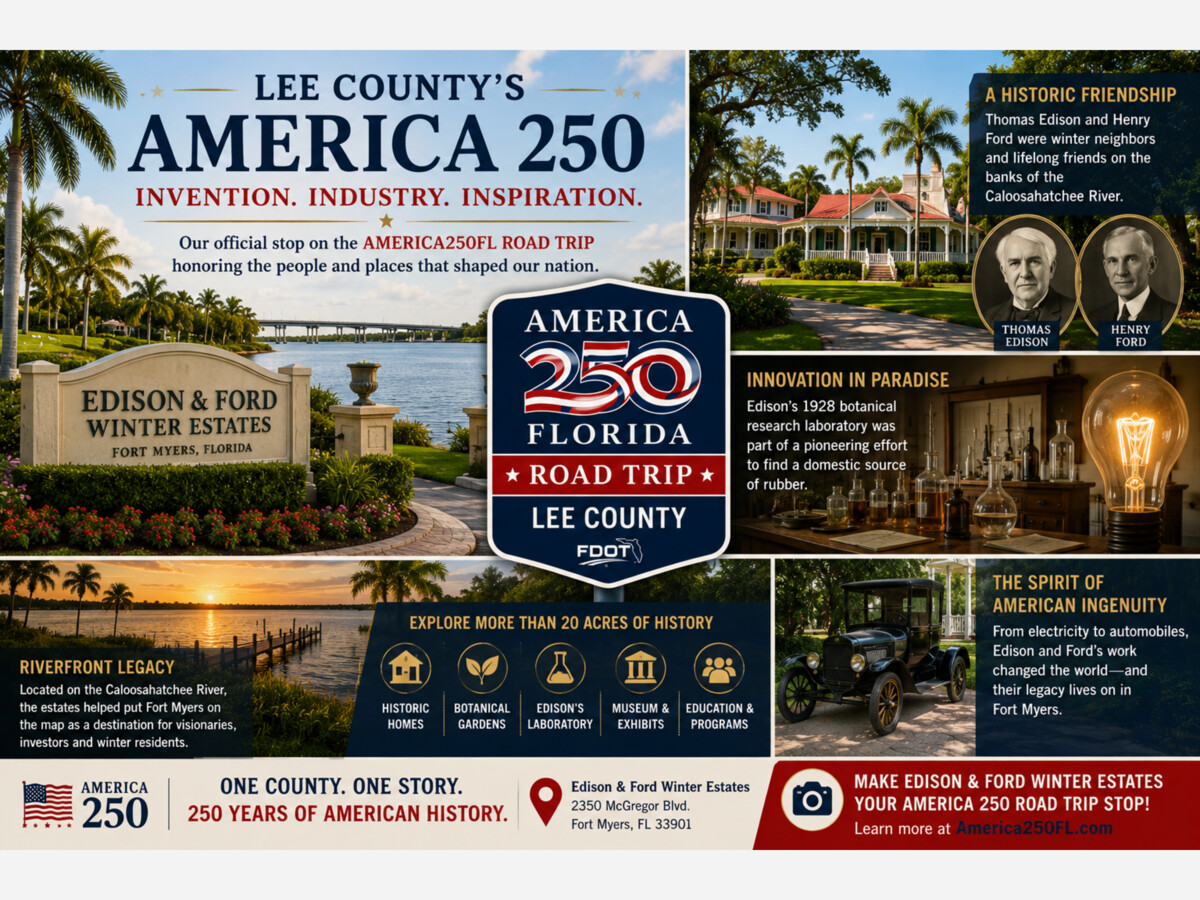



The Fort Myers landmark is Lee County’s official stop on Florida’s America 250 Road Trip, giving Cape Coral and Fort Myers residents a local connection to invention, industry and Southwest Florida history.
LEE COUNTY — Lee County has one official stop on Florida’s America 250 Road Trip, and it is one of Southwest Florida’s most recognizable historic landmarks.
Edison and Ford Winter Estates in Fort Myers is listed as an official stop on the America 250 Florida road-trip map and is the only stop within Lee County. A large sign has been installed near the main parking lot for visitors who want to document the stop as part of the statewide celebration. [1]
For Cape Coral and Fort Myers residents, the designation gives Lee County a direct place in Florida’s commemoration of America’s 250th birthday.
The estates sit at 2350 McGregor Boulevard in Fort Myers, along the Caloosahatchee River. The site includes the winter homes of Thomas Edison and Henry Ford, more than 20 acres of gardens, historic buildings, a museum and Edison’s botanical research laboratory. [2]
That gives Lee County a different kind of America 250 story.
This is not a battlefield story. It is not a courthouse story. It is a story about invention, winter tourism, friendship, industry and the way Southwest Florida became part of America’s modern age.
Thomas Edison first came to Fort Myers in 1885 and purchased 13 acres of land along the Caloosahatchee River for $2,750. The property became known as Seminole Lodge and was designed as a winter retreat with homes, gardens and a laboratory. [3]
At the time, Fort Myers was still a small frontier town. Edison’s arrival helped put the area on the map for wealthy winter residents, investors, inventors and visitors.
Henry Ford’s connection came later. Ford and his family first visited the Edisons in Fort Myers in 1914. In 1916, Ford purchased the property next door, a bungalow estate known as The Mangoes. [4]
The two men were not just famous neighbors. Their friendship connected Fort Myers to some of the biggest forces that shaped American life: electricity, automobiles, mass production, transportation and the culture of invention.
One of the most important parts of the site is the Edison Botanical Research Laboratory. Visitors can still see the 1928 laboratory, where Edison, Ford and Harvey Firestone pursued research into finding a domestic source of rubber. [5]
That detail gives the Lee County stop national weight.
The work done in Fort Myers was tied to a practical American concern: dependence on foreign rubber. Edison’s laboratory was not a tourist prop. It was part of a real effort to solve an industrial supply problem.
That makes Edison and Ford Winter Estates more than a pleasant historic home tour. It is a place where visitors can see how private retreat, scientific curiosity and national industry overlapped in Southwest Florida.
The estates also tell a preservation story.
Edison Ford says the site has been open to the public since 1947 and is a National Register Historic Site. Today, it remains one of the region’s signature cultural attractions, drawing visitors to its historic homes, museum, gardens and laboratory. [2]
For Lee County, the America 250 designation is well-timed.
Southwest Florida is still recovering, rebuilding and redefining itself after years of storms, growth and pressure on local infrastructure. Much of the county’s modern identity is tied to beaches, boating, retirement communities, real estate and tourism. Edison and Ford Winter Estates reminds residents that Lee County’s story also includes science, industry, experimentation and national ambition.
For Cape Coral residents, the stop is close enough for an easy day trip. For Fort Myers residents, it is a local landmark worth seeing again with fresh eyes.
Many locals know the estates as a school field-trip destination or a place to take visiting relatives. America 250 reframes it as part of a larger national story.
That story is not only about Thomas Edison and Henry Ford as famous names. It is about why they came to Fort Myers, what they built here and how their presence helped shape the county’s future.
Edison brought invention culture to the Caloosahatchee. Ford brought the automobile age next door. Together with Firestone, they brought research and industry into a riverfront setting that still stands today.
America’s 250th birthday will be marked across the country. In Lee County, the story is already visible along McGregor Boulevard.
The county’s official America 250 stop is not just a historic house.
It is a reminder that innovation does not always happen in laboratories hidden away from the world. Sometimes it happens in gardens, on porches, beside a river and in places that later generations have to choose to preserve.
[1] Visit Fort Myers, “Celebrate the nation’s 250th anniversary at Edison and Ford Winter Estates.”
[2] Edison and Ford Winter Estates, “Historic Homes.”
[3] Edison and Ford Winter Estates, “Historical People & Places: Edison’s Seminole Lodge.”
[4] Edison and Ford Winter Estates, “Historical People & Places: Ford’s The Mangoes.”
[5] Edison and Ford Winter Estates, “Historic Homes” and Edison Botanical Research Laboratory information.


Sunny, with a high of 83 and low of 70 degrees. Sunny in the morning, patchy rain nearby during the afternoon, partly cloudy in the evening, clear overnight.