81° and Overcast
Image



If you think the public has only heard pieces of the Juvenile Welfare Board controversy, we encourage you to read this entire lengthy report with detailed citations. You can subscribe for free to Tidings Media for future updates.
This article is based on public documents, public meeting materials, official JWB records, and prior media reports cited below. Tidings Media welcomes factual corrections, responses, and additional documentation from any person or organization mentioned.
The article is based on public records, public meeting materials, official JWB documents, prior media reporting, and public board actions. It does not rely on any confidential sources, private interviews, leaked materials unless reported elsewhere, or nonpublic information.
Tidings Media will also consider a free community promotional article submission from any named nonprofit organization whose mission and submission are consistent with Tidings Media’s editorial standards. Tidings Media supports people and organizations that support children, and we welcome the opportunity to highlight organizations doing meaningful work for children and families in Pinellas, Pasco and Hillsborough Counties.
Any formal response from the JWB Governing Board as a body will be published in full, subject only to ordinary editorial limitations for length, legality, relevance, and clarity. That includes a response focused on JWB’s future vision, mission, and priorities rather than the controversy addressed in this article. Individual board members are also welcome to respond or leave a comment on the article.
Pinellas County has a taxpayer-funded power center most residents barely know exists.
It does not look like the County Commission. It does not draw the daily attention of city councils. It does not usually pack a room with angry taxpayers. But the Juvenile Welfare Board of Pinellas County controls one of the largest local streams of children-and-family funding in the county, and the fight over who gets to run it has exposed a much larger public question:
Who controls the children’s money?
The Juvenile Welfare Board, commonly called JWB, is an independent special taxing district created to fund programs for children and families. Its mission sounds almost impossible to oppose. JWB funds early childhood programs, school readiness, school success, child abuse prevention, children’s mental health, hunger initiatives, literacy programs, family support, neighborhood family centers, youth mentoring and other services that reach deep into Pinellas County’s nonprofit and government ecosystem.[1]
That is the public-facing story.
The deeper story is that JWB is also a taxpayer-funded institutional hub. Its board includes elected officials, public officials, gubernatorial appointees and people connected to the local nonprofit and public-sector world. Its budget gives it enormous leverage over agencies that depend on government funding. Its CEO helps shape which programs are recommended, which agencies are monitored, which contracts continue, and which dollars are moved.
That makes the CEO search more than a personnel dispute. It makes it a fight over control of a major local funding system.
For fiscal year 2026, JWB’s total budget is $156.2 million. Its budgeted property tax revenue you pay to fund JWB is $111.5 million. The budget includes $113.1 million for children and family programs, $15.3 million for general government, and a projected ending fund balance of $27.8 million.[2] We at Tidings Media support the stated mission of the Juvenile Welfare Board 100%.
Those financial and tax spending numbers matter because JWB is not just another nonprofit. It is a taxing authority. Its revenues come primarily from "ad valorem" property taxes, with a current millage rate of 0.8250. In plain English, Pinellas property owners are paying into this system whether they follow JWB politics or not.[3] They're a separate taxing authority and a line item on your tax bill.
JWB does not make money in the market sense, it only spends money. It does not sell a product, generate a profit, or compete for customers. It exists to collect and spend public money.
That distinction matters. JWB is often discussed in the language of charity, compassion and children’s services. But financially, this is not a charity bake sale. It is a special taxing district with a nine-figure public annual budget. Every year, tens of millions of dollars are routed from Pinellas County taxpayers into programs, agencies, contracts, administrative salaries, consultants, software, oversight systems and grant recipients.
The size of the internal operation is also larger than many residents would expect. When JWB announced former CEO Beth Houghton’s retirement in 2025, the agency said she most recently oversaw a $133.2 million annual program and general government budget and a workforce of 76 employees.[4] Under interim CEO Michael Mikurak, St. Pete Catalyst later reported that JWB had 79 employees and a $132.2 million impact budget.[5] And, the spending numbers are only increasing.
JWB’s FY2026 budget later described a reduction of 2.5 full-time equivalent positions as part of its administration budget changes, while still including a 3% cost-of-living adjustment to maintain “current, competitive market compensation” for staff.[6]
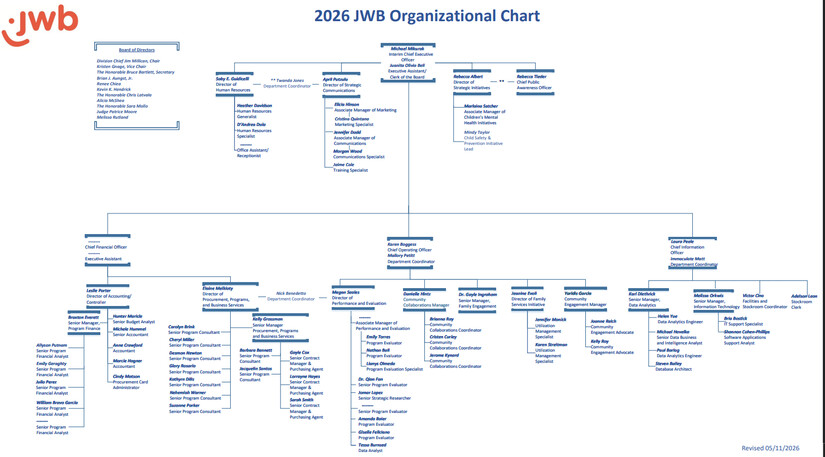
JWB’s FY2026 budget includes an organizational chart showing the internal structure behind the taxpayer-funded agency. The agency publicly described former CEO Beth Houghton as overseeing a $133.2 million annual budget and a workforce of 76 before her 2025 retirement.
The CEO compensation package also reflects the scale of the job. When JWB posted the CEO job in December 2025, the advertised compensation range was $200,000 to $245,000, with participation in the Florida Retirement System and other employee benefits available to JWB employees.[7]
That range did not appear out of nowhere. In 2021, then-board chair Michael Mikurak supported increasing Houghton’s base salary to $200,000 after JWB reviewed CEO salaries at children’s services councils in Broward, Palm Beach, Miami-Dade and Hillsborough counties. According to JWB minutes, Mikurak said the increase would also bring JWB to the correct market range if a new CEO needed to be hired.[8]
The same 2021 discussion noted that Houghton received a $700 monthly car allowance and the same cell phone stipend available to other JWB employees.[9]
The compensation package later grew. In 2022, JWB board materials recommended increasing Houghton’s base salary from $200,000 to $220,400, retroactive to Oct. 1, 2022, and raising the CEO automobile allowance to $1,000 per month.[10] Houghton’s original employment agreement also provided for Florida Retirement System Senior Management Class enrollment, executive-management benefits, 240 hours of annual leave each year, professional dues and travel provisions, and 12 weeks of salary severance if terminated without cause and if she signed a release of claims.[11] It's not a crazy salary for an organization that oversees this much spending, and this large of a staff.
None of that proves wrongdoing. But it does prove this is not a small children’s charity quietly passing around donations. It is a taxpayer-funded institution with a large staff, executive compensation, government benefits, a public budget exceeding $150 million, and enormous influence over which agencies receive public money.
The person who runs JWB is not simply managing office staff. The CEO sits at the center of a public-money pipeline that reaches across nonprofits, schools, health providers, local governments, contractors, consultants and politically connected civic organizations.
JWB says it invests in high-quality programs and partnerships aligned with its strategic plan. The organization says its investments support early childhood development, school readiness, school success, prevention of child abuse and neglect, strengthening community and organizational capacity.[12]
But the practical question is not whether children need help. They do.
The question is whether the public can clearly see how these dollars are steered, who benefits from them, how funding decisions are reviewed, and what happens when employees, board members, or other stakeholders raise concerns.
The Juvenile Welfare Board controversy became so unusual that one of the early warning signs involved a former interim CEO hiring one of the attorneys from the Hulk Hogan lawsuit against Gawker.
Michael Mikurak retained attorney Shane Vogt, whose firm publicly identifies him as part of the legal team that represented Terry Bollea, better known as Hulk Hogan, in the invasion-of-privacy case against Gawker. Vogt’s firm says he helped lead the team that represented Hogan in the jury trial over Gawker’s publication of a nonconsensual sex tape.[13]
Now that same legal firepower has shown up in the middle of a Pinellas County children’s funding board.
According to local reporting republished by JWB, Vogt alleged that gubernatorial appointee Renee Chiea defamed Mikurak during a February JWB meeting when she said Mikurak was not right for the CEO job and raised concerns about past spending while he was a board member. Vogt threatened to sue over Chiea’s comments and over the way the CEO search was conducted. He also sent a demand letter to JWB seeking records from board members’ phones.[14]
That is not normal public-agency turbulence. That is a children’s welfare board turning into a legal circus.
The escalation did not stop with a threat letter. Vogt later submitted a settlement proposal that would have called off the CEO search, restarted the process with a national search firm, installed Mikurak as CEO until June 2027 while that search was underway, and paid Mikurak $50,000 to resolve civil claims against Chiea plus another $50,000 in attorneys’ fees.[15]
The draft settlement offered by Mikurak's legal team reportedly would be a compromise of disputed claims, not an admission of liability or wrongdoing. Mikurak told the Tampa Bay Times he wanted the proposal to speak for itself.[16]
Available public records and local reporting reviewed by Tidings Media did not show whether the threatened legal escalation involving Chiea or the JWB board has been fully resolved. JWB has since restarted the CEO search, Mikurak’s interim contract concluded June 1, and COO Karen Boggess was named interim CEO while the board pursues a new executive search process.[17]
That may be described publicly as a reset. It also raises the obvious question of whether the reset will produce real independence or simply a quieter, less controversial institutional choice.
JWB’s own budget documents show the size of the operation. The largest FY2026 program categories include out-of-school time programs at about $21.3 million, behavioral health at about $20.2 million, parent education and family support at about $12.3 million, family stabilization at about $8.6 million, early learning centers at about $7 million, neighborhood family centers at about $6.9 million, childhood hunger at about $5.5 million, and literacy at about $5.4 million.[18]
Those program names sound straightforward. The decision-making behind them is more complicated.
JWB says its investments are driven by funding principles and competitive procurements aligned with its strategic plan. Its public funding page says investments fall within strategic result areas that include Early Childhood Development, School Readiness, School Success, Prevention of Child Abuse and Neglect, and Strengthening Community.[19]
JWB’s CEO job description makes clear that the CEO has major influence over the system. The CEO works with the board to develop plans, establish policies for evaluating funding requests, monitor funded programs, prepare the annual budget and millage levy, oversee financial management, partner with agencies and local governments, and ensure measurable outcomes tied to Pinellas taxpayer dollars.[20]
A CEO at JWB is not merely managing an office. The CEO sits near the center of a countywide funding system that touches nonprofits, schools, government agencies, contractors, public officials and politically connected institutions.
JWB’s public policies say funds entrusted by Pinellas taxpayers are supposed to promote countywide programs and initiatives that make a clear and visible impact and are cost-effective. The policies also say JWB makes efforts to coordinate with other planning and funding agencies to eliminate unnecessary duplication and maximize resources.[21]
On paper, that is a control system.
In practice, the public must still ask whether the control system is being used aggressively enough, whether the board receives enough independent scrutiny, and whether the structure creates incentives that make public criticism, internal dissent or independent review more difficult.
One recent discussion should concern taxpayers. At an April 2026 board meeting, JWB staff discussed 15 agencies with program budget advances totaling $1.88 million, most of which were issued in 2019. Staff described the advances as interest-free loans JWB had been carrying on its books. In 2026, JWB sent letters seeking repayment, saying the goal was to reduce financial risk without creating hardship for agencies.[22]
That does not prove corruption. It does prove that JWB had enough discretion over public funds that millions of dollars could sit for years as advances to agencies, later requiring a formal discussion about getting the money back.
That is exactly the kind of issue a strong financial watchdog would be expected to question.
JWB does have outside financial audits. The question is whether those audits are enough for the kind of controversy now surrounding the agency.
JWB’s public budget page says its audited financial statements are posted online, and that prior-year audited financial statements can be viewed through the Florida Auditor General’s website.[23] Its special district accountability page also links to the final complete audit report for the most recent completed fiscal year and says JWB’s fiscal year runs from Oct. 1 through Sept. 30.[24]
For FY25, JWB’s independent auditor was Cherry Bekaert LLP. Finance Committee materials from April 2026 state that Cherry Bekaert completed JWB’s annual audit for FY25 and that this was the firm’s eighteenth year providing audit services to JWB.[25]
Eighteen years with the same outside auditor does not prove a problem. But it is another reason taxpayers should not be expected to accept “we have an audit” as the end of the conversation.
JWB’s bylaws, as described in those Finance Committee materials, say the Finance Committee assists the board by reviewing financial reports provided by the independent auditor. The committee is also supposed to annually review JWB’s financial condition and operating results with management and report any issues or concerns to the Executive Committee.[26]
That is important. It means JWB is not operating without an annual outside financial audit.
But a clean financial-statement audit does not answer every public-integrity question now facing JWB. An annual audit is designed to test whether the financial statements are fairly presented and whether certain internal-control and compliance issues must be reported. It is not the same thing as an independent forensic audit of the CEO search, board communications, contract-renewal patterns, retaliation allegations, political pressure, grant scoring, or whether funded agencies and institutional stakeholders have too much influence over the system.
JWB’s own solicitations page now says the agency is seeking proposals from CPA firms to audit its financial statements beginning with the fiscal year ending Sept. 30, 2026.[27] That may be routine. But after 18 years with the same outside audit firm, a CEO search that collapsed under legal threats and political controversy, and a fired CFO alleging retaliation, taxpayers deserve more than routine.
That is why the next step should be public-facing transparency, not just another assurance letter. Taxpayers should be able to see the audits, the management letters, the internal-audit summaries, the contract-renewal history, the grant-scoring process, the agency performance scorecards, the repayment status of old advances, and any communications that shaped the failed CEO search.
Annual outside audits matter.
But in a $156 million taxpayer-funded institution, sunlight matters more.
This should not be treated as an attack on children’s services. Tidings Media supports people and organizations that support children.
Sunlight is the best disinfectant. JWB should welcome it. If JWB’s mission is to protect children and strengthen families, then the public deserves confidence that the money is being spent based on need, outcomes, integrity and transparency, while avoiding even the appearance that relationships, institutional habit or political comfort influence funding decisions.
In June 2024, JWB publicly announced Robbi Stivers as its new chief financial officer. At the time, the organization praised his more than 20 years of government finance experience, his knowledge of risk assessment and mitigation, and his track record for accountability and transparency. JWB said Stivers would be responsible for sound fiscal and contracting policies, accounting, budget preparation and analysis, procurement, contract management, and program finance.[28]
Less than two years later, Stivers was out.
Stivers applied for the CEO position but was not selected as a finalist. He later accused interim CEO Michael Mikurak of retaliation and misuse of public funds, according to local reporting. The same reporting says Stivers was placed on leave and dismissed after complaints were filed against him, while Stivers called the complaints unfounded and retaliatory. Mikurak denied the retaliation claim and said the matter involved documented human-resources complaints that required legal review.[29]
The Tampa Bay Times reported that on Feb. 18, 2026, Stivers filed notice that he intended to sue the Juvenile Welfare Board for unlawful retaliation.[30]
Those allegations remain unresolved, and they should be treated as allegations unless and until proven through records, investigation, settlement, or litigation.
But the timeline is what makes the matter impossible to dismiss.
A CFO hired and publicly praised for accountability later raises concerns, applies for the CEO job, is passed over, is placed on leave, is fired, and then files notice of intent to sue for retaliation.
That is not a routine personnel matter. That is a public-integrity warning sign.
The CEO search began after Beth Houghton’s retirement and quickly turned into a test of who controls JWB’s future.
The board selected finalists, and the process eventually centered around interim CEO Michael Mikurak and outside candidate Glen Gilzean Jr., a former Orange County Supervisor of Elections. Local reporting described controversy from Gilzean’s prior Orange County role, including allegations and questions about spending during his tenure. Gilzean denied wrongdoing, and this article does not report that he has been found liable for misconduct.[31]
Then came the first vote.
On April 6, the JWB board voted 6-5 to hire Gilzean as CEO. The Tampa Bay Times reported that DeSantis appointees Melissa Rutland, Brian Aungst Jr., Kristen Gnage, Alicia McShea and Renee Chiea voted for Gilzean, with Public Defender Sara Mollo providing the tiebreaking vote.[32]
But that vote was not enough to finish the appointment. Under the board’s process, Gilzean still needed a second approval before the appointment became official.[33]
That second step is where the process broke.
By the time the board returned to the issue in May, the legal and political pressure around the search had intensified. Mikurak’s attorney had sent a demand letter. Board members’ phone records had become part of the controversy. Questions about political pressure had spilled into public reporting. The board was no longer simply choosing between two finalists. It was trying to survive the fallout from the search itself.
Then Brian Aungst Jr. changed the direction of the process.
Aungst had voted for Gilzean in April. But at the May meeting, he pushed to restart the process instead. According to local reporting, Aungst said, “The best thing for this organization, to get us back on track, to stop the insanity, would be to ask staff to bring back options on June 25 for a professional search firm. Start the process over.”[34]
Five board members ultimately voted to restart the CEO search: Aungst, Pinellas County Commissioner Chris Latvala, Circuit Judge Patrice Moore, Board Chair Jim Millican, and gubernatorial appointee Melissa Rutland. Four members dissented: Public Defender Sara Mollo and gubernatorial appointees Renee Chiea, Alicia McShea and Kristen Gnage. Superintendent Kevin Hendrick left the meeting for another obligation, and State Attorney Bruce Bartlett was out of town.[35]
The motion to restart passed 5-4. The practical effect was decisive: Gilzean had won the first vote 6-5 in April, but the second approval never happened. Instead, the board scrapped the search, prevented Gilzean’s appointment from receiving final approval, and started over with a contracted executive search firm.[36]
JWB then appointed Chief Operating Officer Karen Boggess as interim CEO while the new search moves forward. JWB’s own announcement said Mikurak’s interim contract would conclude June 1, 2026, and that Boggess would serve as interim CEO to ensure continuity of leadership and operations.[37] She seems like a logical interum choice, although she's not expected to participate in the candidacy for a permanent CEO position.
JWB’s public statement framed the restart as a move toward continuity and a thorough search. That is the safe institutional version.
The public record suggests something more volatile.
Before the restart, Mikurak’s lawyer proposed a settlement that would call off the CEO search, restart the process with a national search firm, install Mikurak as CEO until June 2027, and pay $50,000 to resolve civil claims involving board member Renee Chiea, plus $50,000 in attorney’s fees, according to local reporting.[38]
That is extraordinary.
A public agency’s CEO search had reached the point where the interim CEO’s lawyer reportedly proposed a structure that would have had the practical effect of ending the pending CEO vote, restarting the search, keeping Mikurak in the interim role, and resolving disputed civil claims tied to board member Renee Chiea, who had publicly questioned him.
Taxpayers should not be expected to shrug at that.
One of the most important figures in this fight is Renee Chiea, a gubernatorial appointee to the JWB board.
Chiea is not one of the five ex-officio officials who sits on the board because of another public office. She is an unpaid gubernatorial appointee. JWB’s own board policies state that board members receive no salary or other compensation for service, although members may receive reimbursement for travel and related expenses when the travel is in JWB’s interest.[39] Chiea is a government employee like several of the other board members, but does not serve on the board because of her employee classification like several of the other board members do.
That distinction matters. Chiea was politically appointed, but she is not sitting there as the county commissioner, the school superintendent, the public defender, the state attorney or a juvenile judge. She is a citizen appointee with a background in health policy, compliance and government-regulated systems.[40]
According to local reporting republished on JWB’s own website, Mikurak’s lawyer alleged that Chiea defamed Mikurak at a February meeting when she said Mikurak was not right for the job and raised concerns that a board had misspent money years ago when he was a board member. The lawyer threatened legal action and sought records from board members’ phones.[41]
Board minutes from April also reflect that a demand letter to Chiea threatened legal action, and that Chiea’s attorney responded. The minutes say the attorney believed the accusations may have been based on speculation and preferred the matter be part of the public record.[42]
That matters because Chiea has been one of the more visible board members publicly raising concerns about the process.
Disclosure: Renee Chiea has connections to Tidings Media founder David Happe through mutual activism at the local school board. Happe participated in the reporting, framing and construction of this article. Renee Chiea was not interviewed, consulted, or used as a source for this article.
The fact that this disclosure is necessary for transparency does not make the questions about JWB tainted or less relevant. It makes transparency more important.
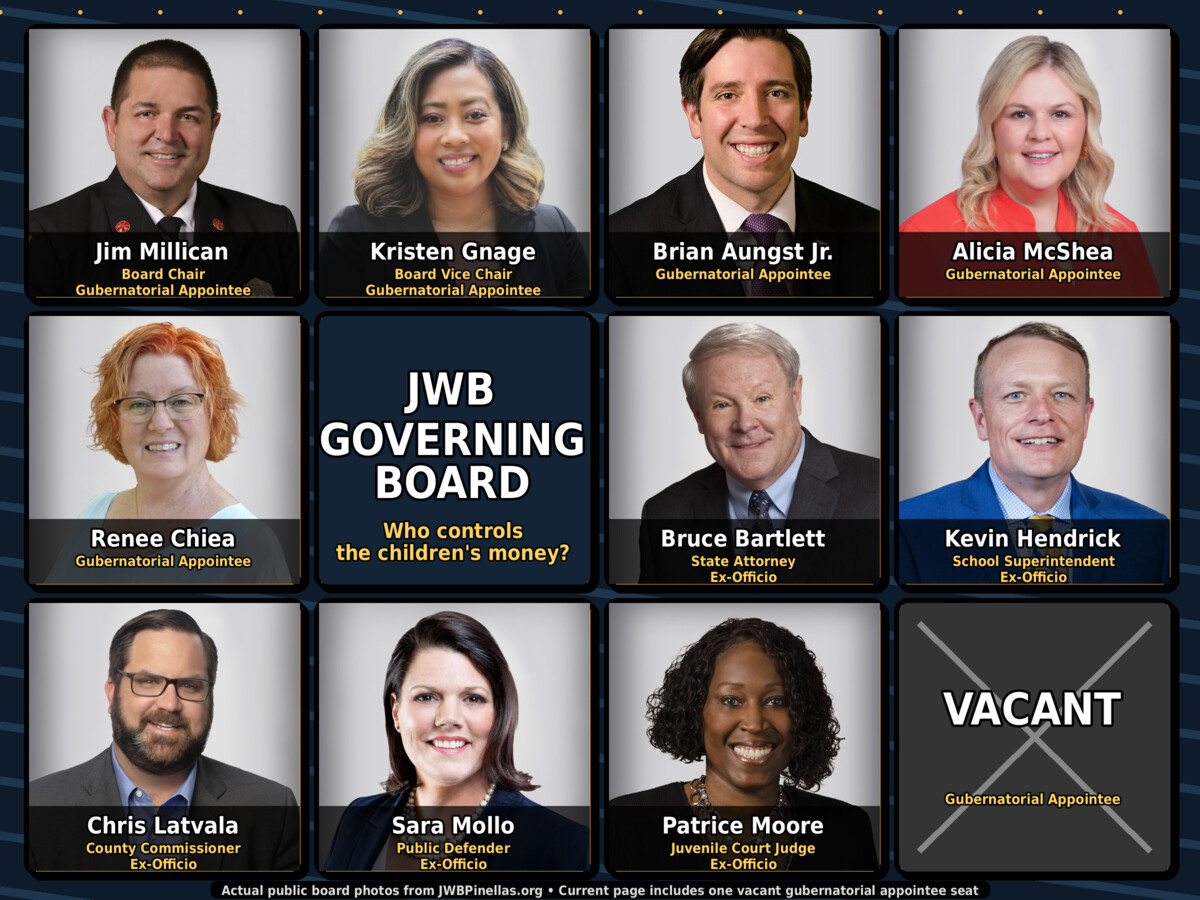
JWB is governed by an 11-member board. Six members are appointed by the Florida governor. Five are ex-officio members who serve because of the office they hold: the State Attorney, Public Defender, Juvenile Judge, County Commissioner, and School Superintendent.[43]
The current board includes major public offices and political figures, including Pinellas-Pasco State Attorney Bruce Bartlett, Public Defender Sara Mollo, Pinellas County Schools Superintendent Kevin Hendrick, Pinellas County Commissioner Chris Latvala, and Circuit Judge Patrice Moore, along with gubernatorial appointees including Jim Millican, Kristen Gnage, Brian Aungst Jr., Renee Chiea and Alicia McShea.[44]
That structure is important. JWB is often discussed as if it is only a children’s agency. It is also a political board that controls taxpayer funds.
The Tampa Bay Times reported that records from board members’ phones showed Aungst texted prominent Republicans around the state about votes for Gilzean being “gettable” from county officials and that he would “get it done.” Aungst told the Times he was simply letting people who knew and supported Gilzean know about the opportunity to support him.[45]
That is exactly the kind of record that shows how a supposedly quiet children’s board can become a political battlefield.
JWB’s structure is partly fixed by law. The board has 11 members: six appointed by the governor and five ex-officio members connected to public offices. Those ex-officio seats are the State Attorney, Public Defender, Juvenile Judge appointed by the Chief Judge, County Commissioner, and School Superintendent.[46] The structure makes sense as all of those elected officials work in areas as stakeholders to Juvenile Welfare and government spending oversight.
That means the public cannot simply vote out the entire JWB board at once. But that does not mean the current lineup deserves to stay frozen in place after this level of turmoil.
The County Commission can and should appoint a different commissioner to the JWB seat. The Chief Judge can and should consider whether a different eligible juvenile-division judge should serve. The governor can and should review the appointed seats as terms expire or vacancies arise. And the ex-officio officeholders should publicly explain whether they believe they can credibly restore confidence after a CEO search that collapsed under legal threats, political-text controversies, retaliation allegations and a failed final appointment process.
This is not personal. It is governance. Everything discussed above happened on the watch of the current board, and not one of the members conduct is above scrutiny by the taxpayers.
The law may require a county commissioner, a judge, a school superintendent, a state attorney and a public defender to be part of the board. It does not require the public to pretend this board has handled the last year well.
A clean slate is not always possible in government. But fresh faces, fresh oversight and fresh accountability are possible.
For a board that controls more than $150 million in annual taxpayer money for children and families, that should be the minimum expectation.
The next layer of this story is the money.
JWB’s FY2026 budget lists $113.1 million in children and family services programs. The largest budgeted recipients and program lines include the Florida Department of Health’s Pinellas County Health Department at about $11.4 million, R’Club Child Care at about $10.8 million, Directions for Living at about $7 million, Suncoast Center at about $6.8 million, Boys & Girls Clubs of Tampa Bay at about $5.7 million, The Children’s Home Network at about $5.1 million, and the St. Petersburg Free Clinic at about $5 million.[47]
That is where the public should start asking harder questions.
Most of these organizations do valuable work. Many serve vulnerable children and families. But that does not make them immune from scrutiny. When an agency receives millions of taxpayer dollars from a board that includes elected officials, public officials and politically connected appointees, the public has a right to understand the full relationship between public funding, agency leadership, lobbying activity, board relationships, campaign contributions by individuals, political committees, consultants, vendors and elected officials.
Because many JWB-funded agencies are charitable nonprofits, direct candidate contributions by the organizations themselves would raise serious tax-law concerns. Federal rules generally prohibit 501(c)(3) organizations from intervening in political campaigns for or against candidates.[48]
That means the money trail may not be as simple as a nonprofit writing a campaign check.
The public should instead look at the whole circle: agency executives, board members, paid consultants, lobbyists, vendors, law firms, political committees, event sponsorships, gala networks, campaign hosts, personal donations, and elected officials who later sit in judgment over the agencies’ funding streams.
That is the real question.
Does JWB operate as a clean public funding board that objectively measures outcomes for children? It might.
Tidings Media is reviewing campaign-finance records tied to the largest JWB-funded organizations, their senior leaders, vendors, and politically active allies. At this stage, we are not reporting that any specific JWB-funded nonprofit made an improper candidate contribution. We are reporting that the size of the funding stream, the political makeup of the board, the CEO-search turmoil, the firing of a CFO who now alleges retaliation, and the legal threats and demand letters involving Chiea make this a public-integrity issue that demands a full money trail. We have no record or allegation of any wrongdoing at this point. It's just time the public started watching this with interest. There's a lot of money flowing through the JWB.
Nothing in this article alleges that any named JWB-funded nonprofit, executive, board member, vendor, consultant, or law firm violated campaign-finance law, tax law, lobbying rules, procurement rules, or JWB policy. The point is that a public funding stream of this size deserves transparent review.
Local media has covered pieces of the controversy. The Tampa Bay Times has reported on the messy CEO search, the Gilzean vote, the Stivers notice of intent to sue, political pressure allegations, the legal threats, and the board’s decision to restart the process. The St. Pete Catalyst has reported on Mikurak’s denial of retaliation allegations, Stivers’ accusations, Gilzean’s Orange County scrutiny, and the appointment of Karen Boggess as interim CEO.[49]
But the larger story is bigger than board drama.
The larger story is the public-money ecosystem around JWB.
Who has received JWB money for years? Which contracts are renewed without meaningful competition? Which programs, if any, fail performance expectations but remain funded? Which agencies received advances, and why were they not collected sooner than now? What did Stivers believe he found? What did Chiea see that made her willing to challenge the process publicly? Why did the CEO search become a legal battlefield instead of a clean public process?
Those are the questions that now matter and are worthy of further tracking and discussion.
JWB’s board has now restarted the CEO search. Officially, this is being framed as a chance to conduct a thoughtful and comprehensive recruitment process. Maybe it will be.
But the public should recognize what happened first.
Gilzean had a 6-5 vote in April. Then the board needed a second approval. Then Brian Aungst Jr., who had voted for Gilzean the first time, pushed to restart the process instead. Then the board voted 5-4 to scrap the search. Then JWB appointed Chief Operating Officer Karen Boggess as interim CEO while a new search begins.
That sequence matters because it shows the restart was not merely an orderly governance decision. It followed months of infighting, legal threats, public-record controversies, a failed final appointment process, and a board that could not hold together long enough to complete its own CEO selection.
A restart buys time.
It removes the immediate pressure of the Gilzean vote. It allows the process to settle back down. It gives elected officials, appointees, funded agencies and other stakeholders time to reassess the process and the candidates before the board makes a final decision.
That may produce a qualified CEO. It may also produce a CEO who is acceptable to the existing political and nonprofit establishment.
The public will not know which unless this process is watched closely from the beginning.
The next CEO should be asked direct questions in public. Will they release a full list of funded agencies, contract amounts, renewals and performance results in a clear public database? Will they identify all agencies with prior advances or repayment issues? Will they release CEO-search communications to the fullest extent allowed by law? Will they protect employees who raise financial concerns? Will they allow an outside independent forensic review of disputed spending and contract practices? Will they commit to publishing plain-English scorecards for every major program?
If the answer is no, taxpayers should understand what that means.
The easiest way to avoid scrutiny at JWB is to hide behind the word “children.” When it comes to kids, this is the one area where there is general alignment, in that we all want what is best for the kids. The amount of money being spent by JWB might be right. It might even be not enough. The controversy has consumed enough public attention that recent JWB meetings can feel more focused on governance turmoil than on the child-welfare mission the agency exists to serve.
Nobody wants to be accused of opposing child welfare, mental health, hunger programs, early learning, or child abuse prevention. But supporting children does not require blind trust in a local funding system. In fact, if the children are the mission, accountability should be stronger, not weaker.
A $156 million public budget deserves scrutiny.
A $111.5 million property-tax stream deserves scrutiny.
A fired CFO alleging retaliation deserves scrutiny.
A CEO search disrupted by legal threats, political text messages and a 6-5 vote that never became a final appointment deserves scrutiny.
A board member facing legal threats after raising integrity concerns deserves scrutiny.
Pinellas County taxpayers should stop treating the Juvenile Welfare Board as a quiet children’s agency and start treating it as what it is: one of the most powerful local government funding centers in the county.
The children deserve services that work.
The taxpayers deserve to know where the money goes.
And the people inside the system who ask hard questions deserve protection, fair treatment and a process the public can trust.
[1] Juvenile Welfare Board of Pinellas County, FY25 Annual Report; JWB Funding Opportunities and Strategic Plan materials.
[2] Juvenile Welfare Board FY2026 Budget Book, Budget Overview and Revenues & Expenditures Summary.
[3] Juvenile Welfare Board FY2026 Budget Book; JWB Budget & Financials materials.
[4] Juvenile Welfare Board, “Juvenile Welfare Board CEO Beth A. Houghton Announces Her Retirement,” May 30, 2025.
[5] St. Pete Catalyst, “Meet Juvenile Welfare Board interim CEO Mike Mikurak,” March 3, 2026.
[6] Juvenile Welfare Board FY2026 Budget Book, Budget Overview, describing a 2.5 FTE reduction, 3% cost-of-living adjustment and 7.62% administrative rate.
[7] Juvenile Welfare Board CEO Posting, released Dec. 19, 2025, listing Pay Grade 120 and anticipated salary range of $200,000 to $245,000.
[8] Juvenile Welfare Board board minutes, Nov. 4, 2021, CEO annual evaluation and employment agreement amendment discussion.
[9] Juvenile Welfare Board board minutes, Nov. 4, 2021, discussion of CEO car allowance and cell phone stipend.
[10] Juvenile Welfare Board board materials, Dec. 8, 2022, “Approve Executive Committee Recommendations on Chief Executive Officer’s Annual Evaluation and FY23 Goals.”
[11] Juvenile Welfare Board board materials, July 11, 2019, “Appoint Beth A. Houghton as Chief Executive Officer and Approve Employment Contract and Related Terms,” including Senior Management Class FRS enrollment, 240 hours of annual leave, professional dues and travel provisions, executive-management benefits, and severance terms.
[12] Juvenile Welfare Board FY25 Annual Report; JWB Funding Opportunities page.
[13] Vogt Law, Notable Cases, Terry Bollea/Hulk Hogan v. Gawker.
[14] Tampa Bay Times, “The Pinellas Juvenile Welfare Board Meets Thursday. Is a CEO Vote on the Agenda?”, May 18, 2026; republished by JWB.
[15] Tampa Bay Times reporting republished by JWB, May 18, 2026, describing Mikurak’s April 29 settlement proposal.
[16] Tampa Bay Times reporting republished by JWB, May 18, 2026.
[17] Juvenile Welfare Board, “JWB Governing Board Relaunches CEO Search, Names COO Karen Boggess Interim Leader,” May 21, 2026.
[18] Juvenile Welfare Board FY2026 Budget Book, Revenues & Expenditures Summary.
[19] Juvenile Welfare Board Funding Opportunities page.
[20] Juvenile Welfare Board CEO Posting dated Dec. 19, 2025.
[21] Juvenile Welfare Board Bylaws & Policies page.
[22] Juvenile Welfare Board April 6, 2026 board meeting materials/minutes discussing program budget advances.
[23] Juvenile Welfare Board Budget & Financials page, Audited Financial Statements section.
[24] Juvenile Welfare Board Special District Accountability page, General Financial Information section.
[25] Juvenile Welfare Board Finance Committee Meeting, April 6, 2026, “Recommend Approval of the FY25 Annual Comprehensive Financial Report,” Item II.B.
[26] Juvenile Welfare Board Finance Committee Meeting, April 6, 2026, “Recommend Approval of the FY25 Annual Comprehensive Financial Report,” Item II.B.
[27] Juvenile Welfare Board Solicitations page, Audit Services RFP.
[28] Juvenile Welfare Board June 13, 2024 announcement naming Robbi Stivers CFO.
[29] St. Pete Catalyst, “Meet Juvenile Welfare Board interim CEO Mike Mikurak,” March 3, 2026.
[30] Tampa Bay Times reporting on Robbi Stivers’ Feb. 18, 2026 notice of intent to sue.
[31] Tampa Bay Times and St. Pete Catalyst coverage of the JWB CEO search, Glen Gilzean, Michael Mikurak, and allegations involving the finalists.
[32] Tampa Bay Times, “Pinellas Juvenile Welfare Board poised to name Glen Gilzean CEO,” April 6, 2026.
[33] Tampa Bay Times, “The Pinellas Juvenile Welfare Board Meets Thursday. Is a CEO Vote on the Agenda?”, May 18, 2026; republished by JWB.
[34] Power Broker, “‘Stop the insanity:’ Juvenile Welfare Board restarts CEO search process,” May 23, 2026.
[35] Power Broker, “‘Stop the insanity:’ Juvenile Welfare Board restarts CEO search process,” May 23, 2026.
[36] Tampa Bay Times, “After months of drama, Pinellas Juvenile Welfare Board to start CEO search over,” May 21, 2026; Power Broker, “‘Stop the insanity:’ Juvenile Welfare Board restarts CEO search process,” May 23, 2026.
[37] Juvenile Welfare Board, “JWB Governing Board Relaunches CEO Search, Names COO Karen Boggess Interim Leader,” May 21, 2026.
[38] Tampa Bay Times, “The Pinellas Juvenile Welfare Board Meets Thursday. Is a CEO Vote on the Agenda?”, May 18, 2026; republished by JWB.
[39] Juvenile Welfare Board Board Policies, V-9, Authorized Expenditures.
[40] Juvenile Welfare Board profile for Renee Chiea; Executive Office of the Governor appointment announcement.
[41] Tampa Bay Times reporting republished by JWB on May 18, 2026.
[42] Juvenile Welfare Board April 6, 2026 board meeting minutes.
[43] Juvenile Welfare Board Governing Board page.
[44] Juvenile Welfare Board Governing Board page and April 6, 2026 board meeting minutes.
[45] Tampa Bay Times reporting republished by JWB on May 18, 2026.
[46] Juvenile Welfare Board Governing Board page; Florida Attorney General informal opinion, June 28, 2011, summarizing Chapter 2003-320, Laws of Florida, and the JWB board structure.
[47] Juvenile Welfare Board FY2026 Budget Book, Expenditures: Children & Family Programs Alphabetized.
[48] Internal Revenue Service, “Restriction of Political Campaign Intervention by Section 501(c)(3) Tax-Exempt Organizations.”
[49] Tampa Bay Times, St. Pete Catalyst and Power Broker coverage reviewed by Tidings Media.


Light rain shower, with a high of 89 and low of 74 degrees. Overcast in the morning, light rain shower in the afternoon, overcast overnight.