78° and Patchy rain nearby
Image
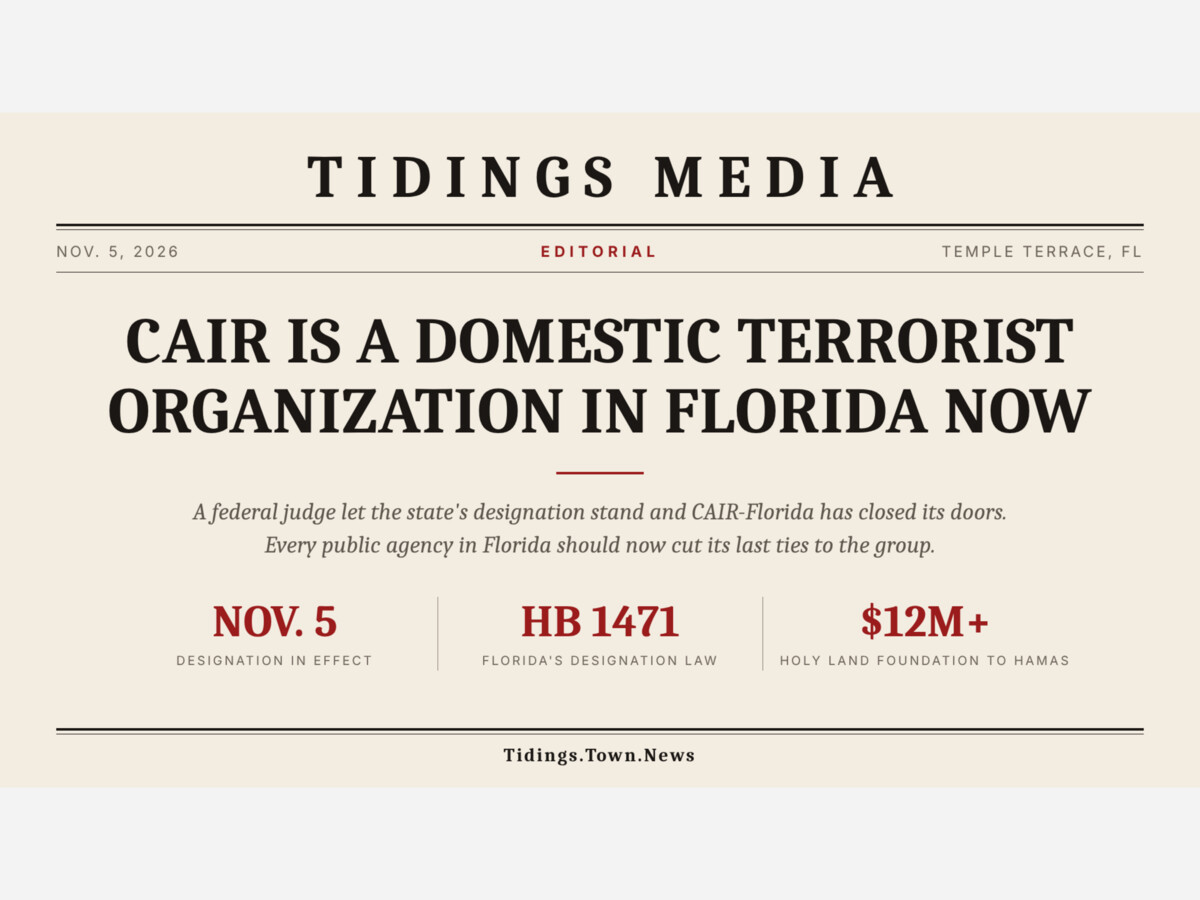



The Council on American-Islamic Relations, a national Muslim advocacy group known as CAIR, became a designated domestic terrorist organization under Florida law on Thursday, along with its state chapter, CAIR-Florida. The designation rests on a law the Legislature passed this year that lets the governor and Cabinet add a group to the state's terrorist list on the recommendation of the Florida Department of Law Enforcement, and they voted to list CAIR in September.[1][2] CAIR asked a federal judge to block the designation, and the judge refused. CAIR-Florida then suspended its operations across the state, stopped accepting donations from Floridians and posted a notice outside its headquarters in Temple Terrace, near Tampa, blaming state officials for the closure.[1][11] Tidings Media believes the state got this right, and the reasons go back nearly two decades to a federal terrorism-financing case in Texas that CAIR has never been able to put behind it.
That case involved the Holy Land Foundation, a Texas-based charity that was once the largest Muslim charity in the United States. The Treasury Department shut it down in 2001 and listed it as a global terrorist entity, and in 2008 a federal jury in Dallas convicted its leaders of sending more than $12 million to Hamas, the group the United States has designated a foreign terrorist organization since 1997.[3][4] Prosecutors named CAIR an unindicted co-conspirator, placing it on a list of people and organizations they identified as part of the scheme but did not charge. CAIR's first office in Washington opened with help from a Holy Land Foundation grant, and its executive director, Nihad Awad, acknowledged in written testimony to the U.S. Senate that the group had received the charity's money.[4][5] Ghassan Elashi, one of the founding board members of CAIR's Texas chapter, was among those convicted in the case.[6]
CAIR later asked the judge who presided over that trial to remove its name from the co-conspirator list, and he refused. In a 2009 order, U.S. District Judge Jorge Solis wrote that the government had produced "ample evidence to establish the associations" between CAIR, the Holy Land Foundation and Hamas.[8] Prosecutors had also presented evidence that CAIR's founders attended a 1993 meeting in Philadelphia with Hamas supporters and Holy Land Foundation officials.[9] The FBI ended its formal working relationship with CAIR in 2008, and the United Arab Emirates added CAIR to its list of terrorist organizations in 2014.[7] The Florida Department of Law Enforcement relied on that record in recommending the designation, along with alleged ties between current CAIR figures and Palestinian Islamic Jihad, another U.S.-designated terrorist group.[2]
Thursday's result was the state's second attempt. Gov. Ron DeSantis first declared CAIR a terrorist organization by executive order last December, and in March a federal judge in Tallahassee blocked that order, ruling that the governor could not impose the label on his own in a way that infringed on the group's constitutional rights.[11] Rather than drop the effort, the Legislature wrote a formal designation process into state law, and the state followed that process this time. The court that heard CAIR's latest challenge allowed the designation to take effect, with one narrow exception that protects lawyers who represent the group.[1] CAIR says it will appeal, which is no surprise from an organization that has spent years taking its critics to court.[12]
For anyone in Florida still thinking about sending CAIR a donation, signing up as a member or doing work on its behalf, the picture is simple. You would be backing a designated domestic terrorist organization, and knowingly providing material support to one is now a crime in this state.[10] CAIR-Florida itself is telling people to stop giving and stop engaging.[11] For once, we agree with them.
Florida shouldn't stop at a closed office. Under the new law, designated groups are cut off from public money, state contracts and certain campus activity.[10] That ought to mean something in every county commission, school district, sheriff's office and public university in the state. The Florida House urged state and local agencies, law enforcement included, to cut ties with CAIR back in January 2024.[13] Any that still treat CAIR as a community partner, invite its people onto panels or let it lead trainings should end it now and say so publicly.
Gov. DeSantis, Attorney General James Uthmeier and the Cabinet took heat for this from the ACLU and the Southern Poverty Law Center, which are representing CAIR in court.[1] They did it anyway, first through the Legislature and then in federal court, and they won the first round. The appeal goes next to the U.S. Court of Appeals for the Eleventh Circuit in Atlanta, and the state should fight it as hard as it fought this one. CAIR spent twenty-five years building its operation in Florida, and Floridians should make sure it stays closed.


Patchy rain nearby, with a high of 84 and low of 72 degrees. Patchy rain nearby during the morning,