Image



I keep hearing the same theory around Tampa Bay. All those new Republican registrations in Florida, the story goes, aren't really Republicans at all. They're Democrats in disguise who switched parties to mess with GOP primaries, and the closed primary doesn't stop them because changing your party online takes about three minutes.
I understand why people believe it. It's easy to do, and it would explain an election that came out a lot closer than the registration numbers said it should. So I went and looked at the research and the state's own numbers. I didn't find any evidence that raiders hijacked anything. What I found is that a lot of registered Republicans didn't bother to vote.
Florida is a closed primary state, which means you have to be registered with a party to vote in that party's primary. The door isn't as wide open as the three-minute website makes it look, though. A party change only counts for a primary if it's made by the registration deadline, the 29th day before the election.¹ For this year's August 18 primary, that deadline was July 20.² Anyone planning to raid had to commit a month ahead, often before they knew which candidate they'd want to sabotage.
Political scientists have studied crossover voting for decades, and the finding hasn't changed much. It's uncommon, and deliberate sabotage is rarer than that. Wisconsin is the cleanest test case, because every voter there can pick either party's primary on the same ballot without registering with anybody. Even there, fewer than 2% of self-identified party members said they planned to cross over, and the ones who do mostly just prefer the other side's candidates or figure their own primary is already decided.³
When parties have gone to court claiming that outsiders were corrupting their primaries, they haven't been able to back it up with evidence.⁴ The best-known organized attempt was Rush Limbaugh's "Operation Chaos" in 2008, when he urged Republicans to vote for Hillary Clinton to weaken Barack Obama. It didn't work.⁵
Over the last couple of years, about 95,000 Florida voters changed their registration to Republican, and just under 40,000 Republicans went the other way.⁶ That leaves a net gain of roughly 55,000. As of September 30, the state had 5,678,755 active registered Republicans and 4,133,397 Democrats.⁷ Even if every one of those net switchers were a saboteur, and the research says they aren't, they'd make up about 1% of the Republican rolls. In retail, that's a rounding error.
The motive usually runs the other way, too. In a lot of Florida counties the Republican primary is the only election that really decides who holds the office. A Democrat or independent who switches so they can have a say in that race wants their vote to count, and that's about as far from sabotage as you can get. Research on states with similar rules found that voters tend to gravitate toward the primary of whichever party is stronger locally, which produces crossover by Democrats in red states.⁸ Those voters are more likely to back the candidate closest to their own views than the weakest one on the ballot.
Three other things account for most of the growth. The first is people moving here. Nearly 444,500 people moved to Florida between July 2021 and July 2022 alone, the biggest one-year move-in the state had seen, and every newcomer who registers changes the math.⁹ The second is housekeeping. When Miami-Dade cleaned up its voter rolls in 2025 and removed more than 172,000 inactive voters, Republicans came out with a net gain of over 38,000, enough to flip the county's registration for the first time.¹⁰
The third is Democrats who never joined the other team at all. They just walked away from their own. Since September 2024, about 113,700 Democrats changed their registration to no party affiliation, compared with about 67,000 Republicans.⁶ That widens the gap between the two parties without adding a single Republican. Party switching is real, but it's the smallest of these pieces.
I spent my career in retail, and a loyalty card isn't a sale. Registration tells you which label somebody picked. It doesn't tell you whether they'll get off the couch on a Tuesday in November. According to The Associated Press's certified count as of November 16 at 3:37 p.m. ET, Byron Donalds won the governor's race with 50.0% of the vote to David Jolly's 48.7%, and AP called the race for Donalds.¹¹ State Affairs put the margin at about 100,000 votes, in a state DeSantis carried by more than 19 points in 2022.¹² Republicans had the numbers on paper. Too many of them weren't inspired enough to show up.
Part of that comes down to how the nominee was chosen. Donalds did win a primary, beating 10 other Republicans,¹³ but it never felt like much of a contest. Trump endorsed him in February 2025, before Donalds had even announced, and that made it all but impossible for anyone else to pose a serious threat.¹⁴ To a lot of rank-and-file Republicans, it looked like the party had made the pick before a single ballot was cast. Donalds also declined to debate his primary rivals, and Lt. Gov. Jay Collins asked on national TV what he was scared of.¹⁵ In the general election, the two campaigns traded blame over debate invitations for weeks until Jolly announced he wouldn't debate at all, and Florida ended up with its first governor's race in more than 50 years without a televised debate.¹⁶ A candidate who never has to make his case on a stage gives his own voters one less reason to care.
The calendar didn't help either. Midterms almost always punish the party in power, and in 2026 that was the Republicans, who held the White House, Congress and Tallahassee. When times get tight, voters blame whoever is holding the keys, even for things that rise and fall with the economy more than with any law. In 2010, Democrats lost 64 House seats after gas prices climbed 56% between Barack Obama's inauguration and the October before the vote.¹⁷
Gas was a big deal here too. Florida's average hit $4.52 a gallon on May 7, the high for the year, and was still at $4.42 in late September.¹⁸ Earlier in the year AAA said prices had reached their highest level in nearly four years.¹⁹ Prices eased through October, and by November 16 the state average was down to $3.62, its lowest in eight months, as oil and gasoline futures fell.²⁰ But voters had spent the whole campaign season paying those prices, and that's the number they carried into the voting booth.
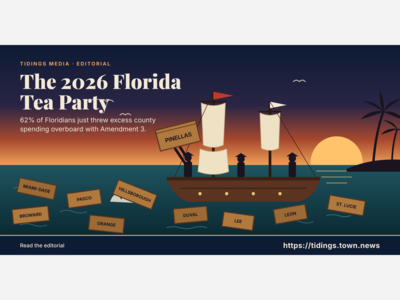
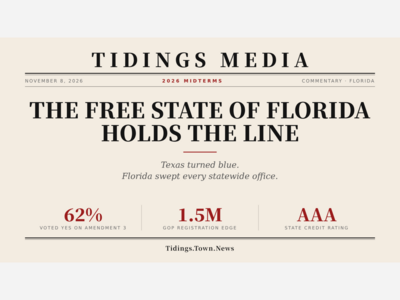
Independents mattered too. Florida has 3,345,188 voters registered with no party,⁷ and early analysis showed independents leaning toward Democratic candidates. One political scientist argued that without Amendment 3, the property-tax measure that passed with 62%, enough Republicans would have stayed home to change the outcome. Democrats flipped 16 seats in the state House and broke the Republican supermajority.¹²
There was crossover voting in Florida this year, just not in the primaries. According to that same State Affairs analysis, some registered Republicans voted for Democrats, particularly in legislative races, and others stayed home.¹² Nobody had to change parties or sneak into a primary to pull that off. In a general election, every voter can pick whoever they want, and plenty of them did.
So the next time someone tells you Florida's Republican registration numbers are fake, ask them for the evidence. Florida's voter file is a public record, and real raiders would leave tracks: party switches piling up right before primary deadlines, the same voters switching back afterward, and "Republicans" who skip the GOP primary but turn out for the general. Until someone shows that pattern, I'm taking the registration numbers at face value. Florida has plenty of Republicans. This November, too many of them didn't see a reason to vote.


Patchy rain nearby, with a high of 73 and low of 69 degrees. Patchy rain nearby during the morning,