Image
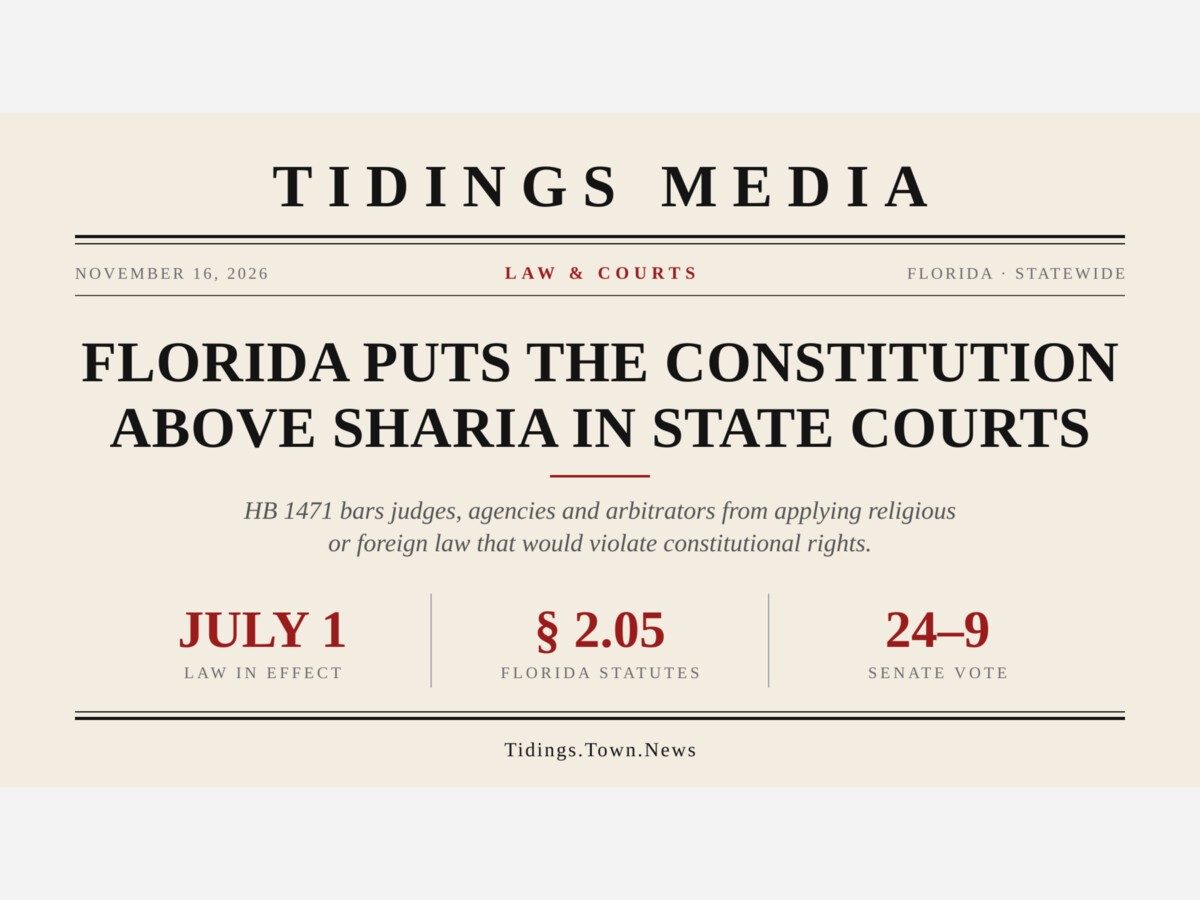



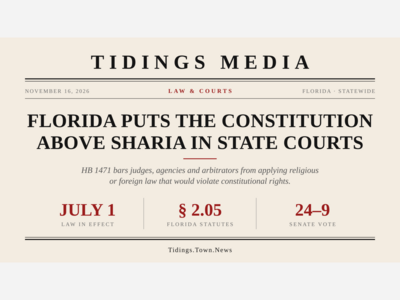
The statute, which names Islamic law explicitly, bars judges, agencies and arbitrators from applying any religious or foreign legal code that would violate constitutional rights. Gov. Ron DeSantis calls it the strongest measure of its kind in the country.
TAMPA—Florida has enacted one of the most direct measures in the nation against the use of Sharia in its legal system, a law that bars courts, state agencies and arbitrators from applying any religious or foreign legal code in a way that would violate rights protected by the U.S. or Florida constitutions.¹ ²
The statute, signed by Gov. Ron DeSantis on April 6 and in force since July 1, defines "religious law" as a legal system tied to a faith's sacred texts or traditions, and then states: "The term includes Sharia law."² Mr. DeSantis acknowledged that Sharia isn't being applied in Florida courts today, describing the law as a way to head off its "creep into different institutions."³
The bill's House sponsor, state Rep. Hillary Cassel, has said Florida is the first state to ban Sharia law.⁴ Its authors also drafted it with an eye on a 2012 federal appeals ruling that blocked a similar Oklahoma amendment, a precedent likely to frame any court challenge.⁵
What the law does
The provision, codified as section 2.05 of the Florida Statutes, is targeted rather than a blanket prohibition. It bars applying religious or foreign law only where doing so would violate a person's constitutional rights, and it blocks courts from enforcing foreign judgments, choice-of-law clauses and forum-selection clauses that would produce the same result.² It exempts natural law as understood in the American legal tradition, federal and state statutes, the common law, tribal law and ratified treaties, along with the internal ecclesiastical affairs of religious organizations, such as hiring and disciplining clergy.²
A House staff analysis says the restrictions apply to tribunals "established by law or agreement of the parties," language that reaches private arbitration.⁶ Florida already had a narrower rule on the books. In 2014, then-Gov. Rick Scott signed a bill barring judges from applying foreign law in divorce, alimony and custody cases when it conflicts with state public policy, making Florida the eighth state with such a statute.⁷
How it passed
Ms. Cassel, a Dania Beach Republican, first filed the measure as HB 119, the "No Shari'a Act," on Oct. 7, 2025. In January she withdrew it and moved the language into HB 1471, a much broader bill that lets state officials designate domestic terrorist organizations.⁸ The Tampa Bay Times reported that staff in the governor's office wrote the original draft of the Senate version, sponsored by Sen. Erin Grall of Vero Beach.⁹
The bill moved in the shadow of litigation. In December 2025, Mr. DeSantis issued an executive order labeling CAIR a terrorist organization, and a federal judge blocked it on March 4, one day after the House passed HB 1471.¹⁰ The House vote broke along party lines, and the Senate approved the bill 24-9, with two Republicans voting no.¹¹ During floor debate, Ms. Cassel rejected an amendment from Rep. Ashley Gantt, a Miami Democrat, to strike the references to Sharia, calling it "a foreign framework" rather than a religious practice.⁸
'Ahead of the curve'
Mr. DeSantis has cast the law as a defense of a single legal system. "To uphold the rule of law, our state must operate under one legal system, the Constitution must remain the law of the land," he said in announcing the signing.¹ On X, he wrote that the law would protect "Floridians' constitutional rights from the application of foreign and religious laws, including Sharia law."¹² At the signing ceremony at the University of South Florida, he called the provision the "most robust action" taken by any state.¹¹
In a Fox News interview, the governor pointed to Europe. "We don't want to end up like Europe where they have no-go zones," he said, adding that Florida was ahead of the curve.¹³ He told Fox host Sean Hannity that the state would spend "millions for education and public safety but not one cent for jihad,"¹⁴ and at the signing he tied the issue to immigration, saying the country must stop "importing people that reject the values of this country."⁹
Lt. Gov. Jay Collins, who appeared with the governor, said Sharia is no personal spiritual guide and vowed that Florida would never tolerate honor killings.⁹
Donalds takes up the cause
Rep. Byron Donalds, whom the Associated Press declared the winner of the Nov. 3 governor's race, has made opposition to Sharia part of his message, though a review of his public remarks found no comment on the statute's text. As of 12:20 p.m. ET on Nov. 16, AP's count showed Mr. Donalds with 50.0% of the vote to 48.7% for Democrat David Jolly, figures that may have changed since.¹⁵
At a February listening session at the Chabad of Central Boca Raton, appearing alongside Rep. Randy Fine, Mr. Donalds warned that implementing Sharia in the U.S. would pose an "existential threat" to the country's constitutional order.¹⁶ "Look, Sharia law is incompatible with our constitution," he said at the event, where he also voiced concern about planned Muslim-centered housing developments of the kind proposed as EPIC City in Texas.¹⁷ ¹⁸
Mr. Donalds is a member of the Sharia-Free America Caucus, a 38-member House group formed in February by Rep. Chip Roy of Texas that backs federal legislation to keep courts from considering Islamic law and to tighten immigration rules.¹⁹ At a Sept. 2 rally in Delray Beach, a day after Mr. DeSantis endorsed him, he pledged to reject Sharia law and build on the governor's record.²⁰ As governor, he will oversee the agencies that defend the law in court.
Legal challenges ahead
Legal experts expect the law to be tested in court, and Muslim advocacy groups have said they view it as aimed at their faith.¹¹ Any challenge would likely draw on several lines of argument, and the state has answers to each.
The Oklahoma precedent
In Awad v. Ziriax, the U.S. Court of Appeals for the 10th Circuit upheld an injunction against Oklahoma's 2010 "Save Our State" amendment, which barred state courts from considering Sharia.⁵ The court applied the strict scrutiny that the Supreme Court's 1982 decision in Larson v. Valente requires for laws favoring or disfavoring particular religions, and it rejected Oklahoma's argument that the measure covered all religious law, noting that the text named only Sharia.²¹ The Supreme Court reaffirmed Larson's bar on denominational discrimination last year in Catholic Charities Bureau v. Wisconsin Labor and Industry Review Commission.²²
Florida's drafters appear to have studied that case. By defining religious law generically and listing Sharia as one example, the state stands on firmer ground than Oklahoma did. Sharia nonetheless remains the only tradition the statute names, lawmakers voted down an amendment to remove it, and the bill's backers have promoted the law as a Sharia ban.
A challenger would argue the name serves no legal purpose beyond singling out one faith. Florida sits in the 11th Circuit, which isn't bound by the 10th Circuit's ruling, so the question remains open there.
Statements on the record
Courts weighing whether a law targets a religion may consider what officials said about it, as the Supreme Court did in Church of the Lukumi Babalu Aye v. City of Hialeah in 1993 and Masterpiece Cakeshop v. Colorado Civil Rights Commission in 2018. The record behind HB 1471 includes the governor's remarks linking Sharia to immigration and jihad, the lieutenant governor's comments on honor killings and a signing ceremony staged in front of a sign denouncing Sharia law. A litigant could also point to a contradiction, since the statute defines Sharia as religious law while its House sponsor told colleagues it isn't a religious practice.² ⁸
The state's likely answer is Trump v. Hawaii, the 2018 decision that upheld a facially neutral travel policy despite inflammatory statements by the president. That ruling rested heavily on deference to the executive branch on immigration and national security, an argument with less force when the subject is how state courts handle contracts and divorces.
The church exemption
The exemption for internal church affairs was added through amendments sought by the Florida Conference of Catholic Bishops, according to United Voices, a group that opposed the bill.⁸ On paper it applies to every faith, which is Florida's strongest defense. In practice it shields denominations that settle disputes through an internal hierarchy, such as Catholic canon-law tribunals, while communities that rely on voluntary private arbitration remain inside the prohibition.
That group includes Jewish rabbinical courts, known as batei din, along with Islamic arbitration panels and Christian conciliation services. Jewish groups and the Anti-Defamation League raised the same concern about rabbinical-court divorces when Florida weighed earlier versions of the idea in 2012.²³
Private arbitration
Constitutional rights restrain government rather than private parties, so a voluntary arbitration between two people doesn't ordinarily "violate" equal protection or due process. The statute nonetheless asks courts and arbitrators to decide when a private religious agreement would do exactly that.⁶ A rabbinical-court divorce in which only the husband can grant the religious divorce, or a dower provision in an Islamic marriage contract, could land on either side of the line depending on the judge.
Read narrowly, the law would rarely apply. Read broadly, it would let a party who loses a religious arbitration try to relitigate the award by claiming a rights violation, unsettling agreements Florida courts have long enforced under ordinary contract principles. The forum-selection rule adds a forecasting test, asking whether a foreign forum "will likely" produce a violation, which leaves judges wide discretion in international commercial cases.
Federal arbitration law
The Federal Arbitration Act requires courts to enforce arbitration agreements except on grounds that would void any contract, and the Supreme Court held in AT&T Mobility v. Concepcion in 2011 and Kindred Nursing Centers v. Clark in 2017 that state rules singling out arbitration are preempted. Section 2.05 speaks directly to arbitration panels and limits the law parties may choose to govern their disputes, so a party to an arbitration involving interstate commerce could argue the statute is preempted. Florida would likely respond that the rule applies equally to courts and works as a general contract defense, a question no court has yet taken up.
Overlap with existing law
Florida courts already decline to apply foreign law that offends public policy, the 2014 statute covers family cases, and the state's version of the Uniform Foreign-Country Money Judgment Recognition Act lets judges refuse foreign judgments on public-policy grounds. The new statute carries no penalty or enforcement mechanism. That overlap doesn't make it unconstitutional, but it matters under strict scrutiny, which requires the state to show a compelling interest.
In the Oklahoma case, the 10th Circuit gave weight to the state's inability to point to a single instance of the problem its amendment was meant to solve.²⁴ Mr. DeSantis's acknowledgment that Sharia isn't being applied in Florida courts is likely to figure in that analysis.³
One bill, many subjects
The Florida Constitution requires each law to embrace a single subject. HB 1471 pairs a choice-of-law rule for courts and arbitrators with terrorist designations, new crimes, university expulsions and school-voucher eligibility. State courts read the single-subject rule generously, and the bill's title, "Systems of Law and Terrorist Organizations," appears designed to join its two halves, but the pairing gives challengers another argument in state court.
The packaging also ties the Sharia provision to a designation regime now in active litigation. The governor and Cabinet designated CAIR and its Florida chapter under the new law, the designations took effect Nov. 5, and Chief U.S. District Judge Allen Winsor declined a day earlier to block them. CAIR has closed its Florida operations and appealed.²⁵ ²⁶ Those cases challenge the designation provisions, and the Sharia section has yet to be tested in court.
The state's defenses
The drafting gives Florida several advantages. The generic definition of religious law improves on Oklahoma's failed amendment, and the narrow trigger means the statute seldom requires a court to do anything it wouldn't already do. The exclusions for treaties, statutes, tribal law and the common law also limit disruption to ordinary commerce.
That narrowness creates a hurdle for challengers, who must show a concrete injury to sue in federal court. The Oklahoma plaintiff relied largely on the stigma of an amendment that condemned his faith by name, a theory the 11th Circuit may or may not accept.
The first test may come in a Florida trial court, in a divorce or contract dispute where one side invokes section 2.05 against a religious agreement. For now the law stands as written, and its backers, including the incoming governor, have made clear they intend to defend it.
Notes
1. Executive Office of the Governor, "Governor Ron DeSantis Signs Legislation to Combat Terrorist Groups and Ban Sharia Law in Florida," April 6, 2026. flgov.com
2. § 2.05, Fla. Stat. (2026), "Application of religious or foreign law"; s. 1, ch. 2026-28, Laws of Fla. flsenate.gov
3. Jim Turner, News Service of Florida, "DeSantis signs 'domestic terrorist' naming law," Ocala Gazette, April 8, 2026. ocalagazette.com
4. Mitch Perry, "Advocates fear Florida's domestic terrorist law could reach beyond Muslim groups," Florida Phoenix, April 7, 2026. floridaphoenix.com
5. Awad v. Ziriax, 670 F.3d 1111 (10th Cir. 2012). ca10.uscourts.gov
6. Florida House of Representatives, Final Bill Analysis, CS/CS/HB 1471 (2026). flsenate.gov
7. Associated Press, "Fla. Gov. OKs bill to prohibit use of foreign law," Washington Times, May 12, 2014. washingtontimes.com
8. United Voices, "Why Florida Should Reject the 'Domestic Terrorist' Designation Bills," policy brief, March 5, 2026. unitedvoices.com
9. FlaglerLive, "Democrats Warn Of Overreach as DeSantis Signs Bill Conflating Terrorism with Muslims," April 6, 2026. flaglerlive.com
10. United Voices, statement on federal injunction of executive order, March 4, 2026. unitedvoices.com
11. Fresh Take Florida, "DeSantis signs bill allowing state designation of domestic terrorists, restrictions on Sharia law," WUFT, April 6, 2026. wuft.org
12. Ron DeSantis (@GovRonDeSantis), post on X, April 6, 2026, as reported by ClickOrlando. clickorlando.com
13. Taylor Penley, "New Florida law targeting alleged 'jihad' puts state 'ahead of the curve,' DeSantis says," Fox News, April 8, 2026. foxnews.com
14. Peter Stevens, "Sharia law is BANNED in Florida under 'terrorist infiltration' crackdown," GB News, April 7, 2026. gbnews.com
15. The Associated Press, Florida governor general election results, as of Nov. 16, 2026, 12:20 p.m. ET. Figures may have changed since.
16. VINnews, "Byron Donalds Says He'll Visit Israel as Governor, Warns Against Sharia Law," Feb. 16, 2026, via Ground News. ground.news
17. Grayson Bakich, "Rick Scott Hits 'Stupid' Democrats Over Sharia Law: 'No Place in America,'" The Floridian, March 5, 2026. floridianpress.com
18. Javier Manjarres, "Byron Donalds Says he Will Visit Israel as Governor, Outlines 'Existential Threat' Sharia Law Poses to America," The Floridian, Feb. 13, 2026. floridianpress.com
19. Ericka Piñon, "House Republicans Form 38-Member Sharia-Free America Caucus," The Floridian, Feb. 11, 2026. floridianpress.com
20. Florida's Voice, "Donalds tells Delray Beach crowd Florida faces 'common sense vs. crazy' choice," Sept. 3, 2026. flvoicenews.com
21. Law and Religion Forum, "Circuit Upholds Injunction Against Oklahoma Anti-Sharia Amendment," 2012. lawandreligionforum.org
22. Catholic Charities Bureau, Inc. v. Wisconsin Labor & Industry Review Commission, 605 U.S. ___ (2025).
23. "Jewish Divorce Caught in Sharia Law Fight," The Forward, 2012. forward.com; see also The Blaze/AP, March 2, 2012 (ADL statement). theblaze.com
24. Michael Peabody, "10th Circuit Rules Oklahoma Amendment Barring Islamic Law was Unnecessary and Discriminatory," ReligiousLiberty.TV, Jan. 11, 2012. religiousliberty.tv
25. Baptist News Global, "CAIR Florida unit closes for now due to new state law," November 2026. baptistnews.com
26. ACLU, CAIR Foundation, Inc. and CAIR-Florida, Inc. v. DeSantis, case page. aclu.org

Patchy rain nearby, with a high of 76 and low of 57 degrees. Partly Cloudy in the morning, patchy rain nearby in the afternoon, clear overnight.