63° and Overcast
Image




A Tidings Media Editorial · Nov 13, 2026
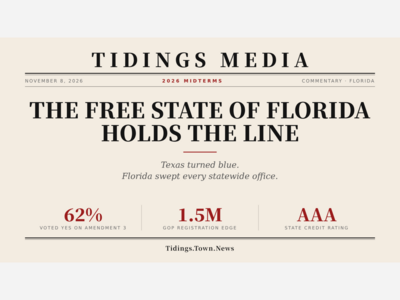
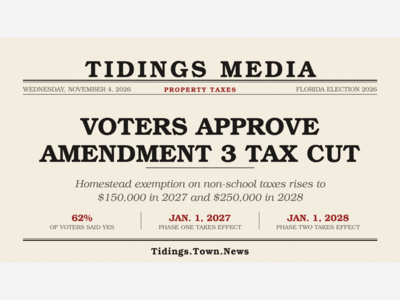
In December 1773, colonists in Boston settled an argument about taxation by dumping 342 chests of tea into the harbor. On November 3, 2026, Floridians settled a similar argument without boarding a single ship. They went to the polls and wrote a property tax cut into the state constitution, and roughly 62 percent of them said yes to Amendment 3, clearing the 60 percent supermajority that the constitution demands for any amendment.¹ That is a landslide by the standard Florida sets for itself, and it arrived over the objections of nearly every city hall, county commission and local government lobby in the state.
The pollsters did not see it coming. A week before the election, the Tampa Bay Times reviewed the available surveys and found that only one showed the amendment reaching 60 percent.² A St. Pete Polls survey put support at 45 percent, and Governor DeSantis himself told an audience in Alabama that he did not know whether it would pass.³ An Associated Industries of Florida poll conducted by McLaughlin & Associates had it at 53 percent and failing in every media market, Tampa Bay included.⁴ Voters had other ideas. When Mason-Dixon asked supporters why they were voting yes, nearly half said property taxes were too high, and 29 percent pointed directly at excessive government spending.⁵ That is the part county commissioners should read twice. This was not only a vote for a smaller tax bill. It was a verdict on how local governments have been spending the money.
The amendment takes effect January 1, 2027.⁶ On that date the homestead exemption against all non-school property taxes rises to $150,000, and it climbs to $250,000 in 2028 before being adjusted for inflation in later years.⁷ The $25,000 exemption against school taxes stays as it is, because school levies were left out of the measure entirely.⁷ For second homes, rentals and commercial property, the annual cap on assessment increases is cut in half, from 10 percent to 5 percent, while the Save Our Homes cap on homesteads and portability are untouched.⁶ People who were not permanent Florida residents as of December 31, 2026 receive a smaller $50,000 non-school exemption until their fifth year of homestead.⁶
The second half of the amendment matters as much as the first. It rewrites the constitution to require that county and municipal property tax revenue be used solely for public safety, education and schools, infrastructure, natural resources, bond debt service and retirement obligations, along with the basic operation of government.⁸ Local officials can still approve other expenditures unless state law forbids them, which means the Legislature now holds the pen on what falls outside the core list, and the governor has said lawmakers will take up implementing legislation.⁹ A separate transparency law, HB 1329, also takes effect January 1, 2027, and it requires local governments to post more detailed budgets and to model the spending cuts they would make.¹⁰ Homeowners will see the new exemption on their TRIM notices in August 2027 and on their tax bills in November 2027.¹¹ The state's Revenue Estimating Conference puts the recurring cost to local governments at about $12 billion a year once the amendment is fully phased in.¹² Local officials call that number a catastrophe. Voters looked at the same number and called it a refund.
If commissioners want to know why voters were willing to take $12 billion off the table, they can start with the examples the state already put in front of them. Florida DOGE, the audit effort led by CFO Blaise Ingoglia, spent 2025 combing through local budgets and published what it found. Jacksonville spent $75,000 on a hologram of its mayor to greet travelers at the airport and $7.5 million on a one-mile sidewalk, nearly eight times the average state transportation estimate for that kind of work.¹³ Broward County spent $175,000 on virtual art in the Metaverse and $44,000 supporting a United Nations treaty.¹³ Orlando has spent $460,000 since 2020 on a tree inventory, and Hillsborough County paid $950,000 in employee vehicle allowances and $572,000 for unconscious bias training.¹³ Across the bay, DOGE reported that Hillsborough's general fund grew more than 56 percent since 2019 to nearly $860 million, and it flagged almost $279 million in spending over five years.¹⁴
Pinellas County did not escape the list. DOGE's January 2026 report cited spending on homelessness services, enterprise IT systems, sports fees tied to negotiations with the Rays, terminal leave payouts and contracts, along with a $75,000 annual festival sponsorship.¹⁵ In South Florida, Palm Beach County's general fund nearly doubled between 2019 and 2025, and Broward's grew from $1.2 billion to $1.9 billion over the same period.¹⁶ County leaders have pushed back. Hillsborough Commissioner Harry Cohen argued that 83 percent of his county's property tax revenue goes to public safety and infrastructure, and Ingoglia acknowledged that DOGE did not perform forensic audits.¹⁷ Those are fair points, and they miss the larger one. Nobody had to prove fraud for voters to conclude that a government buying holograms and metaverse art had more money than it needed. Budgets do not double in six years because a county is pinching pennies.
County commissions now face a choice, and the voters have already told them which way to go. The easy path is to raise millage rates, invent new fees and threaten to cut deputies and firefighters until the public flinches, which is unlikely to happen and more likely to lead to changes in the seats of representation. Some local officials were warning about cuts to public amenities that before the ballots were even counted. That path treats a constitutional amendment as an inconvenience to be routed around, and it treats the people who passed it as a problem to be managed. The harder and more honest path is to go line by line through the discretionary spending that DOGE spent a year cataloging, fund the core services the constitution now names, and stop everything else. Florida's constitution now spells out what property taxes are for. A commission that answers a 62 percent mandate with a tax hike should expect the same voters to answer back at the next election.
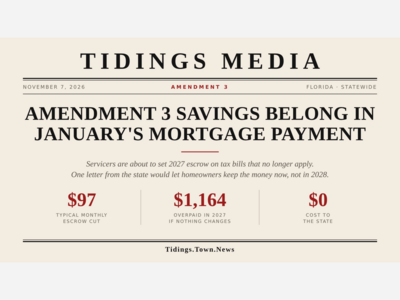
There is one more piece of unfinished business, and Tallahassee can fix it now. Most Florida homeowners with a mortgage do not pay their property tax bill directly. Their lender or mortgage servicer collects it every month through escrow, and under normal practice those servicers will keep collecting on the old, higher tax amount until their annual escrow review catches up with the new law, which for many families could mean most of 2027. Industry analysts have already noted that federal escrow rules allow servicers to run an off-cycle escrow analysis when a material change affects expected tax payments, and that servicers may need to adjust payments in the first quarter rather than wait.¹⁸ Tidings Media calls on Governor DeSantis, CFO Ingoglia, the Office of Financial Regulation and the Legislature to direct the mortgage servicers licensed in this state to re-index escrow accounts now, using projected 2027 tax amounts, so that monthly payments fall with the January 1, 2027 payment. Voters approved this relief in November 2026. There is no good reason for banks to hold it for another year, and every month they do is a month families keep making an interest-free loan to their servicer.
The colonists in Boston had no vote, so they used the harbor. Floridians had a vote, and they used it. The message to every county commission in this state is the same one the tea carried in 1773: the people who pay the bill have decided the spending has gone far enough.
Do you hear this, commissioners?


Sunny, with a high of 72 and low of 62 degrees. Overcast for the morning, sunny in the afternoon, clear in the evening, overcast overnight.