Image
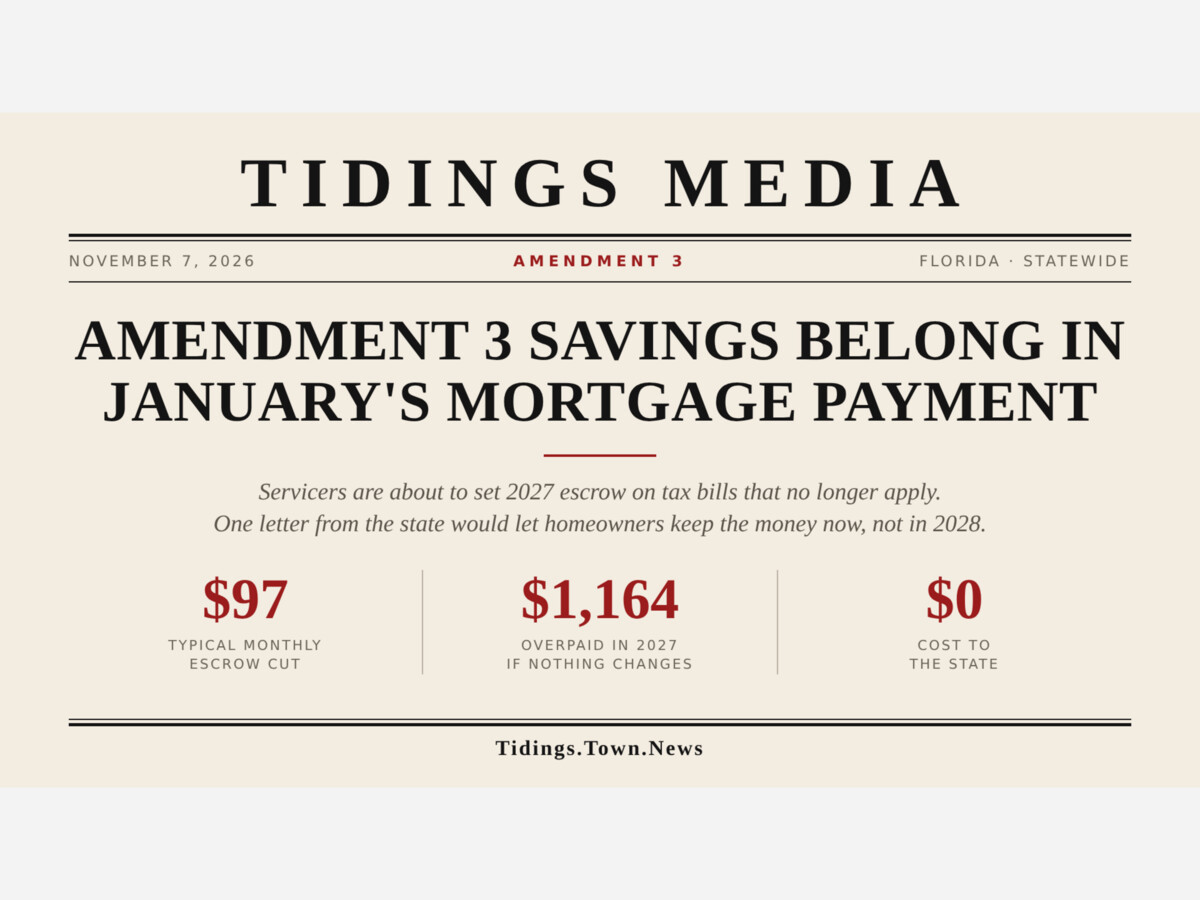



Mortgage companies are about to set 2027 payments using tax bills that no longer apply. One letter from Florida's financial regulator would let homeowners keep their savings starting in January instead of waiting until 2028, at no cost to the state.
By David Happe · Nov 7, 2026
Florida voters approved Amendment 3 on Tuesday with about 62 percent of the vote [1]. For a typical homesteaded family, it will cut the 2027 property tax bill by roughly $1,000 to $1,300, depending on the county [2][3][4]. Most of those families pay their property taxes through their mortgage, and whether they see the savings in 2027 or in 2028 depends on what mortgage companies do over the next several weeks. If the companies keep basing monthly payments on the old tax bill, homeowners will spend all of 2027 paying taxes they no longer owe and get the money back as a refund in 2028. If the companies recalculate now, a typical family's mortgage payment drops by about $97 a month starting January 1.
The fix needs no new law, no state spending and no change to anyone's tax bill. It changes only when homeowners get to keep their own money. Florida's Office of Financial Regulation can ask the mortgage companies it licenses to make the change, and state legislators of either party can ask the office to act before the end of November.
Tidings Media has found no other news outlet or public official calling for this. Coverage since Tuesday, including guidance published by Florida mortgage lenders, has treated the delay as routine: homeowners will see a lower payment after their servicer's next annual escrow review, once the smaller November 2027 tax bill has been paid [18][19]. The closest anyone has come is an industry analysis in HousingWire, written for mortgage companies rather than homeowners, which noted that servicers may need an off-cycle escrow review in the first half of 2027 instead of waiting for the annual one [20]. We have found no one asking the state to make sure that happens, or to make it happen by January 1.
The stakes reach every corner of the state. Every homesteaded homeowner who pays property taxes through a mortgage escrow account, in all 67 counties and with every servicer, is in the same position, because servicers across Florida follow the same federal rule and the same annual schedule. Homeowners without a mortgage, or who pay their tax bill directly, are not affected by the timing, and rental and second homes do not get the larger exemption. For everyone else with a homestead and an escrowed loan, the question is the same: lower payments in 2027, or a refund in 2028.
Amendment 3 divided Floridians. Supporters saw overdue relief from rising property taxes, while opponents, including the Florida Sheriffs Association, warned that cities and counties would lose revenue they need for public safety and other services [5]. This proposal does not reopen that debate. The tax cut is now in the state constitution, and recalculating escrow does not change how much tax any homeowner owes or how much revenue any city, county or school district collects. Every dollar of the 2027 tax bill still gets paid in full and on time. What changes is whether a family's savings sit in a mortgage company's account for a year or stay in the family's budget.
Supporters of Amendment 3 should want the savings to show up where voters will notice them, on the first mortgage statement of 2027. Opponents lose nothing if the savings arrive sooner, since the amount of tax collected is the same either way. And people across the political spectrum can agree that a company should not collect money it knows a customer does not owe. A legislator who asks the Office of Financial Regulation to act is not taking a side on Amendment 3. They are asking that a decision voters already made be carried out accurately.
A payment that drops by $97 a month leaves a family that much more to spend on groceries, car repairs, child care or a local contractor during 2027. Held in escrow, the same money does nothing for the household or for local businesses until a refund check arrives in 2028. Across the state the amounts add up fast. For every 100,000 escrowed households that keep about $97 a month, roughly $9.7 million a month stays in Florida family budgets, or about $116 million over the course of 2027. Florida has far more than 100,000 homesteaded homes with escrowed mortgages, so the statewide figure is many times larger, spread across every month of 2027 instead of arriving in one lump in 2028.
The amendment raises the homestead exemption, which is the portion of a home's value that is not taxed because the home is the owner's permanent residence. Today that amount is about $51,411 for city, county and special district taxes. It rises to $150,000 on January 1, 2027, and to $250,000 on January 1, 2028, with increases for inflation after that [6][7]. School taxes keep the existing $25,000 exemption [7]. People who become Florida residents on or after January 1, 2027, start with a smaller exemption and wait five years for the full amount [8].
Florida bills property taxes after the year they cover. The bill arriving in mailboxes this month pays for 2026 and is unaffected by the vote [9]. The first bill using the new exemption goes out in November 2027. Before it arrives, homeowners get a TRIM notice in August. TRIM is short for "truth in millage," and the notice previews a property's value, exemptions and proposed tax rates for the coming bill [2]. Millage is the tax rate itself. One mill is $1 of tax for every $1,000 of taxable value, so 12 mills on $100,000 of taxable value comes to $1,200. Homeowners who pay their own tax bill will simply pay less in November 2027. The timing problem falls on homeowners who pay through escrow.
An escrow account is a holding account run by the company that services your mortgage. The servicer is the company that collects your monthly payment, and it is often not the bank that made the loan. Part of each monthly payment goes into the escrow account, and the servicer uses that money to pay your property tax bill and, in most cases, your homeowners insurance. Many lenders require escrow, and a large share of Florida homeowners with a mortgage pay their taxes this way.
Once a year the servicer runs an escrow analysis. It estimates the coming year's taxes and insurance, divides the total by 12 and mails you a statement with your new monthly payment. Many Florida servicers do this soon after paying the November tax bill, so the new payment usually begins early in the year.
Escrow is governed by a federal rule called Regulation X, which carries out the Real Estate Settlement Procedures Act of 1974, known as RESPA. When a servicer does not yet know the next year's tax bill, Regulation X lets it estimate from the previous year's bill, adjusted for inflation if it chooses [10]. The rule also lets servicers keep a cushion, an extra reserve of up to one-sixth of the year's expected bills, or about two months of payments [10]. Servicers who follow that shortcut this winter will base 2027 payments on a 2026 bill that was figured with a $51,411 exemption, though the 2027 bill will be figured with a $150,000 exemption.
Take a long-time Florida resident with a homestead exemption, a home assessed at $150,000 or more, and city, county and special district tax rates that add up to about 11.8 mills. That rate is close to the countywide average the Volusia County property appraiser used in its own estimate [2]. Your figures will depend on your county, your city and your home's assessed value, but the method is the same everywhere.
Step 1: the new exemption. This homeowner's exemption from non-school taxes is $51,411 in 2026 and $150,000 in 2027, so an extra $98,589 of the home's value stops being taxed for those purposes.
Step 2: the yearly savings. At 11.8 mills, each $1,000 of exempt value saves about $11.81. Multiply $11.81 by 98.589 and the 2027 tax bill comes out about $1,164 lower than the 2026 bill [2].
Step 3: the monthly payment. Divide $1,164 by 12 and you get about $97, which is how much this homeowner's monthly escrow payment should drop in 2027.
|
If escrow is recalculated now |
If nothing changes |
|
|---|---|---|
|
Monthly escrow payment in 2027 |
About $97 lower, starting January 1 |
Same as 2026 |
|
Extra money collected during 2027 |
None |
About $1,164 |
|
Extra money held in the cushion |
None |
Up to about $194 (one-sixth of $1,164) |
|
When the homeowner gets the savings |
Every month during 2027 |
As a refund in early 2028 |
|
Interest paid to the homeowner on the extra money |
Not applicable |
None |
In November 2026 the servicer pays the 2026 tax bill. Over the following months it runs its escrow analysis, uses the 2026 bill as its estimate for 2027 and sets the new monthly payment. The homeowner then pays about $97 a month more than necessary for all of 2027. In November 2027 the servicer pays the new, smaller tax bill, and the account is left holding about $1,164 more than it needed, plus an oversized cushion. The next escrow analysis, in early 2028, finds the surplus. Federal rules require the servicer to refund a surplus of $50 or more within 30 days of that analysis if the borrower is current on payments [10], so the homeowner finally gets the money back in early 2028.
The same thing would happen again a year later. On January 1, 2028, the exemption rises to $250,000. If servicers again rely on the previous year's bill, they will set 2028 payments from the 2027 bill, which was figured on a $150,000 exemption. Volusia's estimates put total yearly savings at about $2,345 in 2028 compared with today [2], so the same homeowner would overpay roughly another $1,181 during 2028 and wait until early 2029 for that refund. Escrow would trail the tax law by a full year through both steps of the amendment.
Your escrow payment also covers homeowners insurance, so your total payment can still move up or down if your insurance premium changes. Amendment 3 affects only the property tax portion.
Overpaying escrow works a lot like overpaying the IRS. A big refund each spring feels good, but it means the taxpayer lent the government their own money for a year without interest, which is why financial planners tell people to adjust their withholding. Taxpayers can do that themselves by giving their employer a new W-4. Homeowners have no equivalent for escrow, because the servicer sets the monthly amount.
A homeowner who wants to set money aside for a year can put it in a savings account and earn interest. They should not be made to do it through their mortgage company, and a servicer should not build up a surplus in someone's escrow account from a tax estimate it already knows is wrong. Waiting is also harder on the servicers. A year of overcollection across every homesteaded escrow account in the state would have to be unwound all at once in early 2028, with refund checks, corrected statements, phone calls and complaints arriving together, and every refund is a chance for an error. Recalculating this winter is the same work done once, with nothing to refund later.
Money in an escrow account belongs to the homeowner, not the servicer. Servicers must keep it separate from their own funds, and when it is held at an FDIC-insured bank, the tax and insurance money is insured as each borrower's own deposit [11]. Courts have generally treated escrow funds as outside a failed servicer's bankruptcy, which means the servicer's creditors cannot take them [12]. For most homeowners, a servicer failure would mean delays and paperwork rather than lost money.
The risk is still real. When American Home Mortgage went bankrupt in 2007, its escrow accounts were frozen for a time, leaving homeowners waiting on money set aside for their taxes and insurance [13]. Law professors writing about that case pointed out that if a failing servicer has already misspent escrow money, the money is gone and the homeowner still owes the tax bill [12]. Mortgages are also sold and transferred between servicers all the time, and each transfer is another chance for an escrow balance to be miscounted or delayed. Every extra dollar a servicer holds is exposed to those problems, so the safest amount of overcollected money to leave with a servicer is none.
The federal rule says servicers may use the prior year's bill when the new one is unknown. It does not require them to, and it also says escrow should collect only enough to cover the bills the servicer expects to pay [10]. After Tuesday's vote, the 2027 exemption is known. A servicer that keeps using the 2026 bill for a homesteaded Florida home is collecting on a number it knows is too high. Servicers already use better estimates for new construction and recent purchases when they know the old bill will be far off, and they have much stronger grounds here.
Servicers also have a financial reason to wait. Mortgage companies earn income from the money held in escrow accounts, and the HousingWire analysis noted that lower escrow balances in Florida could reduce that income and the value of the servicing contracts themselves [20]. Leaving the timing entirely to the companies that earn more by waiting is not a good way to carry out a tax cut voters approved.
The estimate takes one line of arithmetic. Multiply the newly exempt value, about $98,589 for most long-time residents, by the non-school tax rate printed on the homeowner's current bill. The Volusia County property appraiser used that method to estimate average savings of about $1,164 [2]. County records already show which homes have a homestead exemption, so servicers can tell who qualifies.
Cities and counties may raise their tax rates in 2027 to make up for lost revenue, which means a servicer that lowers payments now could come up short later. The answer is a careful estimate, such as applying the new exemption at today's rates or holding back part of the projected savings, not a refusal to account for the amendment at all. If a servicer does come up short, federal rules let the shortfall be spread over the next 12 monthly payments, so no homeowner gets hit with one large bill.
In Florida, mortgage lenders and servicers are licensed and regulated by the Office of Financial Regulation, or OFR, under Chapter 494 of the Florida Statutes [14][15]. OFR answers to the Financial Services Commission, made up of the Governor, the Chief Financial Officer, the Attorney General and the Commissioner of Agriculture [14][16]. The Office of Insurance Regulation answers to the same commission, but it oversees insurance companies, which do not run escrow accounts. OFR is the office with authority over this issue.
We are asking the Commissioner of Financial Regulation, who heads OFR, to send guidance to every licensed mortgage servicer before the end of November, so servicers have time to put corrected payments in place for January 1, 2027.
The guidance should ask servicers to:
State guidance has limits. Many of the largest servicers are national banks that also answer to federal regulators, and OFR cannot rewrite a federal rule. A clear statement from Tallahassee that Florida expects escrow payments to reflect the constitution voters just amended would still carry weight with every servicer doing business here, and it would give the companies that want to do this a reason to move quickly.
Your state representative and state senator can ask OFR and the Financial Services Commission to act, and a phone call or letter from a legislator gets attention. Find both by entering your address on the Florida Senate's "Find Your Legislators" page, which lists your state senator and state representative together [17]. Contact both of them, whatever their party. This is a request to carry out a vote accurately, not a request to agree with how anyone voted.
Send each of them a link to this article with a short note, for example: "Amendment 3 passed, but homeowners who pay taxes through mortgage escrow won't see the savings until 2028 unless servicers update their 2027 estimates. Please ask the Office of Financial Regulation to direct mortgage servicers to recalculate escrow using the new exemption, effective January 1. It costs the state nothing and puts money back in Florida families' budgets right away."
For legislators, the timing matters too. A lower payment on the January 2027 mortgage statement is something constituents can see and connect directly to the vote they cast. If servicers keep collecting on the old numbers, those same families will see no change in their payment for all of 2027, and many will reasonably conclude the amendment did nothing for them. A January payment cut gives every legislator something concrete to point to when constituents ask what Amendment 3 changed.
If you pay through escrow and have a homestead exemption, watch for your next escrow analysis statement and compare its 2027 property tax estimate with your 2026 bill. If the estimate is the same or higher, write to your servicer and ask it to re-estimate the 2027 tax payment using the new $150,000 exemption. Include a copy of your current tax bill, which shows your tax rates, and keep a copy of your letter. If the servicer refuses or doesn't respond, you can file a complaint with the Office of Financial Regulation and with the federal Consumer Financial Protection Bureau.
Floridians voted for lower property taxes in 2027. A mortgage payment that drops on January 1 delivers that result in the year voters chose and keeps the money working in local economies all year, at no cost to the state. OFR can make it happen with one letter, and legislators of both parties can ask for that letter this month.



Sunny, with a high of 82 and low of 69 degrees. Sunny in the morning, clear during the afternoon and evening,