

Image
Commentary · Tidings Media · Nov 8, 2026
On a night when a Democratic wave rolled across the country, Florida held. Voters on Nov. 3 kept every statewide office in Republican hands, sent Byron Donalds to the Governor's Mansion and approved the largest homestead tax cut ever put on the ballot. A thousand miles to the west, Texas went the other way, and the contrast says a great deal about which version of conservative government is built to last.
Donalds defeated David Jolly 50.0% to 48.7%, a margin of roughly 108,000 votes, and becomes the first Black person ever elected statewide in Florida and the nation's first Black Republican governor.[1] He takes the oath on Jan. 5, 2027.[2] U.S. Sen. Ashley Moody won her seat outright over Angie Nixon, 50.9% to 48.0%.[3] The Cabinet stayed red as well: Attorney General James Uthmeier won 50.93% to 49.07% over José Javier Rodríguez, and Chief Financial Officer Blaise Ingoglia won 50.94% to 49.06% over Annette Taddeo.[4] Agriculture Commissioner Wilton Simpson was re-elected alongside them, completing a clean sweep of the Cabinet.[5]
This was the year Democrats took control of both houses of Congress and flipped Senate seats in Kansas and South Carolina, two states President Trump carried by double digits in 2024.[6] Florida Republicans swept every statewide office anyway. The state has elected Republican governors without interruption since 1999, and Donalds now carries that streak into a fourth decade.[7]
Republicans also keep both chambers of the Legislature and every committee gavel.[8][9] That majority writes the budget, sets the agenda and decides what reaches the new governor's desk, which means the program voters endorsed on Nov. 3 has a clear path into law.
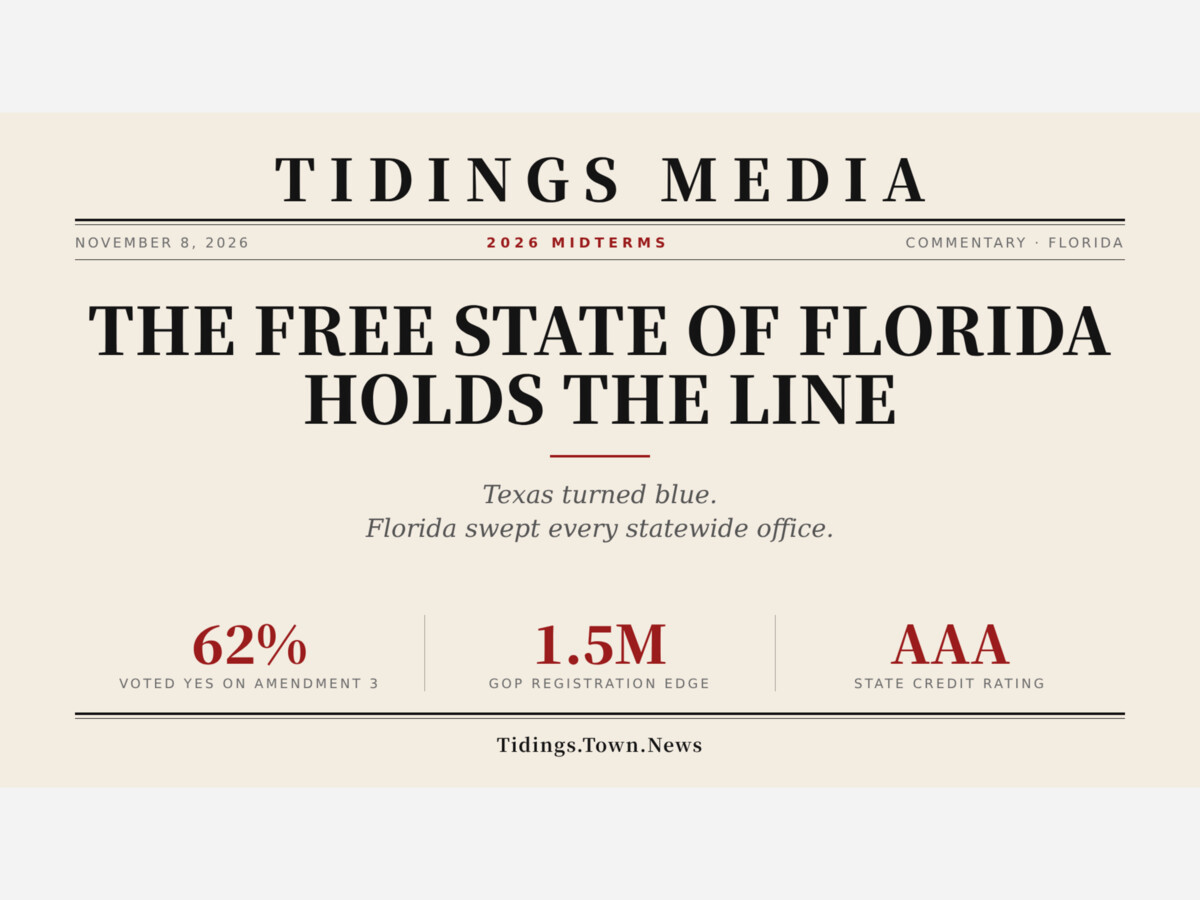
Behind the sweep sits a voter roll that has moved hard to the right in a short time. When the books closed for the 2020 general election, Florida had 5,303,254 registered Democrats and 5,169,012 registered Republicans, a Democratic edge of about 134,000.[49] The state's latest party-affiliation report shows 5,678,755 Republicans, 4,133,397 Democrats, 3,345,188 voters with no party affiliation and 514,782 in minor parties.[50] That is a Republican advantage of more than 1.5 million, a swing of roughly 1.7 million voters in six years, during which Democratic rolls shrank by more than a million.
The edge held through this fall's registration drives. Between the July 20 primary deadline and the Oct. 5 general election deadline, Republicans added 86,694 voters to 85,134 for Democrats, and the gap at book closing stood at about 1.5 million.[51][52] Republican Party of Florida Chairman Evan Power said the party had turned its focus from registration to turnout after two years of what he called historic growth.[51]
Party registration matters more in Florida than in most states, because Florida still runs closed primaries. Registered Republicans vote in Republican primaries, registered Democrats vote in Democratic primaries, and voters with no party affiliation cannot vote in either party's partisan contests.[54] Anyone who wants a say in choosing a party's nominee has to join that party by the registration deadline, which this year was July 20.[55] The only exception is the universal primary: when every candidate for an office belongs to the same party and the winner will face no one in November, every registered voter can take part, though a write-in candidate who qualifies for the general election closes that contest back to party members.[54][55] Open-primary activists tried again this summer to change the system, and the closed primary still stands.[56] For conservatives, the closed primary is a feature: Republicans pick Republican nominees, and with 5.68 million registered Republicans, the GOP primary is where much of Florida's direction is set.
The Lone Star State, long the other half of the Sun Belt's conservative anchor, broke hard to the left. Democrat Gina Hinojosa defeated Gov. Greg Abbott by nearly seven points as of early Wednesday morning, and James Talarico beat Ken Paxton for a U.S. Senate seat in a state Trump won by double digits.[6] Democrat Vikki Goodwin ousted Lt. Gov. Dan Patrick, and the 2025 mid-decade congressional redistricting that was supposed to hand Republicans five more U.S. House seats backfired.[10] These were the first statewide Democratic wins in Texas since 1994.[11] A record Latino turnout of roughly 1.6 million, nearly double the last midterm, and double-digit reversals in South Texas border counties drove much of it.[12]
Florida faced the same national headwinds and the same anger over prices. The difference is that Florida Republicans walked into this election with results voters could see on their own tax bills and in their own children's schools, and the rest of this report is a tour of those results.
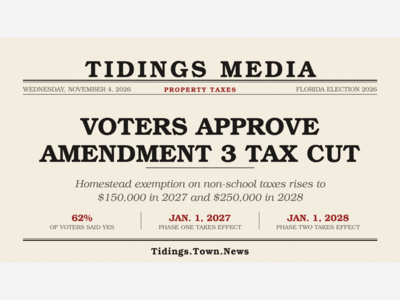
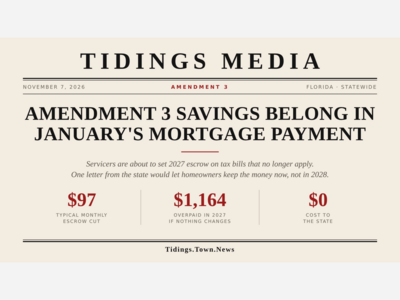
Amendment 3 passed with about 62% of the vote, clearing the 60% supermajority the Florida Constitution requires for any amendment.[13] Three in five Florida voters, across party lines, chose to cut their own property taxes. The amendment raises the homestead exemption for non-school taxes to $150,000 in 2027 and $250,000 in 2028, with inflation adjustments after that, and cuts the annual assessment cap on non-homestead property from 10% to 5%.[14] The changes take effect Jan. 1, 2027, and first show up on tax bills mailed in November 2027.[15] Donalds campaigned for it; Jolly opposed it.[2]
Florida still levies no personal income tax, a protection written into its Constitution, and the state's books keep earning the top marks on Wall Street. Florida holds a AAA rating from every major credit agency, and its rainy day fund has more than tripled since 2019 to its legal maximum.[16] The $117.6 billion budget for 2026-27 continued an accelerated debt repayment program that has now retired half of the state's debt, with 52% expected by next year.[17] Total reserves stand at roughly $18 billion, up from about $10 billion in 2019.[18] Washington, by comparison, lost its last AAA rating in 2025.
Florida's economy now ranks 14th in the world, and about 2% more growth would carry it past South Korea into 13th.[57] Over the last four years Florida's economic growth outpaced the nation's by an average of 2.3 percentage points, and the Florida Chamber expects it to beat national GDP growth again this year.[58] Florida TaxWatch projects real GDP growth of 2.5% in 2026.[59] The Chamber also ranks Florida first in the nation for new business startups, net income migration and new business migration.[57]
People keep voting with their feet. In the six years since the 2020 Census, Florida has added more than 2.1 million net new residents, driven by migration, and state economists forecast another 2.6 million between 2025 and 2035.[60] TaxWatch projected roughly 900 net new residents arriving every day in 2026.[61]
The clearest turnaround is in property insurance, the cost Floridians complained about most. After the Legislature's 2022 and 2023 reforms ended one-way attorney fees and curbed assignment-of-benefits abuse, litigation fell sharply.[62] Citizens Property Insurance, the state-backed insurer of last resort, peaked at 1.42 million policies in October 2023 and approved its first average rate decrease since 2015 for 2026.[63] By Sept. 18, 2026, Citizens was down to 255,099 policies, and 20 insurers had entered the Florida market since the reforms, bringing more than $850 million in new capital.[64] Regulators reported home insurance rates falling in 51 counties this year, and lawsuits over Citizens claims are down 55% since 2023.[65][66]
Since 2023, when HB 1 removed income limits and enrollment caps, every Florida child eligible for public school can take a state scholarship to a private school or a home education program.[19] In the 2025-26 school year, 286,284 students used the Family Empowerment Scholarship for Educational Options or the Florida Tax Credit Scholarship, worth about $8,000 on average and accepted at more than 2,500 private schools. Another 140,147 students with disabilities used the Unique Abilities scholarship, and 76,274 home-educated students used the Personalized Education Program.[20] No other state has put this much money in the hands of parents rather than districts.
In September 2025, Surgeon General Joseph Ladapo and Gov. Ron DeSantis announced Florida would work to end vaccine mandates, making it the first state to take on the fight. The Department of Health moved to drop the four school requirements set by rule rather than statute: chickenpox, hepatitis B, Hib and pneumococcal disease.[21] The requirements written into state law, including measles and polio, are the Legislature's to change, and a broader "medical freedom" bill has already cleared the Senate.[22] Donalds backs the department's rule and may keep Ladapo on.[23] Florida families who object to a vaccine on religious or medical grounds can already claim an exemption, and state policy keeps moving toward more parental say.
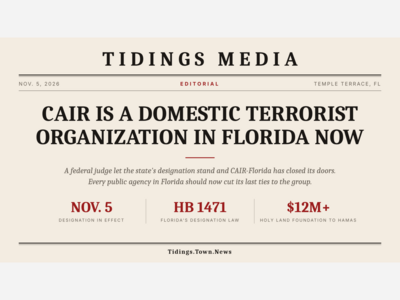
On April 6, 2026, DeSantis signed HB 1471 in Tampa. The law, which took effect July 1, bars Florida courts, administrative bodies, arbitrators and tribunals from applying any foreign or religious law, naming Sharia as an example, where doing so would violate rights under the U.S. or Florida constitutions.[24] It also lets the state designate domestic and foreign terrorist organizations and cut off their access to public funds and support.[25] DeSantis said the law is meant to keep Sharia from creeping into state institutions, and he said plainly that he expected the groups it targets to sue.[26][27] The principle is simple: one law, one Constitution, for every Floridian.
Florida did not wait for Washington. On Dec. 8, 2025, following Texas Gov. Greg Abbott's lead by less than a month, DeSantis signed an executive order designating the Muslim Brotherhood and the Council on American-Islamic Relations as foreign terrorist organizations and directing the Florida Department of Law Enforcement and the Florida Highway Patrol to take all lawful measures to stop their unlawful activities in the state.[36] U.S. District Judge Mark Walker blocked that order on March 4, 2026, and the state appealed.[37] Rather than give up, the Legislature wrote the authority into statute. HB 1471 lets the state's Chief of Domestic Security designate an organization as a domestic or foreign terrorist organization when specified criteria are met, with the governor and Cabinet approving or rejecting the designation by majority vote, and it carries criminal penalties for knowingly providing material support to a designated group.[37]
The day the law took effect, July 1, FDLE Commissioner Mark Glass recommended designating CAIR, the Muslim Brotherhood and antifa, along with more than 90 other groups including the Sinaloa Cartel.[38] On Sept. 11 the governor and Cabinet adopted the rule governing the process, which gives a named organization seven days to file a written objection.[39] On Sept. 29 they voted to designate CAIR and CAIR-Florida as domestic terrorist organizations, on the state's finding that the group operates as a front for Hamas and the Muslim Brotherhood.[40] Then, on the day after the election, a federal judge denied CAIR's emergency request to block the designation, finding the group unlikely at this stage to win its due-process and First Amendment claims. The designation took effect, CAIR suspended its operations in Florida, and Attorney General Uthmeier called it a great win for the people of Florida.[40]
The ACLU is appealing on CAIR's behalf.[40] Florida wrote the designation power into statute, defended it in federal court and won. Donalds inherits that framework, along with an Attorney General who just won re-election on it.
The culture Florida's policies protect is showing up in its churches. Florida Baptist congregations reported 33,123 baptisms in 2025, the highest total since 2010.[42] That builds on 2024, when Florida's churches recorded 30,701 baptisms, more than any other Southern Baptist state convention and well ahead of Georgia and both Texas conventions.[43] Florida Baptists have led the denomination in baptisms for years running, and in 2022 their congregations accounted for 12.2% of all Southern Baptist baptisms nationwide.[44] The growth is coming from new congregations too: 68 churches were planted across the state in 2025, with another 132 prospective planters working through the process.[45]
The national numbers point the same way. The Southern Baptist Convention saw baptisms and worship attendance rise again last year.[46] A national study of congregations released this spring found worship attendance rising for the first time in decades, with evangelical congregations among the most likely to report a budget surplus while mainline churches were more likely to run deficits.[47] Nondenominational churches, many of them evangelical in belief, have been growing as well.[48] Measured by baptisms and new churches, Florida is leading a revival.
Donalds ran as the continuity candidate, saying the job is to build on what DeSantis built rather than change course, and he has promised to keep the current approach on education, deregulation and immigration.[7][28] His first-year commitment is a top-to-bottom study of property taxes and fees, with the goal of eventually eliminating homestead property taxes altogether.[29] He has also pointed to tort reform as the reason auto insurance rates have started to fall, and says property insurance is next, along with cutting the permitting delays that drive up the cost of building a home.[30] Nationally, he supports ending the current reading of birthright citizenship and credits DeSantis for leading on it.[31]
With a governor, a Cabinet and a Legislature all pulling the same direction, Florida conservatives are in position to deliver for working families next. Starting teacher pay of $49,435 already ranks 19th in the nation, and carrying that success through a teacher's career would lift an average salary of $56,663 that ranks 50th.[32] The state's unemployment benefit, capped at $275 a week for up to 12 weeks, has room for a modest update that keeps Florida's tradition of getting people back to work quickly.[33] The 2025 CHOICE Act gave employers strong tools to protect their investments, with mandatory preliminary injunctions on covered noncompetes of up to four years, and a light touch can keep it focused on the executives it was written for.[34][35] Donalds has made affordability his top priority, and a stronger paycheck for working Floridians is the natural next step.
Texas Republicans woke up Wednesday to a Democratic governor, a Democratic senator-elect and a redistricting gamble that blew up in their faces. Florida Republicans woke up to a new governor, a full Cabinet, majorities in both chambers, a 1.5 million voter registration edge and a constitutional tax cut approved by three of every five voters. On the worst night for Republicans nationally in a generation, the Free State of Florida went undefeated statewide, and the policies that got it here are the ones Byron Donalds was elected to keep.

Sunny, with a high of 79 and low of 63 degrees. Sunny in the morning, cloudy during the afternoon and evening, clear overnight.