64° and Clear
Image




ORLANDO and TALLAHASSEE — Florida’s political class is finally saying the quiet part out loud: property taxes are not a “bill” so much as a permanent toll booth between families and the American dream of ownership. And Gov. Ron DeSantis has decided the state should stop pretending this is normal.
His argument is blunt. “Property taxes effectively require homeowners to pay rent to the government,” DeSantis said while pitching a statewide rebate plan as a down payment on something bigger: structural change that voters would have to approve. (See Footnote 1.)
That “something bigger” is now moving from campaign rhetoric to constitutional mechanics. A cluster of House proposals for 2026 would sharply reduce, and in some versions effectively eliminate, a large portion of property taxes on homesteaded homes. Even when those proposals stop short of full repeal, they point in one direction: Florida testing the limits of a no-income-tax model by trying to gut the most hated tax in local government.
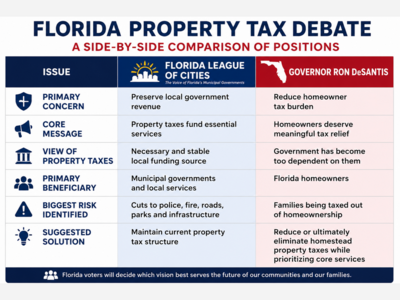
The opposition is already organizing, and it mostly looks like the familiar coalition: progressive policy groups, Democratic lawmakers, and local government power centers that treat property taxes as sacred because they fund payroll, pensions, and the daily operations of government. They are calling the proposal “devastating,” warning of service cuts, and floating the specter of higher sales taxes. The fight is real. The question is whether DeSantis can turn taxpayer anger into a durable majority on Election Day.
DeSantis has not limited himself to nibbling around the edges. His administration’s public posture has been consistent: immediate relief now, constitutional reform next.
In March 2025, he proposed property-tax rebate checks averaging $1,000 per homesteaded property, framed as a way to buy time while setting up a 2026 ballot campaign. (Footnote 1.) In budget coverage later, the Associated Press reported that DeSantis “has continued his call to slash property taxes,” with Democrats attacking the idea as unnecessary and risky for local services. (Footnote 2.) The Wall Street Journal, in a major report on the idea, described Florida exploring a historic move that would likely require a 2026 constitutional amendment campaign. (Footnote 3.)
The politics are obvious. Property taxes are visible, annual, and impossible to ignore. They rise even when your income does not. They punish retirees on fixed incomes. And unlike sales taxes, you cannot reduce your exposure by spending less. That makes them politically combustible.
DeSantis is betting that Florida voters will choose the freedom of ownership over the comfort of the status quo.
Right now, the most concrete legislative language is not a single DeSantis-written “repeal property taxes” bill. It is a set of House joint resolutions aimed at the Florida Constitution.
Two proposals illustrate how the legislature is trying to build a politically survivable path:
1) HJR 201 (Regular Session 2026): Exempt homesteads from non-school property taxes starting in 2027.
The ballot language states the amendment would “exempt homestead property from all ad valorem taxation other than school district levies.” It also adds a guardrail aimed at public safety politics by prohibiting local governments from cutting law enforcement funding below a defined baseline. (Footnote 4.)
2) HJR 203 (Regular Session 2026): A phased approach that becomes full non-school exemption by 2037.
This proposal would increase the homestead exemption from non-school property taxes by $100,000 each year for ten years, then make homesteads fully exempt from non-school property taxes beginning January 1, 2037. It also includes the same law enforcement funding floor concept. (Footnote 5.)
If you want the direction of travel in one sentence, it is this: homesteaded homeowners get moved off the local-government property-tax rolls, while the state tries to keep police funding from becoming the political hostage that kills the reform.
That is also the key limitation: these proposals focus on non-school property taxes. They are not, on their face, the total abolition of all property taxes statewide. They are the skeleton of a larger project.
This is not just a policy debate. It is a constitutional calendar.
Step 1: The 2026 session opens, and the proposals have to survive the legislative grinder.
Florida’s 2026 Regular Session convenes January 13, 2026, with the Senate calendar marking March 13, 2026 as the 60th day. (Footnote 6.) That window is where any amendment language must advance, be negotiated, and pass.
Step 2: The legislature has to place an amendment on the ballot.
A proposed constitutional amendment requires at least 60 percent voter approval to pass. (Footnote 7.) If the legislature is the vehicle, it moves by joint resolution, then heads to the ballot with final language and ballot summary.
Step 3: Voters decide in the General Election.
Florida’s General Election is November 3, 2026. (Footnote 8.) That date is the centerpiece of DeSantis’ strategy because it forces a clean question: do voters want to keep funding government the same way, or not?
Step 4: Implementation begins, if passed.
The House proposals themselves contemplate a start date of January 1, 2027, with the more ambitious phase-in version reaching full non-school exemption on January 1, 2037. (Footnotes 4 and 5.)
This is where the fight stops being ideological and becomes arithmetic, law, and institutional self-preservation.
1) Local government revenue reality.
Property taxes are the oxygen supply for counties, cities, and school districts. That is not a slogan, it is the financing mechanism. Opponents will hammer that point.
Sadaf Knight, CEO of the Florida Policy Institute, called property taxes “the driver and the lifeblood of local governments” and warned that eliminating them would leave “a $43 to $55 billion hole in local budgets.” (Footnote 9.) That figure, repeated often by critics, is designed to end the debate by sheer scale.
But this is where the pro-repeal case has a counterpunch: if a tax is so large and entrenched that government cannot imagine living without it, that is often evidence the tax has become less about necessity and more about a blank check.
2) “Defund the police” politics, flipped.
Opponents are already trying to weaponize public safety, accusing the governor of creating conditions that could starve police and fire budgets.
Orange County Commissioner Nicole Wilson warned that losing property-tax funding could mean “defunding the police” and even “having people not show up when your house is on fire.” (Footnote 9.) Another critic quoted in Governing argued that eliminating property taxes “would have the effect of defunding because the bulk of property tax money goes to police and other public safety spending.” (Footnote 10.)
The legislative response is telling: HJR 201 and HJR 203 both include explicit law enforcement funding floors. That is Tallahassee admitting the politics here are lethal unless the reform is armored. (Footnotes 4 and 5.)
3) The rural-county problem, including Republicans.
Not all skepticism is partisan. Some of the strongest warnings come from fiscally constrained counties with limited tax bases.
Wakulla County Commissioner Ralph Thomas, a Republican, said eliminating homestead taxes “would not be a matter of just tightening our belt… this will be a dismemberment of vital services.” (Footnote 11.) That quote matters because it shows the reform must answer for Florida’s uneven map, not just coastal homeowner anger.
DeSantis’ position, as reported, is that the state would backfill revenue for fiscally constrained counties. (Footnote 11.) That promise is politically necessary, and fiscally complicated.
4) The replacement-tax question: sales taxes, consumption taxes, and who pays.
Opponents want the debate framed as a trade: property taxes go down, sales taxes go up. Florida Policy Institute has pushed polling suggesting voters would rather keep property taxes than accept a 12 percent state sales tax rate. (Footnote 12.) That framing is not accidental. It is meant to scare suburban homeowners into defending a tax they hate.
A pro-elimination argument does not have to accept that binary. Florida could combine spending restraint, base broadening, targeted consumption taxes that capture tourist spending, and protections for low-income residents. But opponents will insist the only honest option is massive rate hikes, because that narrative protects the current system.
The opposition lineup is not mysterious:
Progressive policy organizations arguing the change is regressive or destabilizing. (Footnotes 9 and 12.)
Democratic legislative leadership arguing this is a “shell game.” Florida House Minority Leader Fentrice Driskell called the proposal a “shell game” and said it could turn rural counties into a “welfare state” dependent on Tallahassee. (Footnote 2.)
Local government interests warning of service cuts and using public safety as the shield. (Footnotes 9, 10, and 11.)
DeSantis’ core bet is that this coalition overplays its hand. When the message becomes “leave property taxes alone,” it can sound like a defense of permanent, rising taxation as the normal price of living in your own home. That is not a winning message in a state where affordability is now a political emergency.
The fairest description of DeSantis’ proposal is not that it is easy. It is that it is worth fighting over.
Property taxes are the most defensible tax if your priority is stable local government revenue. They are also one of the most corrosive taxes if your priority is long-term, middle-class homeownership that does not feel like a lease from the county.
Florida has a choice in 2026: keep the machine running the same way, or accept the disruption that comes with reducing the government’s claim on your home.
DeSantis wants that choice on the ballot. The people who benefit from the current system want it buried in committee rooms and budget spreadsheets.
Now through early January 2026: Interim committee work and quiet negotiations on what, exactly, goes to voters.
January 13, 2026: Regular Session convenes. (Footnote 6.)
January to March 2026: House and Senate must converge on a ballot-ready amendment. (Footnotes 4 and 5 show what is already drafted.)
November 3, 2026: Voters decide. (Footnote 8.)
January 1, 2027: Earliest effective date under current House proposal language. (Footnotes 4 and 5.)
January 1, 2037: Full non-school homestead exemption date under the phase-in version. (Footnote 5.)
Executive Office of Gov. Ron DeSantis, “Governor Ron DeSantis Proposes $1,000 Property Tax Rebates for Florida Homeowners” (Mar. 31, 2025). Florida Governor's Office
Associated Press, “DeSantis recommends a $117 billion state budget” (reporting Democratic criticism and quotes from House Minority Leader Fentrice Driskell). AP News
The Wall Street Journal, “Florida Explores Ditching Property Tax as Home Prices Soar” (describing 2026 ballot path and scale of property tax revenue). The Wall Street Journal
Florida House of Representatives, HJR 201 (Regular Session 2026), ballot language and law enforcement funding floor provisions. HouseDocs
Florida House of Representatives, HJR 203 (Regular Session 2026), phase-in exemption language and effective dates. HouseDocs+1
The Florida Senate, “2026 Regular Session Dates” (PDF) showing convene date and session day markers. The Florida Senate
Florida Department of State, Division of Elections, “Constitutional Amendments/Initiatives” (60% approval requirement; amendment pathways). Florida Department of State
Florida Department of State, “2025–2026 Election Dates and Activities Calendar” (General Election: Nov. 3, 2026). Florida Division of State Lands+1
Central Florida Public Media, “Central Florida officials oppose property tax cuts: ‘That would be devastating’” (quotes from Sadaf Knight and Nicole Wilson). CF Public
Governing, “Florida DOGE Begins Its Hunt for Wasteful Spending” (quotes about property tax elimination and critiques). Governing
WGCU PBS & NPR / Florida Trident, “For these Florida counties, eliminating property taxes would mean ‘a dismemberment of vital services’” (quote from Wakulla Commissioner Ralph Thomas; discussion of fiscally constrained counties). WGCU PBS & NPR for Southwest Florida
Florida Policy Institute, “Nearly 7 in 10 Florida Voters Would Choose Property Taxes Over a 12% State Sales Tax Rate, Poll Shows” (poll framing and replacement-tax arguments). Florida Policy Institute

Sunny, with a high of 80 and low of 61 degrees. Sunny during the morning, clear in the afternoon and evening,