70° and Clear
Image
Subscribe to Tidings Media for Free to Get Updates on Florida Health Freedom



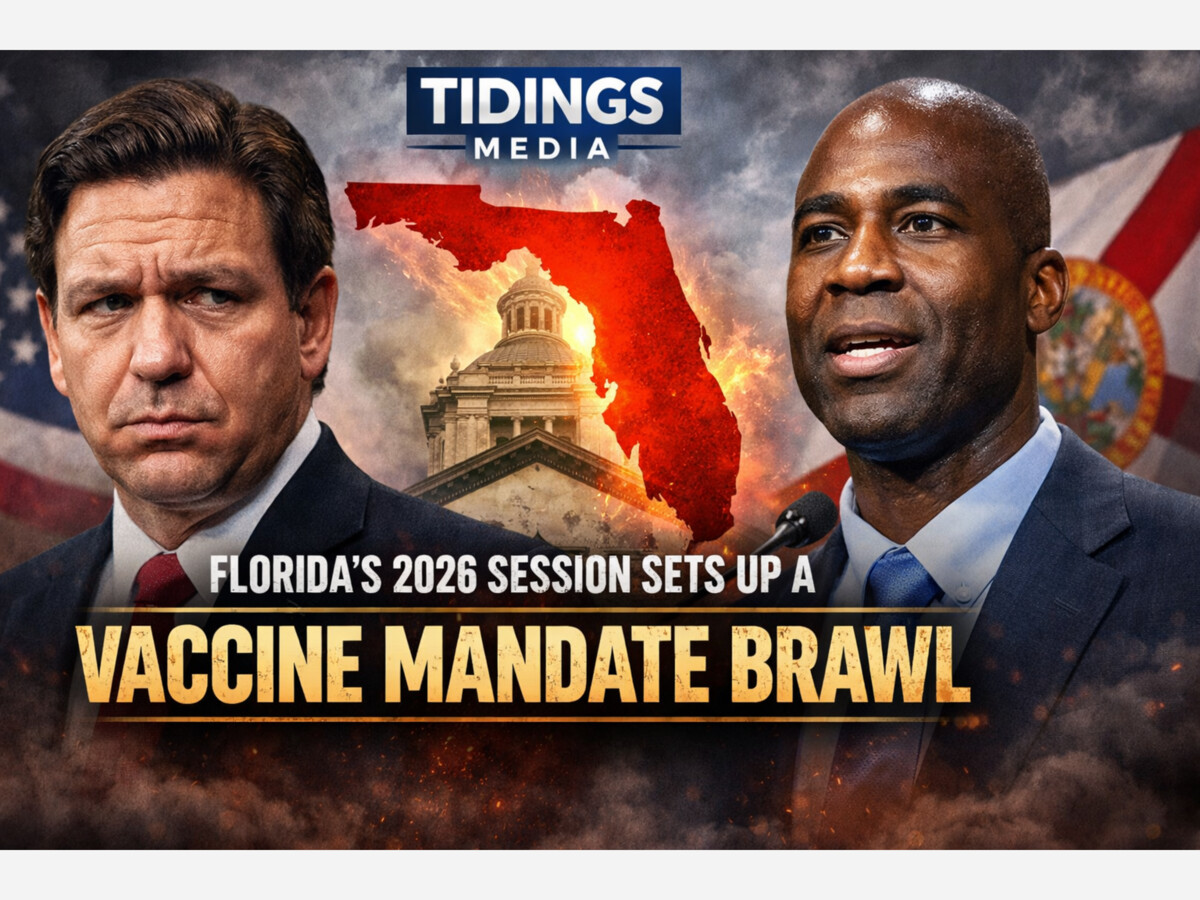
Florida’s 2026 Regular Session begins Tuesday, January 13, 2026, and is scheduled to end Friday, March 13, 2026.¹ In Tallahassee, that window is short, procedural, and unforgiving. It is also long enough for a hard fight over one of the most emotionally charged questions in public policy: How far can the state go to restrict vaccine mandates, especially in schools, without absorbing the blowback if disease rates rise?
For Governor Ron DeSantis and Florida Surgeon General Dr. Joseph Ladapo, the answer is straightforward. They are pushing Florida toward a consent-first model that treats mandates as coercion. For opponents, the answer is also straightforward. They see the move as a direct threat to child health and a reckless gamble with outbreaks.
This is shaping up as a two-front battle, with timelines that matter.
At a September 2025 event, Ladapo did not speak in the cautious language typical of public health officials. He framed vaccine mandates as inherently illegitimate, saying: “Every last one of them is wrong and drips with disdain and slavery.”²
DeSantis has used similar clarity, arguing for permanence. “It was wrong to do vaccine passports in 2021. It’s wrong to do them in 2025… and we need to make that permanent,” he said in one public remark.³ In an earlier official statement, he cast Florida as a national counterweight to medical policy that, in his view, pressures patients and limits choice: “Guided by common sense and sound science, Florida has led the way in protecting patients’ rights.”⁴
Florida’s leadership is not positioning this as a narrow dispute about administrative rules. It is framing a broader struggle about power, compulsion, and parental authority in the ramp up to the 2026 elections.
Florida’s vaccine requirements live in two places. The distinction matters because it determines speed and durability.
First, rules. An agency can change requirements through the administrative process. It is faster and easier to initiate, and it is also easier to challenge.
Second, statutes. Lawmakers can rewrite what is required for school attendance. That takes committee approvals, floor votes, and political consensus. It moves slower. It also sticks.
Florida is working both angles.
The Department of Health has pursued changes that would lift certain vaccine requirements connected to school attendance and related rules. The Associated Press reported that the proposal would remove requirements tied to hepatitis B, varicella (chickenpox), Hib, and pneumococcal disease, while leaving other statutory requirements in place unless lawmakers act.⁵
A public hearing was held December 12, 2025 in Panama City Beach, where supporters and critics argued over the implications.⁶
If you care about timelines, this is the early warning system. Rule changes can be the first domino. They also tend to draw lawsuits and emergency political pressure once the practical impact becomes clear.
One early filed measure, HB 917, pushes the “medical freedom” theme into health care access, consent, and discrimination based on vaccination status. The bill summary includes protections against discrimination and additional requirements around vaccine information and parental signatures for certain vaccine-related decisions.⁷
The text contains a bright-line provision: “A health care provider or health care facility may not discriminate against a patient based upon the patient’s vaccination status.”⁸
The politics here are obvious. The bill treats vaccination status as a civil liberty question in everyday life, not a limited school policy issue.
Not all proposals move in DeSantis and Ladapo’s direction. SB 626 would revise the school attendance immunization statute to explicitly add more diseases to the required list, including hepatitis B, chickenpox, Hib, and pneumococcal disease.⁹
That matters because it collides directly with the rulemaking push. If those requirements are written into statute, the agency’s ability to relax them later becomes far narrower.
SB 626 lists an effective date of July 1, 2026.¹⁰
Democrats are not treating this as a technical debate. Senate Democratic Leader Lori Berman called the effort to remove mandates “dangerous, anti-science, and anti-child,” adding: “Nobody wants to go back to the days of iron lungs.”¹¹
The American Medical Association has also taken a strong position: “The American Medical Association strongly opposes Florida’s plan to end all vaccine mandates, including those required for school attendance,” warning it would “undermine decades of public health progress.”¹²
Expect the opposition to repeat a simple theme: mandates exist because outbreaks are not theoretical.
Florida is not a federal program. Still, national posture matters because it changes the rhetorical weather and the political cover.
In a February 2025 address to HHS staff, Secretary Robert F. Kennedy Jr. said: “Nothing is going to be off limits,” in the context of scrutinizing the childhood vaccine schedule and other potential drivers of chronic disease.¹³
Supporters of Florida’s approach will cite that message as a green light for questioning the status quo. Critics will cite it as proof that Florida is drifting toward a worldview that treats long-settled pediatric health practice as optional.
The mandate debate is often framed as a binary choice between freedom and safety. The truth is uglier.
Childhood vaccines are a public health success story. They also sit at the center of a trust crisis. The state can insist that parents comply, and it can also acknowledge that coercion breeds backlash. Florida’s leadership is choosing the second critique, aggressively, and betting that voters prefer autonomy over institutional certainty.
That bet carries consequences. If mandates are weakened and disease rates climb, Florida will own that outcome. If mandates are weakened and nothing changes, Florida will claim vindication and export the playbook to other states.
Either way, the political class is turning your child’s immunization policy into a campaign weapon.
Here is the calendar that will determine whether this becomes law, dies quietly, or explodes into court fights:
Now through Jan. 13, 2026: Bill filings, press events, and leadership signals about which proposals will get committee time.¹
Tuesday, Jan. 13, 2026: Session convenes.¹
Jan. 13, 2026 at noon: Senate deadline for filing bills for introduction.¹
Mid-January through late February: Committee weeks. This is where bills either advance or get buried.
Tuesday, March 3, 2026: Last day for regularly scheduled Senate committee meetings.¹
Friday, March 13, 2026: Scheduled end of session.¹
Post-session: Effective dates and implementation, including the July 1, 2026 date attached to SB 626 if it passes.¹⁰
In parallel, the administrative rule process continues, which is why the rule track is not a sideshow. It is an early battlefield.⁵⁶
This debate is moving fast, and the details that matter will surface in committee agendas, amendments, rule notices, and floor votes, not in polished press conferences.
Subscribe to Tidings Media for free to get continued coverage of Florida’s health freedom battles, including vaccine mandate bills, school policy changes, court challenges, and the behind-the-scenes maneuvering that decides what becomes law and what dies quietly. You can add your subscription link here at publication.
Florida Senate, “2026 Regular Session Dates” (Regular Session convenes Jan. 13, 2026; last day Mar. 13, 2026; key deadlines).
Reuters, report on Sept. 3, 2025 press event quoting Dr. Joseph Ladapo.
News4JAX, Sept. 3, 2025 coverage quoting Gov. Ron DeSantis on vaccine passports and permanence.
Executive Office of the Governor press release (Mar. 5, 2025) quoting Gov. Ron DeSantis on protecting patients’ rights.
Associated Press, Sept. 7, 2025: Florida’s plan to drop certain school vaccine rules, limited scope unless lawmakers act.
Associated Press syndicated story (Dec. 12, 2025) describing the Panama City Beach hearing on proposed rule changes.
Florida Senate bill summary page for HB 917 (2026) describing provisions related to vaccination status discrimination and vaccine disclosures/consent.
HB 917 filed bill text (PDF) including prohibition on discrimination based on vaccination status.
SB 626 filed text showing added immunizations in school attendance statute language.
Florida Senate bill page for SB 626 showing effective date (7/1/2026).
Florida Senate Democrats press release (Sept. 3, 2025) quoting Sen. Lori Berman opposing removing mandates.
American Medical Association press release opposing Florida plan to end vaccine mandates.
Associated Press (Feb. 18, 2025) quoting HHS Secretary Robert F. Kennedy Jr.: “Nothing is going to be off limits.”


Sunny, with a high of 80 and low of 62 degrees. Sunny during the morning, clear in the afternoon and evening,